Distinguishing the Warp and Weft
Master Wang Xianglu | 2018-06-23 | Download | AI Translate
| 修行之始,当先划定经纬,以信愿行为纲为经,然后分诸条为目为纬。行之条目分为:甲、修个什么。乙、用什么来修。丙、用何法来修。丁、修的法子。戊、修至如何方为究竟。己、修之层次。而此六门中,各又分为次第。 |
At the outset of practice, one must first set out the warp and weft: take faith, vows, and practice as the guiding warp, and divide the various headings into the weft. The headings of practice are: A. What is to be cultivated? B. What is used to cultivate it? C. By what Dharma is it cultivated? D. The method of cultivation. E. What constitutes ultimate completion in cultivation? F. The stages of cultivation. Each of these six divisions, moreover, has its own sequential order. |
| 然而徒说无用,贵在自修。仅听讲而不修,亦是理解,不是事证,画饼不能充饥,毕竟无用。世间人怕穷,贪得财产,不知无道才是真穷,才是世世贫穷,况今生财产福禄,亦是夙世修来,惜乎不彻底,遂得小报,不得大受。是以得闻正法而修行者,是真大富大贵之人,世人不辨真伪,可叹也。 |
Yet empty talk is useless; what is precious is one’s own practice. To listen to teachings without practicing is merely understanding, not experiential realization. A painted cake cannot satisfy hunger and is ultimately of no use. Worldly people fear poverty and greedily seek possessions, not knowing that to lack the Way is true poverty—the poverty of lifetime after lifetime. Moreover, the wealth, blessings, and emoluments of this present life have also been cultivated in former lives; regrettably, the cultivation was not thorough, and thus brings only a small recompense rather than a great fruition. Therefore, one who hears the true Dharma and practices it is a person of truly great wealth and high nobility. That worldly people cannot distinguish the genuine from the false is indeed lamentable. |
| 甲、修个什么 |
A. What Is to Be Cultivated? |
| 行者已读启机分,当然毫无疑义,自知是修个佛,但问佛又是什么,答云佛是大觉者,众生颠倒,都因不觉,落于苦果,所以今世要修,修个因地佛,即生成就。譬如有的放矢,不是盲修瞎练,所以时时要发大愿,愿速开觉慧,即生成佛,救度众生。因此皈依佛皈依法皈依僧之外,更要皈依自己之大菩提心,此是修行第一个目标。 |
Having read the section that inspires the arising of spiritual capacity, the practitioner should naturally be free of all doubt and know that the aim is to cultivate Buddhahood. Yet what is a Buddha? The answer is that a Buddha is one of great awakening. Sentient beings, inverted in their perceptions, fall into the fruits of suffering entirely because they are not awakened. Thus one must cultivate in this life, cultivating the Buddha at the causal stage and attaining realization within this very lifetime. It is like shooting at a target; one is not cultivating blindly and aimlessly. Therefore, one must constantly bring forth great vows: vowing swiftly to open awakening-wisdom, to become a Buddha in this very lifetime, and to liberate sentient beings. Thus, beyond taking refuge in the Buddha, the Dharma, and the Sangha, one must also take refuge in one’s own great bodhicitta. This is the first objective of practice. |
| 乙、用什么来修 |
B. What Is Used to Cultivate It? |
| 行者已经闻法多次,当然了知修行是修个心,但心不可得,又将什么来修耶?答曰:正要以心修心,修证到心不可得,真证到无智亦无得时,才是正得,经云得阿耨多罗三藐三菩提,是证得无生,知一切不可得耳。 |
The practitioner, having heard the Dharma many times, naturally understands that practice is the cultivation of mind. Yet mind cannot be grasped; then what is to be used in cultivation? The answer is: precisely mind is used to cultivate mind. One cultivates and realizes until mind cannot be grasped; only when one truly realizes that there is neither wisdom nor attainment does one attain rightly. The sutra speaks of attaining anuttara-samyak-sambodhi: this is realization of the unborn, knowing only that all things cannot be grasped. |
| 丙、用何法来修 |
C. By What Dharma Is It Cultivated? |
| 修依何法,是一个极大问题,然不在法而在人。简言之,人有何病,再用何药,无定法也。所谓依法不依人者,是对师言。若以对人,当云依人不依法。以人有不等,非执一法而可普施也。 |
Upon what Dharma should cultivation rely? This is a matter of utmost importance; yet it depends not on the Dharma but on the person. Simply put, whatever illness a person has, that is the medicine to be applied; there is no fixed Dharma. The saying, “Rely on the Dharma, not on persons,” is directed to teachers. When speaking of those who receive instruction, one should say, “Rely on the person, not on the Dharma.” Since people are unequal in capacity, one Dharma cannot be rigidly applied to all. |
| 所谓依义不依文者,此对拘执文字者言。不知文与义,究有何别,文以表义,是亦法也,惟无定法,故取义为活,实则诸法皆空,谁为依者。所谓依智不依识者,言重于智也,非废识也,离识即无智,转识成智,亦法也。 |
The saying, “Rely on meaning, not on words,” is directed to those who obstinately cling to language. They do not know what difference there ultimately is between words and meaning: words express meaning, and thus they too are Dharma. Yet because there is no fixed Dharma, one takes meaning as living and flexible. In truth, all dharmas are empty; upon whom, then, can one rely? The saying, “Rely on wisdom, not on consciousness,” emphasizes wisdom; it does not discard consciousness. Apart from consciousness there is no wisdom; transforming consciousness into wisdom is itself a Dharma. |
| 所谓依了义不依不了义者,言求其究竟也。然何者为究竟,何者为不究竟乎?当以方便圆融出之,要非法非非法,正是了义,亦即无定法也。总之要人活计,不是死执,虽然,有定法也。我为此言,岂非矛盾,但有辞可以通。 |
The saying, “Rely on definitive meaning, not on non-definitive meaning,” means that one should seek the ultimate. But what is ultimate, and what is not ultimate? One must express it through expedient means that are harmoniously inclusive: neither Dharma nor non-Dharma is precisely definitive meaning; this is also the absence of any fixed Dharma. In sum, one must be alive and responsive, not rigidly attached. Nevertheless, there are fixed dharmas. Is this not contradictory to what I have said? There are words by which it may be reconciled. |
| 众生苦恼,流浪生死,譬如盲人入山,动则颠仆,无目是其根本苦恼,开眼是去苦惟一法门。学佛正意,是在去迷转觉,开佛知见,依般若法门,方可上登彼岸。 |
Sentient beings suffer and wander through birth and death. They are like blind persons entering the mountains: at every movement they stumble and fall. Having no eyes is their fundamental misery; opening the eyes is the sole Dharma gate for leaving suffering. The true intent of studying Buddhism is to dispel delusion and turn toward awakening, to open the Buddha’s knowledge and vision. Only by relying on the Dharma gate of prajñā can one ascend to the other shore. |
| 《心经》云:菩萨乃至三世佛,无不依般若波罗蜜多,此义万勿动摇,虽圣人复起,不易我言也,此即是定法。惟盲人目病有深浅,业障有厚薄,如何而可开般若,则所用之法不同。然则开慧成佛是目的地,达到此目的地,或舟或车,乘载无定法矣,今死执一法不化,自以为精进者也只好随他。 |
The *Prajñāpāramitā-hṛdaya Sūtra* (*Heart Sutra*) states that bodhisattvas and even the Buddhas of the three times all rely upon prajñāpāramitā. This principle must never be shaken; even if sages were to arise again, they could not alter my words. This is the fixed Dharma. Yet blind persons suffer eye diseases of differing severity, and karmic obstructions of differing weight. Thus the methods used to open prajñā differ. Opening wisdom and becoming a Buddha is the destination; to reach that destination, one may travel by boat or cart—the vehicles that carry one there have no fixed form. As for those who rigidly cling to a single Dharma and will not adapt, considering themselves diligent, one can only leave them to themselves. |
| 大乘二乘,本是假名,以众生因缘不同,根有利钝,遂分大小,实则佛性平等,只有一乘,无有余乘。经云:是法平等,无有高下。世人妄执此法为高,或此法不如他法,又何异于评佛。 |
Mahayana and the two vehicles are merely provisional names. Because sentient beings differ in conditions and faculties, sharp or dull, distinctions of great and small were made. In truth, Buddha-nature is equal: there is only the One Vehicle and no other vehicle. The sutra says, “This Dharma is equal, without high or low.” When worldly people deludedly insist that one Dharma is superior, or that another is inferior to it, how are they different from those who presume to judge the Buddha? |
| 又分某师功行深,某师功行浅,又何异于考师,适成大妄。行者当知法法无上,门门第一,付法之责在师,以因人当机为第一,否则误人慧命,修法之责在己,以一门深入为第一,否则贪多无益,虚掷时光,至为可惜也。 |
Again, to divide teachers into those whose cultivation and practice are profound and those whose are shallow is no different from examining and grading teachers; it becomes a great delusion. Practitioners should know that every Dharma is unsurpassed and every gate is foremost. A teacher’s responsibility in transmitting Dharma is to accord foremost place to the recipient’s particular capacity; otherwise, the wisdom-life of others is harmed. One’s own responsibility in practicing Dharma is to penetrate deeply into one gate; otherwise, greed for quantity brings no benefit, time is vainly squandered, and this is most regrettable. |
| 兹略说诸宗如下: |
The various schools are briefly described below: |
| 一、禅宗 |
1. The Chan School |
| 佛教来中国,以震旦人根器不凡,小乘法日渐衰灭,潜势力之最大者为禅宗。不问男女老幼贵贱,识字不识字,内道或外道,无不喜读《金刚经》与《心经》,即使十恶之人,一回头即可顿悟入门。 |
When Buddhism came to China, the spiritual capacities of the people of that land were exceptional. The teachings of the Lesser Vehicle gradually declined, while the Chan School became the most powerful underlying influence. Whether men or women, young or old, noble or humble, literate or illiterate, followers of the inner path or of outside paths, all delight in reading the *Vajracchedikā-prajñāpāramitā Sūtra* (*Diamond Sutra*) and the *Prajñāpāramitā-hṛdaya Sūtra* (*Heart Sutra*). Even a person guilty of the ten evils may, upon turning back, abruptly awaken and enter the gate. |
| 中华民族性,非他族可比,如布衣藐视王侯、尚义好侠、金钱不分人我,以及吃亏能让等等。虽失于世法欠圆,少有条理,然其意气豪逸阔大,乐于自在,非具夙世禅机,决不能致此。 |
The national character of the Chinese cannot be compared with that of other peoples: commoners may disdain kings and nobles; they esteem righteousness and cherish chivalrous conduct; they do not sharply distinguish between self and others in matters of money; and they can yield when suffering loss. Though they may fall short of worldly refinement and possess little systematic order, their spirit is bold, untrammeled, broad, and expansive, delighting in freedom. Without Chan potential cultivated in former lives, such a disposition could never arise. |
| 又凡人有力作恶者,其人皆属利根,只要一反转,放下屠刀,立地成佛,此人之夙根近于禅者也。至于其他法门,无一不以归元为究竟。诸法皆称某宗某宗,首冠以名,独禅宗径称宗下,以此为各宗之宗。 |
Moreover, anyone capable of committing great evil is a person of sharp faculties. Once such a person reverses course—lays down the butcher’s knife and becomes a Buddha on the spot—their former roots are close to Chan. As for all other Dharma gates, each takes return to the source as its ultimate completion. The various teachings are all called this school or that school, with a distinctive name placed before “school”; Chan alone is directly called “the School,” for it is the school of all schools. |
| 禅一空名,此又法法皆禅宗也,徒因根器不同,有直接入禅者,此上上根器人而今实太少,且缺师资,加以禅仗自力,非一二十年,不得参透三关,亲见实相,于今世似不当机,求其普及甚难,只有借径以通,或由净土入禅,或以密法反证,借仗佛力,合以自力,成就方速,此即我印心宗以密归宗之旨也。 |
Chan is but a name for emptiness; in this sense, every Dharma is the Chan School. Yet because faculties differ, some enter Chan directly. These are persons of the highest and most superior faculties, but such people are now truly very rare; furthermore, there is a lack of qualified teachers. Since Chan relies upon one’s own power, unless one spends ten or twenty years, one cannot penetrate the Three Barriers and personally behold the true reality. In the present age it seems unsuited to the prevailing capacities, and it is exceedingly difficult to make it widely accessible. One can only use an indirect route: entering Chan through the Pure Land, or verifying it in reverse through esoteric Dharma. By borrowing the Buddha’s power and combining it with one’s own power, realization is then swift. This is the intent of our Mind-Seal School: to return to the School through esoteric practice. |
| 二、律宗 |
2. The Vinaya School |
| 言戒律也,律由佛定,戒在行人。儒家有三畏三省慎独等等,都是戒。道家立功过格,亦是戒。佛家说戒,普通者以五戒为根本,戒杀盗淫妄酒。 |
This concerns precepts and discipline. Vinaya was established by the Buddha; precepts are upheld by practitioners. Confucianism has the three reverences, the three self-examinations, vigilance in solitude, and the like; all are precepts. Daoism established ledgers of merit and demerit; these too are precepts. In Buddhism, the ordinary foundational precepts are the five precepts: abstaining from killing, stealing, sexual misconduct, false speech, and intoxicants. |
| 又有八戒,菩萨戒即十大戒,四十八轻戒,比丘有二百五十戒,比丘尼有五百戒,实则有八万四千戒,极言其一切处一切心,在在禁止起恶。故戒者,有禁止意,即修也,戒之可见者曰戒相戒仪,如三千威仪,八万细行。 |
There are also the eight precepts. The bodhisattva precepts comprise ten major precepts and forty-eight minor precepts. Bhiksus have two hundred and fifty precepts, and bhiksunis five hundred. In truth, there are eighty-four thousand precepts, expressing in the strongest terms that at every place and in every state of mind, evil arising is prohibited. Thus, precepts have the meaning of restraint, and this itself is cultivation. The visible aspects of precepts are called their marks and observances, such as the three thousand dignified deportments and eighty-four thousand subtle modes of conduct. |
| 不可见者曰戒德戒品戒心戒香。以心香为戒也,总不离乎戒体,此以空心为得戒。前者戒十恶,此则戒十恶之根,受戒只是一仪规,重在平时持戒,徒有戒相而无戒体,是破根本大戒,名为大妄。 |
Their invisible aspects are called precept-virtue, precept-quality, precept-mind, and precept-fragrance. Taking the fragrance of mind as precept, they never depart from the essence of precepts; this means attaining the precepts through an empty mind. The former restrain the ten evils; this restrains the root of the ten evils. Receiving precepts is merely a ritual procedure; what matters is upholding them in daily life. To possess only the marks of precepts without their essence is to violate the fundamental great precept, and is called a great falsehood. |
| 故有说戒学戒得戒,然后再授戒,本有先后,惟为初机人说戒,先戒杀盗淫等,此救于果也。再进则戒贪嗔痴,此救于因也,心也。再进则戒贪嗔痴之出发处,证得空心,拔除其根,是真得戒,此救于因中因心中心也。 |
Therefore, there is first explanation of precepts, then study of precepts, then attainment of precepts, and only afterward the conferral of precepts; these properly have a sequence. Yet when precepts are taught to beginners, one begins with abstention from killing, stealing, sexual misconduct, and the like; this remedies the result. Advancing further, one restrains greed, anger, and delusion; this remedies the cause, namely the mind. Advancing still further, one restrains the very point from which greed, anger, and delusion arise, realizes the empty mind, and uproots their root. This is the true attainment of precepts; it remedies the cause within the cause—the mind at the heart of mind. |
| 各宗皆是修戒,禅宗以不戒戒,守最高之戒律,非俗子所可梦见。密宗以三密加持,三业如锁,如手结印,身业无由起矣。口持咒,口业无由起矣。心无住著,意业无由起矣。此戒于自然,非同空言,此即我印心宗以密修戒之旨也。 |
Every school cultivates precepts. The Chan School uses non-precept as precept, upholding the highest Vinaya, beyond anything ordinary people can dream of. The Esoteric School employs the empowerment of the three mysteries; the three karmas are as though locked. When the hands form mudrās, bodily karma has no way to arise. When the mouth recites mantra, verbal karma has no way to arise. When the mind abides nowhere, mental karma has no way to arise. These precepts are realized naturally; they are not empty words. This is the intent of our Mind-Seal School: to cultivate precepts through esoteric practice. |
| 三、天台宗 |
3. The Tiantai School |
| 以止观法归宗,即是以心观心,观至究竟地,空假中一切不立矣,但仗自力不易究竟,时下天台宗,只讲止观而不实修,印心宗之上座修法,修证三昧,即是修止,下座时时觉照、观空,即是起用,惟仗佛力加持,故证得不同,此即我印心宗以密修止观之旨也。 |
It takes the Dharma of samatha and vipaśyanā as its central teaching: mind contemplates mind, until at the ultimate ground emptiness, provisional existence, and the middle are all not established. Yet relying on one’s own power, it is not easy to reach ultimate completion. The Tiantai School of today merely lectures on samatha and vipaśyanā without actual practice. In the seated practice of the Mind-Seal School, cultivating and realizing samadhi is the cultivation of samatha; after leaving the seat, constant awareness and contemplation of emptiness are the functioning of vipaśyanā. But because it relies on the Buddha’s empowerment, its realization differs. This is the intent of our Mind-Seal School: to cultivate samatha and vipaśyanā through esoteric practice. |
| 四、法相宗 |
4. The Dharma-Characteristics School |
| 即唯识宗,此宗用意,在世人执相坚固,不得已就相说相,用以破之,最后引到一个空字,如果世人根利,直接破相,本无庸多此辛劳,金刚经四句偈,顿可扫荡净尽。但世人于唯识亦是讲而不修,失去本来。 |
This is the Consciousness-Only School. Its purpose is to address the firm attachment of worldly people to characteristics: it provisionally explains characteristics in order to demolish them, finally guiding people to the word “emptiness.” If worldly people had sharp faculties and directly shattered characteristics, there would be no need for such exertion. A four-line gāthā from the *Vajracchedikā-prajñāpāramitā Sūtra* (*Diamond Sutra*) could instantly sweep all away completely. Yet people today also merely discuss Consciousness-Only without practicing it, thereby losing its original intent. |
| 性相分宗,由来久矣,佛意在使人人破相,去烦恼,明心地以为根本。乃适得其反,转以佛学当作科学研究,果能研究证空,亦可解脱。 |
The division into the schools of nature and characteristics has existed for a long time. The Buddha’s intention was to enable everyone to shatter characteristics, remove afflictions, and illuminate the ground of mind as the foundation. Yet the result has been precisely the opposite: Buddhist learning has instead been treated as an object of scientific research. If one could indeed investigate it and realize emptiness, liberation would also be possible. |
| 然而入海算沙,自为得计,缚上加缚,强分闻思修为三截,误以为此生只可闻,尚不可思,何况说修,不知所说者理,事证在修,能由闻而思维,即是正修,若不思维,等于不闻。心中心法,不取于相,上座时不许见光见佛,一切打破。此即我印心宗以密破相之旨也。 |
Yet people enter the ocean and count its sands, taking this to be a clever course; bonds are added upon bonds. They forcibly divide hearing, reflection, and cultivation into three separate parts, mistakenly believing that in this life one may only hear, not yet reflect, much less cultivate. They do not know that what is spoken is principle, while experiential realization lies in cultivation. To proceed from hearing to reflection is precisely true cultivation; without reflection, hearing is equivalent to not hearing. The Heart-of-Heart Dharma does not grasp at characteristics. During seated practice, one is not permitted to attend to lights or visions of Buddhas; everything is shattered. This is the intent of our Mind-Seal School: to shatter characteristics through esoteric practice. |
| 五、净土宗 |
5. The Pure Land School |
| 净土者,心无染著也,归入本元,十方周遍,言语道断,心行处灭,秽固不立,净亦不有,是真无上净土。惟众生性太活动,不能专一,佛遂专说一西方以坚其信愿,后人遂立为宗。 |
Pure Land means that the mind has no defiled attachment. Returning to the original source, it pervades the ten directions; the path of speech is cut off, and the sphere of mental activity is extinguished. Defilement is certainly not established, nor does purity exist: this is the truly unsurpassed Pure Land. Yet sentient beings are too restless by nature and cannot become single-minded. The Buddha therefore specifically taught of one western land in order to strengthen their faith and vows; later generations consequently established it as a school. |
| 净禅本不分家,此法上中下三根普被,中下根人,得有西方归纳之处,上根人直证惟心净土,既可种因,更可成果,华果同时,有如莲花,故又名曰莲宗,心中心法修第四印者,可以往生西方,可知净密亦不分家。 |
Pure Land and Chan were originally not separate households. This Dharma universally embraces superior, middling, and inferior faculties. Those of middling and inferior faculties have the Western Land as a place in which to gather their minds; those of superior faculties directly realize the Pure Land of mind-only. Thus they may both plant causes and realize fruits; flowers and fruits appear simultaneously, like a lotus. Hence it is also called the Lotus School. Those who cultivate the fourth mudrā of the Heart-of-Heart Dharma may be reborn in the Western Land, showing that Pure Land and Esoteric practice likewise are not separate households. |
| 密宗修弥陀大法,佐以长寿法,亦是此理,惟净土太微妙,不明心地者不知其妙,非认为迂远,即感无味。余尝譬如白水清泉,能品得其清妙者为真功夫,我今学密,方知净妙,此又我印心宗以密归净之旨也。 |
Esoteric Buddhism practices the great Amitābha Dharma, supported by longevity practices; this too rests upon the same principle. Yet the Pure Land is exceedingly subtle and wondrous. Those who have not clarified the ground of mind do not know its marvel; they either deem it roundabout and remote, or find it tasteless. I have often compared it to clear spring water: to taste and discern its pure subtlety is true accomplishment. Now that I study Esoteric Buddhism, I have come to know the purity and wonder of the Pure Land. This is likewise the purport of my Mind-Seal School: returning to the Pure Land through Esoteric Buddhism. |
| 六、密宗 |
VI. Esoteric Buddhism |
| 又名真言宗,真言者,法身如来之语言也,以能显诸法实相,如义真实,或名陀罗尼,乃总持之义,总一切法,持无量义。弘法大师所谓一字含千理也。或名明,言如来智慧光明轮,现自体清净圆明。 |
It is also called the Mantra School. Mantras are the language of the Dharmakāya Tathāgata; because they reveal the true marks of all dharmas and accord with reality as it is, they are also called dhāraṇīs, meaning total retention: they encompass all dharmas and uphold immeasurable meanings. As the Great Master Kūkai said, a single syllable contains a thousand principles. They are also called vidyā, signifying that the wheel of the Tathāgata’s wisdom-light manifests the pure, perfect luminosity of its own essence. |
| 若念诵之,可灭无明业障也,或又名秘密,乃秘妙周密之义,以真言乃法身如来内证之言说,故龙猛菩萨譬以军中之密号,或又名瑜珈,言身口意三密相应也,三密加持,必得即身成佛之胜利,非等觉十地之所知。 |
When they are recited, they can eradicate karmic hindrances of ignorance. They are also called secret, in the sense of being profoundly subtle and all-encompassing, for mantras are utterances inwardly realized by the Dharmakāya Tathāgata. Nāgārjuna Bodhisattva compared them to secret passwords within an army. They are further called yoga, signifying the correspondence of the three mysteries of body, speech, and mind. Through the empowerment of the three mysteries, one will certainly gain the supreme victory of attaining Buddhahood in this very body, a matter unknown even to those at the ten bhūmis of Equal Enlightenment. |
| 曼荼罗,梵语乃轮转圆满具足之义,共有四,各不相离,表圆满法身如来之万德庄严也,云何谓四: |
Maṇḍala is a Sanskrit term meaning cyclic, perfect, complete, and fully endowed. There are four kinds, inseparable from one another; they represent the majestic adornments of the myriad virtues of the perfectly complete Dharmakāya Tathāgata. What are these four? |
| 一、大曼荼罗 如彩画佛菩萨相好形象也。(法界一切有情) |
1. Great Maṇḍala: the painted forms and splendid marks of Buddhas and Bodhisattvas. (All sentient beings in the Dharma realm.) |
| 二、三昧耶曼荼罗 诸尊所持之金刚莲华刀剑轮宝,及种种印契也。(器世界) |
2. Samaya Maṇḍala: the vajras, lotuses, swords, wheels, jewels, and various mudrās held by the deities. (The world of material vessels.) |
| 三、法曼荼罗 一一佛菩萨诸尊之种子真言。(文字真言也) |
3. Dharma Maṇḍala: the seed syllables and mantras of each and every Buddha, Bodhisattva, and deity. (That is, written mantras.) |
| 四、羯摩曼荼罗 诸尊之坐立喜怒威仪事相也。(一切作法事业为羯摩) |
4. Karma Maṇḍala: the postures, standing forms, joyful or wrathful expressions, dignified deportment, and activities of the deities. (All ritual acts and undertakings are karma.) |
| 密宗分事相教相二门,教相者,言教理之分齐,约之为二,一显密对辨门,别二教之优劣,判十住之浅深,明密教无上真实义谛。二自宗不共门,言种种妙理名义,惟限自宗,非余宗能及,两部大经,即《大日经》、《金刚顶经》,故依阿字诃字等字之真实义,说明教理,故总曰教相。至于事相,则言修行之轨则,凡四种,名四秘法: |
Esoteric Buddhism is divided into the two approaches of doctrinal teaching and ritual practice. Doctrinal teaching refers to the distinctions within the teachings and principles. In summary, it has two divisions. First is the approach of distinguishing Exoteric and Esoteric teachings: it differentiates the superiority and inferiority of the two teachings, assesses the shallowness and profundity of the ten abodes, and elucidates the supreme, true meaning and ultimate truth of Esoteric teaching. Second is the approach unique to one’s own school: its various wondrous principles, designations, and meanings are confined to this school and cannot be attained by other schools. Its two great scriptures are the *Mahāvairocana Sūtra* and the *Vajraśekhara Sūtra*. Since they explain doctrine and principle through the true meanings of such syllables as A and Ha, this is collectively called doctrinal teaching. Ritual practice, by contrast, concerns the rules of cultivation. There are four kinds, called the Four Secret Dharmas: |
| 一、息灾,灭自他罪障及不祥等事。 |
1. Pacification: eliminating the karmic hindrances, misfortunes, and other adversities of oneself and others. |
| 二、增益,除苦延寿,集出世福德。 |
2. Increase: removing suffering, prolonging life, and gathering supramundane merit and virtue. |
| 三、降伏,降伏自己无明恼乱,对治国家怨敌。 |
3. Subjugation: subduing one’s own disturbances of ignorance and counteracting the enemies and adversaries of the state. |
| 四、敬爱,受人敬爱,生无碍平等大悲心。 |
4. Reverence and Love: being revered and loved by others, and giving rise to the great compassion of unobstructed equality. |
| 显教与密教不同之点究在何处乎?显为方便,密为真实。二教虽有迟速优劣之不同,但成就无上菩提之归趣则一。马鸣菩萨《起信论》,总示显教成佛之时分,必经三大阿僧祗劫,惟真言密教,专谈即身成佛之旨。 |
Wherein precisely lies the difference between Exoteric and Esoteric teachings? The Exoteric is expedient; the Esoteric is true and real. Although the two teachings differ in swiftness and slowness, superiority and inferiority, their ultimate destination in accomplishing unsurpassed bodhi is one. The *Awakening of Faith* by Aśvaghoṣa Bodhisattva broadly indicates that, in Exoteric teaching, Buddhahood requires passage through three great asaṃkhyeya kalpas. Mantra Esoteric Buddhism alone exclusively expounds the principle of attaining Buddhahood in this very body. |
| 依一念一生一时之修行,具足无量福智,转凡夫有漏之肉身,成大日法身无上之果德,故《大妙金刚经》云:不转法身,得无漏果,此自宗不共之深旨也。 |
Through practice in a single thought, a single lifetime, and a single moment, one fully acquires immeasurable merit and wisdom, transforming the defiled physical body of an ordinary person into the supreme fruition and virtue of Mahāvairocana’s Dharmakāya. Therefore, the *Great Wondrous Vajra Sūtra* says: “Without transforming the Dharmakāya, one attains the undefiled fruition.” This is the profound principle unique to this school. |
| 又密宗由八识修起,依果寻因,净土法相天台等宗,皆由六识修起,依因寻果,故迟速不同。密宗仗毗卢遮那威德力加持,于须臾间,证得无量三昧耶,以不思议法,能变易行者俱生我执种子,生金刚种子。 |
Moreover, Esoteric Buddhism begins its cultivation from the eight consciousnesses, seeking the cause on the basis of the result. The Pure Land, Dharma-Characteristics, Tiantai, and other schools all begin cultivation from the six consciousnesses, seeking the result on the basis of the cause; hence their difference in swiftness and slowness. Relying on the empowering force of Mahāvairocana’s majestic virtue, practitioners realize immeasurable samaya within an instant. By inconceivable dharmas, they can transform the innate seeds of the practitioner’s self-grasping into vajra seeds. |
| 此根本与他宗不共处,未修密者,安得以凡夫情见,测佛之旨哉。密有东密藏密。 |
Herein lies the fundamental feature that this school does not share with others. How could one who has not practiced Esoteric Buddhism measure the Buddha’s intent by the views and perceptions of an ordinary person? Esoteric Buddhism includes East Asian Esoteric Buddhism and Tibetan Esoteric Buddhism. |
| 日本在唐时来学,尊弘法大师为祖,藏密即西藏所传之密,先是红教,后有宗喀巴者出,别立黄教,法则大同小异,黄教按步就班,有一定程序,偏于有相者多,红教则同修无相密乘。 |
Japan sent students to China during the Tang dynasty and reveres the Great Master Kūkai as its patriarch. Tibetan Esoteric Buddhism is the Esoteric teaching transmitted in Tibet. At first there was the Red School; later Tsongkhapa emerged and separately established the Yellow School. Their methods are largely similar, with minor differences. The Yellow School proceeds step by step according to a fixed sequence and leans more heavily toward practices with form. The Red School also cultivates the formless Vajrayāna. |
| 昔达摩初祖,在东土传禅宗,在西藏传无相密乘,诺那活佛,言之甚详,近所传之大乘要道大手印要门诸法,其中有顿入真智一诀要门,极言法身禅定之理,惟当初红教,传非其人,遂多偏空流弊,或竟作恶,不合西藏人之机,此宗喀巴之所由出也。 |
Formerly, the First Patriarch Bodhidharma transmitted Chan Buddhism in the Eastern Land and the formless Vajrayāna in Tibet. The Living Buddha Nona explained this in great detail. Among the Dharma teachings of the Essential Gateway of Mahāmudrā, the Great Path of Mahāyāna, transmitted in recent times, is an essential gateway of direct entry into true wisdom; it greatly expounds the principle of Dharmakāya dhyāna. Yet in the early days the Red School transmitted it to unsuitable persons, and thus many abuses tending toward biased emptiness arose; some even committed evil deeds. This did not accord with the capacities of Tibetans, and this was the reason Tsongkhapa emerged. |
| 东藏密宗,皆是修万法归一,以一相除一切相,尚未臻一归何处之旨,只有禅宗,直指心田,不历阶级,近世惟诺那活佛所传之法,稍稍引入禅宗,相与契合,其推重心中心法,叹为无上密乘,亦屡言之矣。 |
The Esoteric Buddhism of eastern Tibet cultivates the return of the myriad dharmas to one, using the one mark to eliminate all marks; yet it has not reached the principle of where the one returns. Chan Buddhism alone points directly to the field of mind, without passing through stages. In recent times, only the Dharma transmitted by the Living Buddha Nona has somewhat incorporated Chan Buddhism, with which it accords. He repeatedly praised the Heart-of-Heart Dharma as the unsurpassed Vajrayāna. |
| 至印心宗之开山,大愚师尊,实为之祖,先入庐山出家修净土,后又拜经,大病几死,遇盗又几死,后于定中见普贤尊者为之灌顶,传心中心大法,及诸密印密咒,七年苦修,成就下山,开印心法门,为印心宗之祖。 |
As for the founding patriarch of the Mind-Seal School, the venerable Master Dayu was indeed its patriarch. He first entered monastic life on Mount Lu and cultivated the Pure Land. Later he worshiped and studied the sutras, suffered a grave illness and nearly died, and then encountered bandits and again nearly died. Thereafter, in samādhi, he saw the Venerable Samantabhadra empower him and transmit the great Heart-of-Heart Dharma, together with various secret mudrās and mantras. After seven years of arduous cultivation, he attained realization, descended the mountain, and opened the Mind-Seal Dharma gate, becoming the patriarch of the Mind-Seal School. |
| 此法通于各宗,印证心田,密宗之外,别开生面。此法非可妄传,合机则授,非可理测,事证乃知,非取诸相,非废诸相。以印心为宗,以般若为用,以总持为法,以净土为归,修法与他宗特异,证得之速,亦与他法不同。或教以参禅,或授其他密法,徐徐引入,为前方便,以上所说各宗,亦仅大概耳。 |
This Dharma communicates with all schools and confirms the field of mind. Beyond Esoteric Buddhism, it opens a distinct new path. This Dharma must not be transmitted carelessly: it is bestowed when the recipient’s capacities accord. It cannot be fathomed by reasoning; only through actual realization can it be known. It neither grasps at marks nor rejects all marks. It takes Mind-Seal as its school, prajñā as its function, Dhāraṇī as Its Practice Method, and The Pure Land as Its Ultimate Destination. Its mode of practice differs especially from other schools, and the swiftness of its realization also differs from other methods. Some are taught to investigate Chan; others are given different Esoteric Dharma practices and gradually guided inward, these serving as preliminary expedients. What has been said above regarding the various schools is only a general outline. |
| 行者欲问以何法来修,可以先事商榷,本会传法,先考察其人之根器、地位、时间、体力等等,然后付法,以免中途疑退之弊,至于问修的法子,当说明如下。 |
If practitioners wish to ask which Dharma they should cultivate, they may first discuss the matter. Before this association transmits a Dharma, it first examines the person’s capacities, circumstances, available time, physical strength, and so forth; only then is the Dharma bestowed, thereby avoiding the drawback of doubt and retreat midway. As for the method of practice, it should be explained as follows. |
| 丁、修的方法 |
D. Methods of Practice |
| 此段已入正修分,关系至巨! |
This section now enters the portion on actual cultivation, and is of the utmost importance. |
| 一、福慧双修 |
1. Cultivating Merit and Wisdom Together |
| 佛法本以救世,教人自度一切苦厄,免除奸诈残贼损人不利己诸恶,使人安心自在,勿起无谓恐怖,勿种无谓恶因,勿受无谓苦果,天下自然太平。太者普遍广大之意,如人人有平等观念,亦何至造杀盗淫妄诸业。 |
The Buddhadharma is fundamentally directed toward saving the world, teaching people to free themselves from all suffering and adversity, to eliminate such evils as deceit, cruelty, harming others, and failing to benefit oneself. It enables people to abide in peace and ease, not to give rise to needless fears, not to plant needless evil causes, and not to undergo needless bitter fruits; then the world will naturally be at peace. Great means universal and vast. If all possessed the conception of equality, how could they create the karma of killing, stealing, sexual misconduct, and false speech? |
| 但眼前种种苦恼,不问有钱无钱,都是福薄,有钱的不用以造福,使之消耗净尽,不种未来福田,及身而穷,或子孙荡废。无钱的不明致贫之由,皆因夙世悭吝所致,造业愈多,则苦愈甚。智者忧因不忧果,君子忧道不忧贫。 |
Yet all the various sufferings and afflictions before one’s eyes, whether one has wealth or not, arise from scant merit. Those with money do not use it to create merit, but allow it to be exhausted; they do not plant fields of merit for the future and become poor in their own lifetime, or their children and grandchildren become dissolute and ruined. Those without money do not understand the causes of their poverty: it is all due to miserliness in former lives. The more karma one creates, the more severe one’s suffering becomes. The wise are concerned with causes, not results; the noble are concerned with the Way, not poverty. |
| 了知今生苦恼,譬如今岁缺粮,原因在去年少种,今日修行下种,明年必可收成,决不可预借明年之粮,亦不得说没有明年也,此种人都是福薄之辈。 |
Understand that the sufferings of this present life are like a shortage of grain this year, whose cause lies in having sown too little last year. If one cultivates and sows the seeds today, one will surely reap a harvest next year. One must never borrow in advance next year’s grain, nor may one say that there will be no next year. Such people all belong to those of scant merit. |
| 以福薄因缘故,难遇善知识矣,如有福德,则种种因缘,自然引之入佛,故有福无福,不在穷富,穷人而肯修,是真大富大贵之相。 |
Because of the conditions of scant merit, it is difficult to encounter a good spiritual friend. If one possesses merit and virtue, various conditions will naturally lead one into the Buddha’s teaching. Thus, having merit or lacking it does not depend upon being rich or poor. A poor person who is willing to cultivate bears the marks of truly great wealth and nobility. |
| 余尝谓人若求富,是穷相,不穷何求之有,人若求贵,是贱相,不贱何求之有,根本在己自认为穷贱,相由心造,因必有果,非苛论也。大凡多愁之人,恶缘渐足,不久必有不顺或颠倒之事,愁则必穷,恼则必病,本相连也。 |
I have often said that one who seeks wealth bears the mark of poverty; if one were not poor, what need would there be to seek it? One who seeks rank bears the mark of lowliness; if one were not lowly, what need would there be to seek it? The root lies in considering oneself poor and lowly. Marks are created by mind; causes necessarily have results. This is not a harsh assertion. Generally, for those much given to sorrow, adverse conditions gradually become complete, and before long untoward or perverse events will surely occur. Sorrow inevitably brings poverty, and vexation inevitably brings illness; they are inherently connected. |
| 且福薄之人,必碌碌于衣食住,断无暇于修行,为最可怜之人。故遇福薄人,先当使之修福,除其入道之障,有福人使之修慧,并养其福,此谓福慧双修,此非有福人不能承受也。 |
Moreover, those of scant merit must surely remain busily occupied with clothing, food, and shelter, with no leisure at all for cultivation; they are most pitiable. Therefore, when encountering persons of scant merit, one should first enable them to cultivate merit, removing their hindrances to entering the Way. Those who have merit should be enabled to cultivate wisdom while preserving and nurturing their merit. This is called cultivating merit and wisdom together. Without merit, one cannot undertake this. |
| 修福之法,重在布施,六波罗蜜,第一布施,名为种福田,凡有钱而慷慨者,不必定欲其布施也,独悭吝或穷苦者,则劝其多施,一以教其施舍,除其贪习,一以种诸善根,助其因缘,非同世法之讲人情,分穷富而衡多寡者可比也。 |
The method of cultivating merit places emphasis upon dāna. Of the six pāramitās, dāna is first and is called planting fields of merit. Those who possess money and are generous need not necessarily be urged to give. But those who are miserly or impoverished should be encouraged to give more: first, to teach them generosity and remove their habit of greed; second, to plant various wholesome roots and assist their conditions. This is not comparable to worldly conventions that speak of personal favors and assess amounts according to wealth and poverty. |
| 凡夫劣见,求佛专为求福,以为福是佛可付予,求而可得,不得则疑谤起矣,复有求佛得慧,以为慧亦佛可付予,求而可得,不得亦生疑谤矣。近世求道者多,行道者少,修道者多,证道者少,皆因此病。 |
The inferior views of ordinary people seek the Buddha solely for merit, imagining that merit is something the Buddha can bestow, obtainable merely by asking. When it is not obtained, doubts and slander arise. Others seek the Buddha for wisdom, imagining likewise that wisdom is something the Buddha can bestow, obtainable merely by asking. When it is not obtained, they too give rise to doubt and slander. In recent times, those seeking the Way are many, those practicing the Way few; those cultivating the Way are many, those realizing the Way few. All of this is due to this fault. |
| 行者当知福慧应同修,佛不过指示法门,教汝自种善因于前,自得福报于后,欲求富贵,当除悭吝,先习布施。欲求开慧,当亲善知识,亦得先习布施,欲修福者,是真慧,人若真慧者,必肯除贪嗔以造福,然则修福正以修慧,愚人强分为二,亦殊偏执矣。 |
Practitioners should know that merit and wisdom ought to be cultivated together. The Buddha merely indicates the Dharma gate, teaching you to plant wholesome causes yourself beforehand, so that you yourself will receive merit and recompense afterward. If you wish for wealth and rank, you should eliminate miserliness and first cultivate dāna. If you wish to open wisdom, you should draw near to good spiritual friends, and you must also first cultivate dāna. One who wishes to cultivate merit possesses true wisdom; one who truly has wisdom will certainly be willing to eliminate greed and anger in order to create merit. Thus, cultivating merit is precisely cultivating wisdom. Foolish people forcibly divide them into two; this too is a particularly biased attachment. |
| 二、定慧交资 |
2. Samādhi and Wisdom Mutually Support One Another |
| 世人入道,亦知求定,知止而后能定,此儒家所说之定而道家袭取者也,但此是静,不得谓定。定者动定一如之谓也,见境不惑之谓也,一切接,一切不染,无著无住之谓也。 |
When worldly people enter the Way, they also know to seek samādhi. They know that only after abiding can one become settled; this is the settledness spoken of by Confucianism and adopted by Daoism. Yet this is merely quietude and cannot be called samādhi. Samādhi means that movement and stillness are alike; it means not being deluded upon encountering circumstances; it means engaging with all things yet remaining unstained, without attachment and without abiding. |
| 定慧非二,假名为二,即定之时慧在定,即慧之时定在慧,互相交资,如火如光,名若有二,不可分也。世人求定,以硬压不起念,断见闻为定,与木石何异,此是死于空无,落于断灭,反动时必至颠狂成魔。 |
Samādhi and wisdom are not two; they are provisionally named as two. When there is samādhi, wisdom is within samādhi; when there is wisdom, samādhi is within wisdom. They mutually support one another, like fire and its light: though their names seem two, they cannot be divided. Worldly people seek samādhi by forcibly suppressing thoughts so that none arise, and take cutting off seeing and hearing as samādhi. How is this different from wood or stone? This is dying in emptiness and nothingness, falling into annihilation. When movement returns, one will inevitably become deranged and turn into a demon. |
| 又世人妄执定慧为两截事,遂有定多慧少之别,不知此非了义,定慧本属均等,无分多寡,惟世人习气,有好动者,有好静者,遂以好动者谓为多慧,好静者谓为多定,实则去定慧尚遥,定慧当由体起用,交资双融者也,正见不惑,名三昧定,三昧者,正定也,兹将禅定众名开示如后。 |
Moreover, worldly people falsely cling to samadhi and prajna as two separate matters, and thus distinguish between those with much samadhi and little prajna. They do not know that this is not the definitive meaning. Samadhi and prajna are originally equal, with no distinction of more or less. It is only because people have habitual tendencies: some favor activity, while others favor stillness. Thus those who favor activity are called rich in prajna, and those who favor stillness rich in samadhi. In truth, both remain far removed from samadhi and prajna. Samadhi and prajna should arise in function from the essence, mutually supporting and harmoniously interpenetrating. Unconfused right view is called samadhi; samadhi means right concentration. The various names of dhyana are now explained below. |
| (一)三摩地,此是诸定总名,总一切法,持无量义,一切禅定摄心也。 |
(1) Samadhi: this is the collective name for all concentrations. It encompasses all dharmas and upholds immeasurable meanings; it is the gathering of the mind in all dhyana concentrations. |
| (二)奢摩他,止也,调也,灭也,能调诸根不善法,使无染著也,又寂静义,名为定相。 |
(2) Samatha: it means cessation, regulation, and extinction. It can regulate the sense faculties and unwholesome dharmas, so that there is no defiled attachment. It also means quiescence and is called the characteristic of concentration. |
| (三)三摩钵提,又名三摩,勾销也,方便随缘止也,此云等至,言于等持之中,能至胜位,即平等任持,双离沉掉,至胜定至圣位也。 |
(3) Samapatti, also called samapatti: it means canceling out, or expedient cessation in accordance with conditions. It is rendered as “equal attainment,” meaning that within samadhi one can attain the supreme stage: sustaining evenly and naturally, free from both torpor and restlessness, one reaches supreme concentration and the stage of the sages. |
| (四)禅那,此云静虑,以寂灭为义,定慧双融,即静而虑,故非无记,与天台三观不同,因彼属推穷诸法性相,约义生解,此多约心成行,不立所观之境,息二边,止分别也。 |
(4) Dhyana: it is rendered as “quiet contemplation,” with quiescent extinction as its meaning. Samadhi and prajna harmoniously merge: still, yet contemplative. Therefore, it is not an indeterminate state. It differs from the Tiantai Three Contemplations, for those investigate the nature and characteristics of all dharmas and form understanding through their meanings. This teaching instead chiefly concerns the mind's cultivation in practice; it does not establish an object to be contemplated, but ceases the two extremes and stills discrimination. |
| (五)毗钵舍那,此云观,谓以智照理,故云正见,亦云了见,观行成时,境智相应,了了见性不昧故。 |
(5) Vipasyana: it is rendered as contemplation, meaning to illuminate principle with wisdom; hence it is called right view, or also clear seeing. When contemplative practice is accomplished, object and wisdom accord with one another, and one clearly sees the nature without obscuration. |
| (六)优毕义,止观平等也,止即定,观即慧也,又不诤不行义,或名为舍,不诤断常,不行空有,舍二边故。 |
(6) Upeksa: cessation and contemplation are equal. Cessation is samadhi, and contemplation is prajna. It also means neither disputing nor pursuing, and may be called relinquishment: not disputing over annihilation or permanence, not pursuing emptiness or existence, and thus relinquishing the two extremes. |
| (七)末陀摩,此云莫著中道,谓中道亦假名,不应立也。 |
(7) Madhyama: do not cling to the Middle Way. The Middle Way, too, is merely a provisional designation and should not be established. |
| (八)毗恒迦毗遮罗,此云寻伺,亦云觉观,盖粗心感动名觉,细心分别名观。 |
(8) Vitarka-vicara: it is rendered as examination and investigation, or as awareness and contemplation. The stirring of the coarse mind is called awareness; the discriminating activity of the subtle mind is called contemplation. |
| (九)三昧,此云调直定,又名正思正定正受,谓入此定时,不受一切法故。 |
(9) Samadhi: it is rendered as regulated, straight concentration, and is also called right thought, right concentration, and right reception. When one enters this concentration, one does not receive any dharma. |
| 总之定慧相资,总归入阿字门,阿言一切诸法本不生义,生是缘生,本不可得,证入毗卢遮那性海,惟以此一字为真言,自在成立大曼荼罗。凡夫无智慧,不能了观诸法本源,妄谓有生。故甚深密藏者,众生自秘,惟证乃知。 |
In sum, samadhi and prajna support each other and all return to the Gate of the syllable A. A signifies that all dharmas are originally unborn. Arising is dependent arising and is originally unattainable. Upon realizing entry into Vairocana's ocean of nature, this single syllable alone is taken as mantra, freely establishing the great mandala. Ordinary beings lack wisdom and cannot clearly contemplate the source of all dharmas, falsely supposing that there is arising. Thus, the profound treasury of secrets is self-concealed by sentient beings; only through realization can it be known. |
| 一切真言,不离五十字母,皆佛法之总相,阿字居首,总括一切,此五十字,一一皆是得解脱门。解脱者,以定慧证得无生法忍耳,世人如了达此义,证入无生,不起诸相,更有何恶可作,何罪可犯,然则又有何戒可持,此戒之隐于定慧中,非愚夫所可测知,妄断修密修禅为无戒律矣,然持戒法门亦不可不说,所以便初学者。 |
All mantras are inseparable from the fifty letters, which are the general characteristics of the Buddhadharma. The syllable A stands first and comprehends all. Each of these fifty letters is a gate to liberation. Liberation is simply the realization, through samadhi and prajna, of the patience of the non-arising of dharmas. If worldly people understood this meaning, realized the unborn, and ceased giving rise to all characteristics, what evil could they commit, what offense could they perpetrate, and what precepts would there be to uphold? Such precepts are implicit within samadhi and prajna and cannot be fathomed by foolish people, who rashly conclude that practitioners of Esoteric Buddhism and Chan have no discipline. Yet the Dharma gate of upholding precepts must also be taught, as an expedient for beginners. |
| 三、戒合体相 |
III. Integrating the Essence and Characteristics of Precepts |
| 戒有戒体戒相二种,相属威仪,何可废也。然无体则近于伪矣,戒体属心,然心虽无相,尚有一无相在,仍属有相,必至净空无我,无能作,无所作,无能戒,无所戒,斯真具足大戒。 |
Precepts have two aspects: their essence and their characteristics. Their characteristics belong to deportment and ritual conduct; how could these be discarded? Yet without their essence, they approach falsity. The essence of precepts belongs to mind. Although mind is without characteristics, so long as there remains an idea of “without characteristics,” it still belongs to characteristics. One must reach pure emptiness and selflessness, with no agent of action, nothing acted upon, no one who observes precepts, and no precepts observed. Only then does one truly and completely possess the great precepts. |
| 然劣慧者不知也,愚人或误为打破戒律,奔走呼号者有之。又或误为禅宗主自在放任,原不必持戒,因而纵荡者亦有之。一个要打倒,一个要维持,其实都不曾明白戒义,以至如此。 |
Those of inferior wisdom do not understand this. Some foolish people mistakenly take it to mean smashing the precepts and run about crying out in alarm. Others mistakenly believe that the Chan school advocates freedom and abandon, and that there is originally no need to uphold precepts; they therefore become unrestrained and dissolute. One side wishes to overthrow them, the other to preserve them; yet neither has understood the meaning of precepts, and this is why matters have come to such a pass. |
| 夫戒也者,有戒心也,以法范之,故名曰律,众生颠倒,三业不净,对下根人,先使达其戒相,如杀盗淫,有事相可见者,彼易于领悟,故先说五戒,且明因果律以证之,以戒其行,戒于果者也。 |
Precepts have the mind of precepts; when this mind is regulated by Dharma standards, it is called vinaya. Sentient beings are inverted, and their three karmas are impure. For those of lesser capacity, one first enables them to understand the characteristics of precepts. Killing, stealing, and sexual misconduct have manifest concrete forms and are easy for them to comprehend. Therefore, the five precepts are first taught, together with the law of cause and effect to verify them, thereby restraining their conduct. This is restraint with respect to effects. |
| 对上根人,则说戒体,以杀盗淫为果,因在何处,则知贪嗔痴为根,如意业清净,恶业自除,此戒其心,心净则佛土净,戒于因者也。对上乘人,则说体相不二,同一缘空,心不可得,恶依何起,能所双忘,名曰定慧交资。 |
For those of superior capacity, one teaches the essence of precepts. Killing, stealing, and sexual misconduct are effects; where are their causes? One then knows that greed, anger, and delusion are their roots. If mental karma is pure, evil karma is naturally eliminated. This restrains the mind; when the mind is pure, the Buddha-land is pure. This is restraint with respect to causes. For those of the highest vehicle, one teaches that essence and characteristics are nondual, that both are equally empty through conditions. Mind cannot be apprehended; upon what could evil arise? When subject and object are both forgotten, this is called the mutual support of samadhi and prajna. |
| 若有染执,即名破戒,戒律之严,无过于此,故不戒之戒,斯名大戒。佛灭度后,嘱众生以戒为师,此言以自心为依止,借此法以范其心也,若仅守形相威仪,不内求诸心,适导之作伪,宁有是理,世人作恶作伪者多,正坐此病,行人说戒,岂不是怕破戒,我且告以破戒罪过之可怕。 |
Wherever there is defiled attachment, it is called breaking the precepts. Nothing could be stricter than this discipline. Therefore, precepts that are beyond precepts are called the great precepts. After the Buddha entered parinirvana, he instructed sentient beings to take the precepts as their teacher. This means relying upon one's own mind and using this Dharma to regulate it. If one merely observes outward forms and ritual deportment without seeking within one's own mind, one will instead be led into hypocrisy. How could that be right? There are many in the world who do evil and practice hypocrisy, precisely because of this fault. When practitioners speak of precepts, is it not because they fear breaking them? I shall accordingly tell them how dreadful the consequences of breaking precepts are. |
| (一)犯杀盗淫者,自作自受,愿受报者,则放胆去做,凡不明三世因果之理者,先与说三世因果,与破戒之害,信得真切,自然不作恶业,但此系指未明佛理者说。 |
(1) Those who commit killing, stealing, or sexual misconduct reap what they themselves have done. If they are willing to undergo the retribution, they may boldly proceed. For anyone who does not understand the principle of cause and effect through the three times, first explain to them cause and effect through the three times and the harm of breaking precepts. Once they believe it deeply and truly, they will naturally cease creating evil karma. Yet this is instruction for those who have not understood Buddhist principles. |
| (二)已明佛理之居士,彼岂不知戒律,然尚未明何者谓为破戒,以心地未明故,若仅以犯杀盗淫为破戒,则佛戒只一部分,余皆可废矣,故知心戒为戒。今且勿谈高深,如心空无染等义。 |
(2) Lay Buddhists who have already understood Buddhist principles surely know the precepts. Yet they still do not understand what is called breaking the precepts, because the ground of their minds has not been clarified. If merely violating killing, stealing, and sexual misconduct constituted breaking the precepts, then the Buddha's precepts would comprise only one portion, and all the rest could be discarded. Therefore, know that the mind-precepts are precepts. For now, let us not speak of profound matters such as the emptiness of mind and freedom from defilement. |
| 只要说浅显者,如不动恶念,即是持戒,但何谓恶念乎,当告之曰贪嗔痴与杀盗淫其罪正等,倘自心未净,常生恼乱,怨天尤人,即是大破戒,以有因必有后果也,故恨人破戒,即是自己破戒,若不明此理,即同拨无因果,更属可怕。 |
Let us speak only of what is plain and accessible: not giving rise to evil thoughts is upholding precepts. But what are evil thoughts? You should tell them that greed, anger, and delusion are offenses equal to killing, stealing, and sexual misconduct. If one's own mind is impure, continually generating vexation and disturbance, blaming Heaven and reproaching others, this is a grave breaking of precepts, for where there is a cause there must be a subsequent effect. Thus, hating another for breaking precepts is itself breaking the precepts. If one does not understand this principle, it is the same as denying cause and effect, and is even more dreadful. |
| 菩萨不见他过,此有二义,一不见谓不责,不起我见以定其是非也;二不见谓不住著,不以其过为意也。前为悲悯其过犯,此谓有智不取相,所谓智悲双运是也。菩萨处处不离大乘愿,布施所以戒贪,大悲所以戒嗔,般若所以戒痴。然则修一切法,不离乎佛法,不离乎戒,但必内外一如,体相合一,斯名得戒,否则不能逃于妄耳。 |
Bodhisattvas do not see the faults of others. This has two meanings. First, “not seeing” means not reproaching them, not giving rise to Personal-self view in order to judge their right and wrong. Second, “not seeing” means not abiding in attachment, not taking their faults to heart. The former is compassion for their transgressions; the latter is wisdom that does not grasp characteristics. This is what is called the concurrent functioning of wisdom and compassion. Bodhisattvas never depart from the vows of the Great Vehicle: giving counters greed, great compassion counters anger, and prajna counters delusion. Thus, the practice of every dharma does not depart from the Buddhadharma and does not depart from precepts. Yet inner and outer must be alike, and essence and characteristics must be united; only this is called attaining the precepts. Otherwise, one cannot escape delusion. |
| 四、合定慧空 |
IV. Integrating Samadhi, Prajna, and Emptiness |
| 一切波罗蜜法门,或六或十,乃至八万四千,皆以般若为主,三藏十二部,终不离此法门。以慧破空则自定,定能生慧,慧复转空,合之如轮转而妙用无尽。修此三者,非有先后,乃同时启发,此是第一紧要处,务必特加注意。 |
All Dharma gates of paramita, whether six, ten, or even eighty-four thousand, take prajna as their chief principle. The Tripitaka and the twelve divisions of scripture never depart from this Dharma gate. When prajna penetrates emptiness, samadhi naturally arises; samadhi can give rise to prajna, and prajna in turn realizes emptiness. Joined together, they turn like a wheel, their wondrous functions inexhaustible. The cultivation of these three has no sequence of before and after, but is activated simultaneously. This is the most essential point and must receive special attention. |
| 诸仁相处一年,平心而论,自己修证者,岂望人知,且冷暖自知,亦岂他人可知。惟为将来不致误人起见,不能不明白个所以然,诸仁所得益处,实在信心清净,用功切实,不负我大愚师尊苦行多年,受诸疑谤,一番宏法苦心。 |
All of you have associated together for a year. Speaking impartially, would those who have cultivated and realized anything hope that others knew of it? One knows one's own warmth and coldness; how could others know? Yet, lest people be misled in the future, it is necessary to understand the reason clearly. The benefit you have gained truly lies in purity of faith and earnest practice. You have not disappointed the many years of austerities endured by my revered teacher Dayu, nor his painstaking efforts in propagating the Dharma amid every kind of doubt and slander. |
| 且彼此皆曾疑谤过来,后来探险性强,不肯以耳为目,亲自每日修六座九座,练习观照,依法而修,转入正信,非真得实惠,安肯如此深信不惑。 |
Moreover, all of you have passed through doubt and slander. Later, endowed with a strong spirit of exploration, you refused to take what you heard as what you saw. You personally practiced six or nine sessions daily, trained in contemplative illumination, and cultivated according to the Dharma. Thus you turned toward right faith. Had you not truly received actual benefit, how could you have come to such deep and unwavering faith? |
| 诸仁当知,修法同学,有修至三四千座,尚不明所以,不能起用,原因究在何处,知之否乎?彼此共同参究不过一年,所得自觉不同,原因又安在乎?诸仁所得,乃在不修之修,云何不修之修,言不修时亦修也。 |
You should know that among fellow students practicing this Dharma, some have completed three or four thousand meditation sessions and yet still do not understand the reason, nor can they bring it into function. Where does the cause lie? Do you know? You have jointly investigated for no more than a year, yet what you have gained and inwardly experienced differs. Where, then, is the reason? What you have gained lies in practice within non-practice. What is practice within non-practice? It means that even when not formally practicing, one is still practicing. |
| 诸仁深得修法之妙,不仅在佛堂打坐时修,竟肯处处习照观空,运用般若,乃至之游戏之地,练得摄心归一,即此便是起用,不独此法为然,无论修净修禅,法法皆应如是,皆可如是。非法之分有顿渐,乃行人不达起用之咎。 |
You have deeply grasped the wonder of Dharma practice. You do not merely practice while seated in meditation in the Buddha hall; you have been willing everywhere to cultivate illumination and contemplate emptiness, applying prajna even in places of recreation. Training yourselves to gather the mind and return it to unity, you thereby bring the Dharma into function. This is not true of this Dharma alone. Whether one cultivates Pure Land or Chan, every Dharma should be practiced thus and can be practiced thus. It is not that Dharma itself is divided into sudden and gradual; the fault lies in practitioners' failure to understand how to bring it into function. |
| 盖修之一事,岂在两小时,昼夜六时恒居愿海,时时警惕,随境观心,斯名正修。所谓上座修者,修体而已,入奢摩他,名之曰止,由止得定,无明顿灭,但得本,莫愁末,此擒贼先擒王之妙诀也。 |
How could cultivation be confined to two hours? Throughout the six periods of day and night, one should constantly abide in the ocean of vows, ever vigilant and contemplating the mind in accordance with circumstances. This is called right practice. What is called practice while seated is merely cultivating the essence: entering samatha, this is called cessation. From cessation one attains samadhi, and ignorance is suddenly extinguished. Once the root is obtained, do not worry about the branches. This is the marvelous key: to capture the bandits, first capture their king. |
| 所谓下座修者,随地起用而已。禅那静虑,名之曰观,观照起慧,慧观证空,用除习气,功有深浅,法无定法,时无定时,多练则纯熟也,此二大纲,如双轮并进,万勿偏废。又如试刀,前为磨,此为用,不用不知利钝,不磨不能锋利。简言之,要无时无刻不观心,即行住坐卧,处处是修,在在起妙用耳。 |
What is called practice after leaving the seat is simply bringing it into function everywhere. Dhyana, quiet contemplation, is called contemplation. Contemplative illumination gives rise to prajna; prajna's contemplation realizes emptiness, and its function removes habitual tendencies. Accomplishment may be deep or shallow; Dharma has no fixed dharma, and time has no fixed time. The more one trains, the more proficient one becomes. These two great outlines advance together like two wheels; never neglect either. It is also like testing a blade: the former is sharpening, the latter is using. Without use, one does not know whether it is sharp or dull; without sharpening, it cannot become keen. In brief, one must contemplate the mind without cease, at every moment. In walking, standing, sitting, and lying down, everywhere is practice and everywhere the wondrous function arises. |
| 凡人修持经过,必有过程,一曰修以求悟,二曰悟后正修。修以求悟者,根本打开无明,转入正路也。此赖善知识之开示悟入,自己下苦功参究,必有囫地一声之日。囫字是宗门下语,言开悟时廓然之意境也。 |
Every person's course of cultivation necessarily has its stages. First, one cultivates in order to seek awakening; second, after awakening, one cultivates rightly. Cultivating in order to seek awakening means fundamentally breaking open ignorance and turning onto the right path. This relies upon the guidance through instruction of a good spiritual friend, together with one's own strenuous effort in investigation. There will surely come a day of sudden, all-encompassing breakthrough. This expression is Chan terminology, referring to the vast and open state at the moment of awakening. |
| 悟后正修者,开般若后,扫荡习气,入正功作之时,而此功作,不外时时提照观空,宗下公案语录诸书,系在已悟后,借以练习起用,非可于未悟前读以求悟者也,不到开悟时,看亦无用,反生我见,转增诸病,至云无修无得无证,并非离修离得离证,正是不着不住,能所双忘,再加一切缘生,非有实体。 |
Right cultivation after awakening means that, after prajna has opened, one sweeps away habitual tendencies and enters the time of genuine work. This work consists solely in continually raising illumination and contemplating emptiness. The koans, recorded sayings, and other books of the Chan school are for those already awakened, to use in training the arising of function; they are not to be read before awakening in the hope of seeking awakening. Before the time of awakening has arrived, reading them is useless and instead gives rise to Personal-self view, thereby increasing every ailment. As for the saying that there is no cultivation, no attainment, and no realization, it does not mean abandoning cultivation, attainment, and realization. It precisely means neither attachment nor abiding, with subject and object both forgotten; moreover, all things arise through conditions and have no substantial entity. |
| 所谓修得证者,亦缘会而立假名,弥勒菩萨解金刚般若经云:非有为非离,诸如来涅槃,言不取有为法,亦不离有为法,不取不舍,斯是如来涅槃之境,可见有无不二,虽即于事,未染于心,此名曰空。 |
What is called cultivation, attainment, and realization is also a provisional designation established when conditions converge. Maitreya Bodhisattva's explanation of the *Vajra Prajna Sutra* says: “Neither conditioned nor separate from it are the nirvana of all Tathagatas.” This means neither grasping conditioned dharmas nor separating from conditioned dharmas. Neither grasping nor rejecting: this is the realm of the Tathagata's nirvana. Thus, existence and nonexistence are nondual. Although one is amid affairs, the mind remains undefiled; this is called emptiness. |
| 然有人偏执于空,以为一切众生皆有佛性,我又何必再修,人又何必我度呢,不知众生本体是佛者,言如醉汉本来不醉,但因酒而迷,现正颠倒,不能不救,若偏于空,此空即等于著有,毕竟不曾空得也。 |
Yet some cling one-sidedly to emptiness, thinking: “Since all sentient beings possess Buddha-nature, why need I cultivate further? And why need I liberate others?” They do not understand that, although the fundamental essence of sentient beings is Buddha, it is like a drunken man who was not originally drunk but has become deluded through wine and is now utterly confused; he cannot but be saved. To incline one-sidedly toward emptiness makes that emptiness equivalent to attachment to existence; in the end, one has never truly realized emptiness. |
| 世人不解空义,以断灭无有为空,圣人解空,以一切无自性,无实体,一切不可得,有而不有,无从执实之为空,众生苦因,在认妄为真,执于有我,色缚心缚,永不解脱,毕竟痛苦。 |
Worldly people do not understand the meaning of emptiness, taking annihilation and nonexistence to be emptiness. The sages understand emptiness as the fact that all things lack self-nature and substantial reality; nothing can be grasped. Though things appear to exist, they do not truly exist, and thus there is no basis for clinging to them as real. The cause of sentient beings’ suffering lies in taking the false for the true and clinging to a self. Bound by form and bound by mind, they can never gain liberation and ultimately remain in suffering. |
| 圣人悯之,遂教以空境空心诸法,空心即是空境,不执即是证空,证空始明无我,无我即是断苦。所以因地先要开佛知见,佛知见者,般若是也,以般若破空,空即不执,并不执亦不执,斯是净空无我,苦乐皆无依据。 |
The sages, moved by compassion, therefore teach the emptiness of objects, mind, and all dharmas. To empty the mind is itself to empty objects; nonattachment is realization of emptiness. Only upon realizing emptiness does one understand no-self, and no-self is the cessation of suffering. Therefore, at the causal ground one must first open the Buddha’s knowledge and vision. The Buddha’s knowledge and vision is prajna. Use prajna to break through emptiness: emptiness means nonattachment, and even nonattachment is not to be attached to. This is pure emptiness and no-self, wherein neither suffering nor bliss has any ground on which to rest. |
| 世人怕落空,这个怕落,便不曾空,一班小心谨慎之士,都说怕落空,是不明空义,更有世人误解空义,遂说无因果,造种种恶,由于根本未明,所谓茫茫荡荡遭殃祸,即此意也。 |
Worldly people fear falling into emptiness. This very fear of falling means that they have never been empty. Those who are excessively cautious all speak of fearing a fall into emptiness; this shows that they do not understand its meaning. Still others misunderstand emptiness and consequently declare that there is no causality, committing every kind of evil. This is because they have never understood the fundamental truth. As the saying goes, “In vast confusion, one meets calamity and misfortune”; this is precisely its meaning. |
| 行者切忌与糊涂人说般若,生许多疑谤罪过,但又不能不下试探法门,用启其机,观其机是否可讲,然后授之。且妄谈般若,其罪甚大,然非谈之罪,乃妄之过。 |
Practitioners must take great care not to speak of prajna with muddleheaded people, lest many offenses of doubt and slander arise. Yet one cannot refrain from employing skillful means of testing in order to awaken their capacity: observe whether their capacity is suited to such teaching, and only then impart it to them. Moreover, to speak rashly of prajna is a grave offense. The fault, however, is not in speaking of it, but in speaking of it rashly. |
| 今人并般若而废之,因噎废食,诚妄而又妄矣,故不可言而与之言,妄也,可与言而不言,亦妄也,自己不能言而与人言,妄也,自己可以言而不与人言,亦妄也。故解义当圆,决不可因此而废药,又不可因药而疑病,活用在人,于药何咎,今为尔等说十八空义。 |
People today discard prajna altogether; abandoning food for fear of choking, they are truly deluded upon delusion. Thus, to speak to one who should not be spoken to is delusion; not to speak to one who may be spoken to is also delusion. If one is incapable of speaking of it yet speaks to others, that is delusion; if one is capable of speaking of it yet does not speak to others, that too is delusion. Therefore, one’s understanding of the meaning must be comprehensive. One must never discard the medicine on this account, nor should one doubt the illness because of the medicine. Its living application rests with the person; what fault lies with the medicine? I shall now explain for you the meaning of the eighteen emptinesses. |
| 空者,并非空气之空,空间之空,空虚之空,以此空尚属有相也,如空碗,具有空相,以饭满之,空相即无,故非无所见闻觉知之为空也。 |
Emptiness is not the emptiness of air, of space, or of a void, for such emptiness still has marks. An empty bowl, for example, has the mark of emptiness; when filled with food, that mark disappears. Thus emptiness does not mean the absence of all seeing, hearing, awareness, and knowing. |
| 此空云者,乃以般若力,证知事事物物,都无自性,无实体,徒以因缘会合而假有,名遂为空。大智度论云:舍利弗,菩萨欲住内空,外空,内外空,空空,大空,第一义空,有为空,无为空,毕竟空,无始空,散空,性空,自相空,诸法空,不可得空,无法空,有法空,无法有法空。当学般若波罗蜜,兹将此十八空,略释其义如下: |
This so-called emptiness means that, through the power of prajna, one realizes and knows that every event and every thing is devoid of self-nature and substantial reality, provisionally existing only through the convergence of causes and conditions; it is therefore called empty. The *Mahaprajnaparamita-sastra* (*Treatise on the Great Perfection of Wisdom*) states: “Sariputra, if a bodhisattva wishes to abide in inner emptiness, outer emptiness, inner-and-outer emptiness, emptiness of emptiness, great emptiness, emptiness of the ultimate truth, emptiness of conditioned dharmas, emptiness of unconditioned dharmas, ultimate emptiness, beginningless emptiness, dispersive emptiness, emptiness of nature, emptiness of distinctive marks, emptiness of all dharmas, emptiness of the ungraspable, emptiness of nonexistent dharmas, emptiness of existent dharmas, and emptiness of both nonexistent and existent dharmas, that bodhisattva should study Prajñāpāramitā.” A brief explanation of these eighteen emptinesses follows: |
| (一)内空 内即六根,眼耳鼻舌身意,眼空无我无我所等故。 |
(1) Inner emptiness
“Inner” means the six faculties: eye, ear, nose, tongue, body, and mind. The eye is empty because it has neither self nor anything belonging to self, and so forth. |
| (二)外空 外即六入,色声香味触法,色空无我无我所等故。 |
(2) Outer emptiness
“Outer” means the six sense-objects: forms, sounds, odors, tastes, tactile objects, and dharmas. Form is empty because it has neither self nor anything belonging to self, and so forth. |
| (三)内外空 合内外十二入中无我无我所等。 |
(3) Inner-and-outer emptiness
This means that within the combined twelve sense bases, there is neither self nor anything belonging to self, and so forth. |
| (四)空空 以破前三空,谓三空亦空也。 |
(4) Emptiness of emptiness
This is used to dismantle the preceding three emptinesses; that is, the three emptinesses are themselves empty. |
| (五)大空 即十方空,十方无边际,故名为大,以西方论,西方无边,一切处皆有西方,故名为空。 |
(5) Great emptiness
This is the emptiness of the ten directions. The ten directions have no boundaries and are therefore called great. From the standpoint of the western direction, the west is boundless; every place contains the west, and is therefore called empty. |
| (六)第一义空 第一义名诸法实相,以不破不坏者,名为实相,然此实相亦空,何以故,此实相空,无受无著故,若诸法实相而有者,应受应著,而实相者,即是非相,不应受著。 |
(6) Emptiness of the ultimate truth
The ultimate truth is called the true mark of all dharmas. What is neither destroyed nor corrupted is called the true mark. Yet this true mark is also empty. Why? Because this true mark is empty, without apprehension or attachment. If the true mark of all dharmas existed as something real, it would be apprehended and clung to. But the true mark is precisely no mark and should not be apprehended or attached to. |
| (七)有为空 有为法,名因缘和合生,所谓五蕴十二入十八界等,故空。 |
(7) Emptiness of conditioned dharmas
Conditioned dharmas are those produced through the conjunction of causes and conditions, such as the five aggregates, twelve sense bases, and eighteen elements; therefore, they are empty. |
| (八)无为空 无为法名无因缘,不生不灭,如虚空故。难者曰:有为法,以无自性故空则可耳,云何无为法亦空耶,答曰:若除有为,则无无为,有为实相,即是无为,以有为空,故无为亦空,以二事不异故。 |
(8) Emptiness of unconditioned dharmas
Unconditioned dharmas are said to be without causes and conditions, neither arising nor ceasing, like empty space. An objector asks: “It is understandable that conditioned dharmas are empty because they lack self-nature, but how can unconditioned dharmas also be empty?” The answer is: “Apart from conditioned dharmas, there can be no unconditioned dharmas. The true mark of conditioned dharmas is itself the unconditioned. Since conditioned dharmas are empty, unconditioned dharmas are also empty, for the two are not different.” |
| (九)毕竟空 毕竟空者,破一切法,令无遗余,故名毕竟空。此毕竟空亦空,无虚实相待,若有遗余,不名毕竟空。 |
(9) Ultimate emptiness
Ultimate emptiness dismantles all dharmas, leaving nothing remaining; it is therefore called ultimate emptiness. This ultimate emptiness is itself empty, with no opposition of void and real. If anything remained, it could not be called ultimate emptiness. |
| (十)无始空 以一切法无初际,故众生无有始,又以无明覆爱所系,往来生死,始不可得,破是无始法,故名无始空。 |
(10) Beginningless emptiness
Since all dharmas have no initial boundary, sentient beings have no beginning. Moreover, covered by ignorance and bound by craving, they come and go in birth and death, and their beginning cannot be found. The dismantling of this beginningless dharma is called beginningless emptiness. |
| (十一)散空 散名别离相,以诸法和合故有,如车以辐辋辕毂,众和为车,若散离各处,则失车名,人以五蕴四大和合,故名为人,离之人不可得。 |
(11) Dispersive emptiness
“Dispersive” means the mark of separation. Dharmas exist through combination, just as a cart is constituted by spokes, rims, shafts, and hubs; when these are dispersed and separated, the name “cart” is lost. A person is so called through the combination of the five aggregates and four great elements; when they are separated, no person can be found. |
| (十二)性空 诸法性常空,假来相续,故似若不空,譬如水性自冷,假火则热,止火停久,水则还冷。如经云:眼空无我无我所,何以故,性自尔故。 |
(12) Emptiness of nature
The nature of all dharmas is ever empty. They appear to be not empty only because of provisional continuity. It is like water, whose nature is naturally cold: when fire is applied, it becomes hot, but after the fire has ceased for a long time, the water returns to coldness. As a sutra says: “The eye is empty, without self or anything belonging to self.” Why? Because its nature is inherently so. |
| (十三)自相空 一切法有二种相,一者总相,二者别相,是二相皆空,故名自相空。总相者,如一切总皆无常等,别相者,言诸法虽皆无常,而各有一别相,如地为坚相,火为热相等,各各别也。 |
(13) Emptiness of distinctive marks
All dharmas possess two kinds of marks: general marks and particular marks. Both are empty, and this is called emptiness of distinctive marks. General marks are, for example, the fact that all things are impermanent. Particular marks mean that although all dharmas are impermanent, each has its own distinct mark: earth has solidity as its mark, fire has heat as its mark, and so forth; each differs from the others. |
| (十四)诸法空 一切法有内有外,有好有丑,以心生而有,无自体故空。 |
(14) Emptiness of all dharmas
All dharmas may be inner or outer, beautiful or ugly; they arise through mind and are empty because they have no intrinsic substance. |
| (十五)不可得空 一切法乃至无余涅槃,皆不可得,故空。 |
(15) Emptiness of the ungraspable
All dharmas, extending even to nirvana without remainder, are ungraspable; therefore, they are empty. |
| (十六)无法空 无法者,名法已灭,法已灭无,名无法空。 |
(16) Emptiness of nonexistent dharmas
A nonexistent dharma is a dharma that has already ceased. What has already ceased does not exist; this is called emptiness of nonexistent dharmas. |
| (十七)有法空 有法者,诸法以因缘和合而有,实性无故,名有法空。 |
(17) Emptiness of existent dharmas
Existent dharmas are dharmas that exist through the conjunction of causes and conditions. Since their true nature is absent, this is called emptiness of existent dharmas. |
| (十八)无法有法空 取此无法有法诸相,皆不可得,是为无法有法空。` |
(18) Emptiness of both nonexistent and existent dharmas
The marks of these nonexistent and existent dharmas are all ungraspable. This is called emptiness of both nonexistent and existent dharmas. |
| 以上是为十八空,以诸法无我故空,我者主宰义,诸法离缘,即不能自生,故自无主宰,无主宰,故无我。 |
These are the eighteen emptinesses. All dharmas are empty because they are without self. “Self” means a sovereign controller. Apart from causes and conditions, all dharmas cannot arise by themselves; thus they naturally have no sovereign controller. Having no sovereign controller, they have no self. |
| 因缘和合生,故空,始终不可得,故空,以惟心所显现,故空,知一切万法皆从心现,悉无自体,故称为空。若欲住此十八空门,当学般若,行者切勿因我说空,便落空,亦勿因我说空,便怕落空去,落空怕落空,都著于有,仍是颠倒生死。要知未尝有一法能出我之灵台智性耳,智者自会理解得,但不依般若,如人入暗,则无所见矣。 |
Because things arise through the conjunction of causes and conditions, they are empty. Because neither beginning nor end can be grasped, they are empty. Because they are manifestations of mind alone, they are empty. Know that the myriad dharmas all manifest from mind and have no intrinsic substance; they are therefore called empty. If you wish to abide in this Dharma gate of the eighteen emptinesses, you should study prajna. Practitioners, do not fall into emptiness merely because I speak of emptiness; nor, because I speak of emptiness, should you fear falling into it. Falling into emptiness and fearing a fall into emptiness are both attachments to existence and remain inverted birth and death. Know only that not a single dharma has ever existed outside the numinous terrace of your own wisdom-nature. The wise will naturally understand this, but without relying on prajna, one is like a person entering darkness and seeing nothing. |
| 空一切境,是名断色缚,空一切心,是名断心缚,色心二缚如断,即不复退转,但余习未除,仍必加修,至断色心二缚余习为究竟,至此则定慧合一,交相为用,其妙若无尽藏也。 |
To empty all objects is called severing bondage to form; to empty all mind is called severing bondage to mind. When these two bondages of form and mind are cut off, there is no further retrogression. Yet residual habits remain uneliminated and one must continue cultivating. When even the residual habits of the two bondages of form and mind are finally cut off, this is ultimate fulfillment. At that point, samadhi and prajna are united as one and function in mutual interplay; their wondrousness is like an inexhaustible treasury. |
| 五、大心承当 |
5. Undertake It with a Great Heart |
| 取法乎上,仅得其中,故发大心为入道第一要门。志愿大,则成就必大,因果同时成就也,能承当此义,方是如来种子,生如来家,此又名本愿力。 |
Aim for the highest, and one will attain only the middle; therefore, arousing the great heart is the foremost essential gateway to entering the Way. If one’s aspiration is great, one’s accomplishment will necessarily be great; cause and effect are accomplished simultaneously. Only one who can undertake this principle is a seed of the Tathagata, born into the Tathagata’s family. This is also called the power of original vows. |
| 我辈何幸而生于今世,非但得闻正法,并受持正法,上仗佛慈,指示无尽宝藏,譬如穷子遇天眼人指示地埋宝藏,顿成富人。若自己客气,以为发财无份,则亦终身贫穷焉矣。承当即是荷担,荷担如来无上菩提,是佛所咐嘱,又何必小心谦退,自以为让德可风哉,故发大心是修行中第一个关口。 |
How fortunate we are to be born in this present age: not only have we heard the True Dharma, we have also received and upheld it. Relying above upon the Buddha’s compassion, we are shown an inexhaustible treasury, like a poor son meeting a person of heavenly sight who points out a treasure buried in the earth, whereupon he suddenly becomes wealthy. But if one stands on ceremony and thinks oneself fated never to acquire wealth, one will remain poor for an entire lifetime. To undertake is to shoulder the burden of the Tathagata’s unsurpassed bodhi. This is what the Buddha entrusted to us; why then should one timidly withdraw, imagining that humility is a virtue to be admired? Therefore, arousing the great heart is the first critical pass in cultivation. |
| 六、要真出家 |
6. One Must Truly Leave Home |
| 出家之义微矣,佛制削发缁衣为出家者,欲人离去家庭尘俗之烦恼也,人与家庭间,关系比较最深,时间最久,情爱相系又最深,不断爱缚,无由入道,于是慕山林之幽静,喜尘劳之远离,舍而去之,佛为下根人说法,不能不如是,然又有居士,示有妻子财产,日居烦恼之中,无所染污,心离尘劳,是真出家者。 |
The meaning of leaving home is profound. The Buddha established shaving the head and wearing dyed robes as the form of leaving home, wishing that people might depart from the afflictions of household and worldly life. A person’s ties with family are the deepest and most enduring; the bonds of affection and love are also strongest. Unless these bonds of love are severed, there is no way to enter the Way. Thus one admires the seclusion of mountains and forests, delights in remoteness from worldly toil, and abandons these things. The Buddha taught in this way for those of lesser capacity, for he could not but do so. Yet there are also lay practitioners who outwardly possess spouses and property and dwell daily amid afflictions, while remaining unstained by them, their minds removed from worldly toil. These are those who have truly left home. |
| 故居士宜在家出家,言身虽在家,心已出离,若比丘则应出家出家,言身心两出家,永断烦恼。此佛为上根人说,若明心菩萨,则大事已了,入无学位,心无出入,亦无烦恼。 |
Therefore, lay practitioners should leave home while remaining at home: though the body remains in the household, the mind has already departed. Bhiksus, however, should leave home in both senses: body and mind must both leave home, forever severing afflictions. This was taught by the Buddha for those of superior capacity. As for bodhisattvas who have realized the mind, their great matter is already settled and they have entered the stage beyond learning; their minds neither depart nor enter, and they have no afflictions. |
| 徒为教化众生,现比丘相而为说法,亦可表示威仪,故出亦得,不出亦得,总勿自欺欺人,名真出家。又回俗一事,佛制所许,若比丘身不回俗,心常恼乱,不忘名闻利养者,即是回俗,并是破戒,非福田僧,与恶人不异。至清静有德之众,不论比丘居士,皆名僧宝,不可不知。 |
They merely manifest the appearance of bhiksus in order to teach and transform sentient beings and expound the Dharma; this may also express dignified deportment. Thus, to leave home is acceptable, and not to leave home is also acceptable. Above all, do not deceive yourself or deceive others; this is called truly leaving home. Furthermore, returning to lay life is permitted by the Buddha’s regulations. If a bhiksu does not return to lay life in body, yet is constantly disturbed in mind and does not forget fame, profit, and gain, he has in fact returned to lay life and has also broken the precepts. He is not a sangha member who is a field of merit, and is no different from an evil person. As for those who are pure and virtuous, whether bhiksus or lay practitioners, all are called treasures of the sangha. This must be understood. |
| 七、谨防八忌 |
7. Guard Carefully Against the Eight Taboos |
| 云何八忌?一者忌求神通。二者忌多疑而活。三者忌求速与待心。四者忌人情与依他。五者忌呆板执病。六者忌不依规矩。七者忌失觉照。八者忌未得谓得,未证谓证,及衡量他人意境。此名八忌,以犯此即能障道,故忌之。 |
What are the eight taboos? First, do not seek supernatural powers. Second, do not live amid excessive doubts. Third, do not seek swiftness, nor harbor a waiting mind. Fourth, do not be governed by worldly favor or rely on others. Fifth, do not rigidly cling to fixed methods and defects. Sixth, do not disregard the rules. Seventh, do not lose mindful awareness. Eighth, do not claim attainment where there has been none, claim realization where there has been none, or assess the inner states of others. These are called the eight taboos, because violating them can obstruct the Way; therefore, they must be avoided. |
| 一忌神通 |
The First Taboo: Supernatural Powers |
| 求神通者,其根在贪得,因地不正,为害滋大,世人无不求神通,但不识神为何物,通为何事,盲修瞎练,误己误人,更有一班因噎废食之徒,未曾了解斯义,因疑生怖,裹足不前,并佛传之无上心印密乘,亦不敢修,且阻碍他修以为慈悲,譬如庸医误药杀人,不责医而禁其药,过在庸医,于药何咎,何惑之甚也。 |
Those who seek supernormal powers are rooted in greed for gain. Since their causal ground is improper, the harm they bring forth grows all the greater. There is no one in the world who does not seek supernormal powers, yet they do not know what “supernormal” is or what “powers” are. They cultivate blindly and practice recklessly, misleading themselves and misleading others. There is also a group who, choking once, refuse all food thereafter. Never having understood this principle, they give rise to fear from doubt and dare not proceed. They do not even dare to practice the unsurpassed esoteric vehicle of the Mind Seal transmitted by the Buddha, and, considering it compassion, obstruct others from practicing it as well. This is like an incompetent physician who kills someone by prescribing the wrong medicine: instead of blaming the physician, they prohibit the medicine. The fault lies with the incompetent physician; what blame can attach to the medicine? How profound is such delusion! |
| 神有人身血气相因之神,藏于内者曰精,发于外者曰神,心为主,精气神为奴,此神通,即是心意通达,乃心神通也,由我达彼,由体起用,神力有大小之不同,通力亦有灵拙之各异,人之神通,系属本有,譬如灯之有火,火本有光,火不发光者,非无光也,其咎在阻碍不通,为七情六欲所蔽,有体不起用耳。 |
The “spirit” of human beings is mutually dependent upon the blood and vital energies of the body. What is stored within is called essence; what manifests outwardly is called spirit. The mind is the master, while essence, vital energy, and spirit are its servants. Such supernormal power is the unobstructed functioning of mind and intention; it is the supernormal power of mind and spirit. It reaches from oneself to others and gives rise to function from essence. Spiritual power may be great or slight, and the powers of penetration may be keen or dull. Human supernormal powers are inherently possessed. They are like fire in a lamp: fire inherently has light. If a fire does not emit light, this does not mean that it lacks light; the fault lies in obstruction and non-penetration. They are obscured by the seven emotions and six desires, so that, though the essence is present, its function does not arise. |
| 世人不解神通,遂以变幻为神通,实大自误,变幻是幻术,有类于术,非有所凭藉不能施也,神通则不然。 |
Worldly people do not understand supernormal powers and therefore take transformations and illusions to be supernormal powers. This is truly a grave self-deception. Transformations and illusions are merely magical arts, akin to techniques; without something upon which to rely, they cannot be performed. Supernormal powers are not so. |
| 《宝藏论》云:神通有五种,一曰妖通,如狐狸老变,木石精灵依附之类。二曰报通,如鬼神逆知,神龙隐变,或夙世所修天眼未成,今世童年视听特异者之类。 |
The *Treatise on the Treasury* says: “There are five kinds of supernormal powers. The first is demonic powers, such as the transformations of old foxes and the possession of human beings by spirits of wood and stone. The second is karmic-recompense powers, such as ghosts and spirits foreknowing events, divine dragons concealing and transforming themselves, or those who cultivated the divine eye in former lives without bringing it to completion and who, in childhood in this life, have exceptionally unusual sight and hearing.” |
| 三曰依通,如乘符往来,药饵咒水,以及放光引神,必有所依藉等类。此三者假名曰通,实非通也,以不究竟,且必退转故。 |
“The third is dependent powers, such as traveling by talismans, medicines and elixirs, mantras and consecrated water, or emitting light to summon spirits; all such cases necessarily depend upon some support. These first three are provisionally called powers, but are not truly powers, for they are not ultimate and must inevitably deteriorate.” |
| 四神通,计有五,一天眼,二天耳,三他心,四夙命,五神足,此虽名通,然有究竟不究竟二种,无道者,不究竟,终必退转,并有危险,颠狂成魔,堕大地狱,究竟者下再详言之。五曰道通,以道为体而前五神通为用也。 |
The fourth kind, supernormal powers, comprises five: first, the divine eye; second, the divine ear; third, knowledge of others’ minds; fourth, knowledge of former lives; and fifth, divine locomotion. Though these are called powers, there are two kinds: ultimate and non-ultimate. For one without the Way, they are non-ultimate and will ultimately deteriorate; moreover, they entail danger—one may become deranged, turn demonic, and fall into the great hells. The ultimate kind will be explained below in greater detail. The fifth is powers of the Way: taking the Way as their essence and the preceding five supernormal powers as their function. |
| 佛家以求得道通为主,于六通先下手,六通者,居五通之上,漏尽通也,世法为有漏,出世法为无漏,通于二者,概不染著,名曰漏尽,修六通之法,必先明心地,开发觉慧,证得净空以为体,然后缘化万有,无心应物以为用。 |
Buddhists take the attainment of powers of the Way as primary. They first set to work on the six supernormal powers. The sixth, which stands above the five powers, is the supernormal power of exhaustion of asravas. Worldly dharmas possess asravas, while supramundane dharmas are without asravas. To penetrate both, while remaining unstained and unattached by either, is called exhaustion of asravas. In cultivating the sixth power, one must first comprehend the ground of mind, unfold awakened wisdom, and realize pure emptiness as one’s essence; then one responds to and transforms the myriad beings, functioning in response to things without self-conscious mind. |
| 故《宝藏论》又云:智有三种,三智者,一真智,二内智,三外智。博览古今,通达俗事,外智也;割断烦恼,心意寂静,乃小乘所修,此内智也;都非究竟,故不名真。真智者,圣凡不二,情见皆空,了解无物,体用如如,是名真智,此即道通。我人所修,道通为体,五神通为用,未得体而起用,必致堕落,必招后果,甚可畏也。 |
Therefore, the *Treatise on the Treasury* further says: “There are three kinds of wisdom: true wisdom, inward wisdom, and outward wisdom. To read widely through antiquity and the present and be conversant with worldly affairs is outward wisdom. To cut off afflictions and render mind and intention tranquil is the cultivation of the Hinayana; this is inward wisdom. Yet neither is ultimate, and therefore neither is called true. True wisdom is that in which sages and ordinary beings are nondual, emotional views are all empty, and one understands that there is not a single thing; essence and function are thusness. This is called true wisdom.” This is precisely powers of the Way. In our cultivation, powers of the Way are the essence and the five supernormal powers are the function. To activate the function before attaining the essence will inevitably lead to falling and will certainly summon later consequences. This is most fearsome. |
| 道家修者,以发五神通为极则,乃硬压六识,硬摒习气,用制伏法,开五神通,根本未空,遇有力之外境前来,或喜或悲,魔即乘入,如开天眼无隔,能见诸切己恼怨之事,不觉嗔怒,遂致堕落。 |
Taoist practitioners take the manifestation of the five supernormal powers as their ultimate standard. They forcibly suppress the six consciousnesses and forcibly eliminate habitual tendencies, employing methods of subjugation to open the five supernormal powers. Since fundamental emptiness has not been realized, when powerful external conditions arise, whether joy or sorrow, demons seize the opportunity to enter. For example, when the divine eye is opened without obstruction and one sees matters of personal vexation and resentment, one may unwittingly become angry and thereby fall. |
| 或见男女爱悦之事,不觉情移入胎,因贪嗔痴之根未除,暂时压伏不起,一旦反动,不复可制。 |
Or, seeing matters of affection and desire between men and women, one may unwittingly allow emotion to move one into the womb. Since the roots of greed, hatred, and delusion have not been removed, they have only temporarily been suppressed and fail to arise; once they rebound, they can no longer be controlled. |
| 若能先证法空,后开五通,则诸境前来,无美恶亲疏情爱喜怒之别,平等自在,无可动摇,顺逆一如矣,此神通乃属有体有用,名为究竟。否则根本未得,反为神通所误,故非究竟也。贪求神通,即是贪根,亦属好奇劣性。藉此以图名利恭敬,未离得失之贪,安得名道。 |
If one can first realize the emptiness of dharmas and only afterward open the five powers, then, as all circumstances arise, there is no distinction of beauty or ugliness, intimacy or estrangement, affection or aversion, joy or anger. One is equal and free, incapable of being shaken, and adverse and favorable conditions are alike. Such supernormal power possesses both essence and function and is called ultimate. Otherwise, without attaining the root, one is instead misled by supernormal powers; hence they are not ultimate. To greedily seek supernormal powers is itself a root of greed and also belongs to the inferior disposition of curiosity. If one relies on them to seek fame, profit, and reverence, one has not left behind greed for gain and loss. How could this be called the Way? |
| 本会修法,第一不许求神通,坐时见光见佛等等,皆幻心所起,悬为大戒,故常反复告诫,防其稍得胜境,喜魔来入心肺也,故道与术不能不明辨。本会一年来,修法数百人,幸无诸病者,以因地正而所企者大耳。 |
In the Dharma practice of this association, seeking supernormal powers is, first of all, forbidden. Seeing light, seeing Buddhas, and the like while sitting are all produced by the illusory mind. This is established as a major precept. Therefore, we repeatedly warn practitioners, lest, upon gaining even a slight superior experience, the demon of delight enter their hearts. Thus, the Way and techniques must be clearly distinguished. During this past year, several hundred people in this association have practiced the Dharma, and fortunately none have suffered such disorders, because their causal ground is proper and what they aspire to is great. |
| 道家五神通,是用硬功夫修得,佛家五神通,是明心后自然证得,道家得五神通,有用无体,虽初意在道,后则不觉流入为术,故术而非道,佛家证五神通,先体后用,运术以为道。 |
The Taoist five supernormal powers are attained through strenuous effort. The Buddhist five supernormal powers are naturally realized after the mind has been clarified. When Taoists attain the five supernormal powers, they have function without essence. Though their initial intention may be directed toward the Way, they subsequently and unknowingly drift into techniques; thus they are techniques rather than the Way. When Buddhists realize the five supernormal powers, essence comes first and function afterward; they employ techniques as the Way. |
| 道家五神通有退堕,为暂时之得,佛家则无此弊,名究竟得;道家专用五神通,佛家唯不得已时用之。 |
The Taoist five supernormal powers may deteriorate and lead to falling, for they are temporary attainments. Buddhism has no such defect and calls them ultimate attainment. Taoists make exclusive use of the five supernormal powers; Buddhists use them only when there is no alternative. |
| 道家视五神通为神奇,佛家视五神通为极平庸。 |
Taoists regard the five supernormal powers as miraculous; Buddhists regard them as utterly ordinary. |
| 神灵外道,亦具五通,但无漏尽通。学佛本意,是在求解脱,无系缚。惟重漏尽通,以诸漏既尽,彻了世、出世法,乃真佛道也。 |
Spiritistic non-Buddhist paths likewise possess the five supernormal powers, but lack the supernormal power of exhaustion of asravas. The fundamental intent of studying Buddhism is to seek liberation, free of bondage. One should value only the supernormal power of exhaustion of asravas. When all asravas are exhausted and one thoroughly comprehends both worldly and supramundane dharmas, this alone is the true Buddha Way. |
| 若专重神通,则心为神通所持,即属贪得,非但不能了生死,且深入魔障,乃至颠狂,甚可痛也,古德分道通神通以别此义。修心中心密法,以见性明心为主,成就无相悉地。悉地是言大成就,不是乐小法者所可思议。 |
If one exclusively emphasizes supernormal powers, the mind is held captive by those powers. This is greed for attainment. Not only will one be unable to end birth and death, one will enter ever more deeply into demonic hindrances, even to the point of madness. How grievous this is! Ancient worthies distinguished powers of the Way from supernormal powers in order to clarify this principle. In practicing the Heart-of-Heart Dharma, one takes seeing one’s nature and clarifying the mind as primary, accomplishing the formless siddhi. Siddhi means great accomplishment; it is not something that those who delight in lesser dharmas can conceive or comprehend. |
| 从来修东密藏密,往往喜谈神通,此行者自误,非法之咎。神通本非外来,静者心多妙,自然物物皆通,处处应合,以智慧力,运用妙法,苟利于众生,一切皆可方便,苟为自己贪得,即毫厘亦属生死。 |
Those who have traditionally practiced Japanese Esoteric Buddhism or Tibetan Esoteric Buddhism have often delighted in speaking of supernormal powers. Such practitioners mislead themselves; the fault does not lie in the Dharma. Supernormal powers are not originally external acquisitions. The tranquil person’s mind contains many wonders; naturally, all things are penetrated and everywhere correspond. By the power of wisdom one employs wondrous Dharma methods. If it benefits sentient beings, everything may serve as skillful means. But if it is for one’s own greedy acquisition, then even the slightest fraction belongs to birth and death. |
| 又有人闻说神通,即谈虎色变,因噎废食,以为密法即是魔法,谤佛谤法,至可怜悯。 |
There are also those who, on hearing mention of supernormal powers, blanch at the mere mention of them. Choking once, they refuse all food thereafter, deeming esoteric Dharma to be demonic Dharma. They slander the Buddha and slander the Dharma; they are most pitiable. |
| 不知念佛至一心不乱时,证得三昧,当下神游净土,若已生,若今生,若当生,此非神通而何?世人根性,执于有相,必以可见者为神通,不可见之妙谛,反认为虚妄。佛法不取于相,不离于相,依摩诃般若为宗,故不必见光见佛,颠倒其心,惟内观自性,了达无生,心无障碍,神通自在其中。 |
They do not know that when Buddha-recitation reaches one-pointedness without distraction and samadhi is realized, one at once journeys spiritually through the Pure Land—whether one has already been reborn there, is reborn there in this present life, or will be reborn there in the future. If this is not supernormal power, what is it? The faculties of worldly people cling to appearances and must regard what can be seen as supernormal power, while considering the wondrous truth that cannot be seen to be unreal. Buddhadharma neither grasps appearances nor departs from appearances; it takes Mahāprajñā as its principle. Therefore, there is no need to see lights or Buddhas and thereby overturn one’s mind. One need only inwardly contemplate one’s own nature, comprehend the unborn, and let the mind be without hindrance; supernormal powers are freely present therein. |
| 众生心中,本具足体相用三大之因,既然体大相大用大,则何种神通而不备耶。此三大之因,可为法报化三身之果,众生非是不具,只是不知,其不知原因,由于执著事相,迷隔真理。 |
Within the minds of sentient beings are inherently complete the three great causes of essence, appearance, and function. Since essence is great, appearance is great, and function is great, what kind of supernormal power is not fully present? These three great causes can become the fruition of the three bodies of Dharma body, reward body, and the manifestation body. It is not that sentient beings lack them; they simply do not know. The reason for their not knowing is their attachment to phenomenal appearances, whereby they are deluded and cut off from truth. |
| 《金刚经》云:但凡夫之人,贪著其事,所以一切经论,皆破众生身心事相等执。如辅行记云:修三昧者,忽发神通,须急弃之,有漏之法,虚妄故也。 |
The *Diamond Sutra* says: “But ordinary people greedily cling to such matters.” Therefore, all sutras and treatises destroy sentient beings’ attachments to such phenomenal appearances as body and mind. As the *Record of Supplementary Practice* says: “If one cultivating samadhi suddenly manifests supernormal powers, one must promptly cast them aside. Dharmas with asravas are unreal and false.” |
| 佛法重无漏无取,以般若为尊,般若能泯诸相,但安于理,即是事通,若专求通,必障于理,理通者,无非演一乘之门,了无生之理,一言契道,当生死而证涅槃,目击明宗,即尘劳而成正觉,刹那间革凡成圣,须臾即变有为空,如此作用,岂非最大神通乎,天下归仁,即此意耳。 |
Buddhadharma esteems only freedom from asravas and non-grasping, honoring prajñā above all. Prajñā can dissolve all appearances. To rest securely in principle is itself penetration in affairs; but if one exclusively seeks powers, one will certainly be obstructed in principle. Penetration in principle is nothing other than expounding the gate of the One Vehicle and comprehending the principle of the unborn. When a single word accords with the Way, one realizes nirvana amid birth and death; upon directly seeing and clarifying the essential principle, one attains perfect enlightenment amid the dusts of toil. In a single ksana one transforms from ordinary being into sage; in but a moment one transforms the conditioned into the unconditioned. Is this not the greatest of supernormal powers? That all under heaven returns to benevolence is precisely this meaning. |
| 故修法人,应先证得漏尽通,余通皆是邪伪而不真实,邪则不正,惑乱心生,迷于本性,切不可妄冀。 |
Therefore, practitioners must first realize the supernormal power of exhaustion of asravas. All other powers are deviant and spurious, not true and real. What is deviant is not upright; it gives rise to confused and disordered minds and deludes one from one’s original nature. One must never vainly hope for them. |
| 由上观之,妖通报通依通无论矣,其五神通中,所谓天眼天耳他心等等,佛法亦具有,今概称为邪伪者,以其但有神通之用而无道通之体,道通属之漏尽,神通为外道二乘之所共,道通唯大乘法之所明。 |
In light of the foregoing, there is no need to discuss demonic powers, karmic-recompense powers, or dependent powers. Among the five supernormal powers, such things as the divine eye, divine ear, and knowledge of others’ minds are also present in Buddhadharma. Yet they are here collectively called deviant and spurious because they possess only the function of supernormal powers, without the essence of powers of the Way. Powers of the Way belong to the exhaustion of asravas. Supernormal powers are shared by non-Buddhist paths and the two vehicles, whereas powers of the Way are elucidated only by Mahayana Dharma. |
| 佛法惟贵道通,不贵神通,但亦不废神通,惟未到力量,不许运用,防两误耳。故宝藏论又云:智有邪正,通有真伪,若非法眼精明,难可辨了,是以俗间多信伪邪,少信真正,此妙理之难显也。 |
Buddhadharma values only powers of the Way and does not prize supernormal powers, yet neither does it discard supernormal powers. Only, before one has attained sufficient strength, their use is not permitted, in order to prevent two kinds of error. Therefore, the *Treatise on the Treasury* further says: “Wisdom has what is deviant and what is correct; powers have what is genuine and what is false. Unless the Dharma eye is keen and clear, they are difficult to discern. Thus, among ordinary people, many believe in what is false and deviant, while few believe in what is genuine and true. This is why this wondrous principle is difficult to reveal.” |
| 心意寂静,乃小乘入断灭之见,若真智所明,则在体解无物,净秽不二,是谓破法执之要道也。不破法执,不足以言大乘法要,故大乘讲万法皆如,惟心所现等等,皆明入不二法门,则事理圆融,因果交彻,神通妙用,尽在目前矣。 |
Tranquility of mind and intention is the Hinayana view that enters cessation and annihilation. What true wisdom illuminates, however, is the experiential understanding that not a single thing exists and that purity and defilement are nondual. This is called the essential path for destroying attachment to dharmas. Without destroying attachment to dharmas, one cannot speak of the essentials of Mahayana Dharma. Therefore, Mahayana teaches that all dharmas are thusness and are manifested solely by mind, and so forth. All this clarifies entry into the Dharma gate of nonduality. Then phenomena and principle are perfectly interfused, cause and effect mutually penetrate, and the wondrous functions of supernormal powers are entirely before one’s eyes. |
| 总之神通之妙用,在开慧眼法眼之妙通,慧眼知人之根器利钝等,法眼在能知于何人应用何法以度彼等,合之即是佛眼,非另有一佛眼也。此神通由内而外,先通自己,先度自己之习气烦恼,将自己各种业障除净,自然开通。 |
In sum, the wondrous function of supernormal powers lies in the wondrous penetration of opening the wisdom eye and the Dharma eye. The wisdom eye knows whether a person’s faculties are sharp or dull; the Dharma eye knows which Dharma should be applied to which person in order to liberate them. United, these are the Buddha eye; there is not some separate Buddha eye. Such supernormal power proceeds from within to without. One must first penetrate oneself and first liberate oneself from habitual tendencies and afflictions. When one has purified away one’s various karmic obstructions, penetration naturally opens. |
| 但除业障,必依般若为之扫荡,此菩萨所求之大神通也。今更以《大日经》、《仁王护国般若经》③、《心经》等证之。 |
Yet, to remove karmic obstructions, one must rely on prajñā to sweep them away. This is the great supernormal power sought by bodhisattvas. Let this now be further confirmed by the *Mahavairocana Sutra*, the *Prajñāpāramitā Sutra for Humane Kings Who Protect Their States*, and the *Heart Sutra*. |
| 《大日经》云:此菩萨证净菩提心门,名初法明道,菩萨住此,不久勤修,便得除一切盖障三昧。此菩提心者,世人往往误解为大悲心,一似由恶心转入善心,谓为发菩提心。是知菩提本不可得,明一切不可得,是为菩提心。 |
The *Mahavairocana Sutra* says: “When this bodhisattva realizes the gate of the pure bodhicitta, it is called the first path of Dharma illumination. When a bodhisattva abides herein and diligently cultivates for no long time, that bodhisattva attains the samadhi that removes all obscuring hindrances.” Worldly people frequently misunderstand this bodhicitta to mean the mind of great compassion, as though one had turned from an evil mind to a good mind and this were called arousing bodhicitta. One should know that bodhi is originally unattainable; to realize that all things are unattainable is bodhicitta. |
| 初法明道,是言登初地至十地也。道者地也,言必修证三昧,明心不可得,亲见实相后,始可住此。住此者,言住于般若也,非般若无以扫荡一切盖障,不久勤修,自得除盖障三昧,当发五神通。 |
The first path of Dharma illumination means ascending from the first bodhisattva ground to the tenth ground. “Path” means ground. It means that one must cultivate and realize samadhi, illuminate the unattainability of mind, and personally behold the true aspect; only then may one abide herein. To abide herein means to abide in prajñā. Without prajñā there is no means of sweeping away all obscuring hindrances. Diligently cultivate for no long time, and one will naturally attain the samadhi that removes hindrances, whereupon the five supernormal powers will manifest. |
| 神通本来人人具足,非佛菩萨独有而众生独无,以众生为无始无明所障,不能发通。 |
Supernormal powers are originally complete in every person; they are not possessed by Buddhas and bodhisattvas alone while sentient beings alone lack them. Sentient beings are obstructed by beginningless ignorance and therefore cannot manifest these powers. |
| 惟以本来具足故,非可予夺,惟有自己修证,经过一定程序,第一步修以求悟,证得三昧,亲见实相,第二步悟后正修,以般若力扫荡盖障,第三步盖障渐净,神通自然开显,此神通方是永不退转。 |
It is only because this is inherently complete that it cannot be bestowed or taken away. One can only cultivate and realize it for oneself, passing through definite stages. The first stage is cultivation in quest of awakening: realizing samadhi and directly beholding ultimate reality. The second is proper cultivation after awakening, using the power of prajna to sweep away the obscurations. The third is the gradual purification of obscurations, whereupon spiritual powers naturally manifest. Only such spiritual powers are irreversible. |
| 非如外道用强制定功所发之神通,毕竟见境起惑而退转也。故不得净空三昧,先发五神通,是最危险的事。因憎爱之心未除,一切不能平等,种种怪象,都到眼前,随之流转,即是生死颠倒耳。 |
This is unlike the spiritual powers elicited by non-Buddhist paths through forcibly imposed concentration: ultimately, upon encountering objects, delusion arises and regression follows. Therefore, for one who has not attained emptiness samadhi, the prior manifestation of the Five Spiritual Powers is most dangerous. For as long as the mind of aversion and attachment has not been removed, one cannot regard all things with equality. All manner of strange appearances come before one's eyes; to follow their currents is nothing but the inversion of birth and death. |
| 障者,计有五种: |
There are five kinds of hindrances: |
| 一、烦恼障,谓粗分根本六大烦恼:贪、嗔、痴、疑、慢、不正见也,细分即八万四千种习气,此皆夙世积习,障入道之机也。 |
First, the hindrance of afflictions: in broad division, these are the six fundamental afflictions of greed, anger, delusion, doubt, arrogance, and wrong views; in detailed division, they are the eighty-four thousand habitual tendencies. All are accumulated habits from former lives, hindering the capacity to enter the Way. |
| 二、孽障,因过去现在造无数罪孽,其人现虽有得道因缘,而前孽未消,自生种种留难。 |
Second, the hindrance of karmic transgressions: because one has created innumerable sinful karmas in the past and present, even though one may now possess the causes and conditions for attaining the Way, previous transgressions have not yet been eliminated and naturally generate various impediments. |
| 三、法障,谓虽已修持,因前世谤法故,不能遇善知识。善谓善巧,知识乃知其人之根器而以正法利导之,正法者,正合其机之谓也,如药合于病,不拘于何种药也。 |
Third, the hindrance concerning the Dharma: although one has cultivated and practiced, because one slandered the Dharma in former lives, one cannot encounter a good spiritual friend. “Good” means skillful; “spiritual friend” means one who knows a person's faculties and capacities, and beneficially guides that person with the true Dharma. The true Dharma is that which precisely accords with one's capacity, just as medicine accords with an illness, without being confined to any particular kind of medicine. |
| 譬如其人之机,合于净土,若以不合其机之禅密教之,非善知识矣。若其人般若之机已熟,当方便引之,使成就无相悉地,乃仍教以有相法门,亦非善知识矣。此虽师之咎,也是其人夙世疑法谤法,或吝不教人,所得之果报也。 |
For example, if a person's capacity accords with the Pure Land, but one teaches that person Chan or Esoteric teachings that do not accord with that capacity, one is not a good spiritual friend. If a person's capacity for prajna has already matured, one should guide that person skillfully so as to accomplish the formless siddhi; yet if one continues to teach Dharma gates with characteristics, one is likewise not a good spiritual friend. Although this is the teacher's fault, it is also the karmic retribution that this person receives for having doubted or slandered the Dharma in former lives, or for having begrudged teaching it to others. |
| 四、生障,谓虽得闻正法,但忙于谋生,无暇修持,多所障碍故。 |
Fourth, the hindrance of livelihood: although one has heard the true Dharma, one is occupied with earning a living and has no leisure for cultivation and practice; hence there are many obstructions. |
| 五、所知障,谓虽已遇善知识,已闻正法,照以种种因缘,不能和合,如我慢贡高等,足以妨碍般若波罗蜜,此谓五障。可知种种因缘,障入道之门,要打开业障,归入此门,仍是般若,非般若无以除一切盖障。 |
Fifth, the hindrance of what is known: although one has encountered a good spiritual friend and heard the true Dharma, various causes and conditions fail to come together—for example, arrogance and conceit—which suffice to obstruct prajna-paramita. These are called the five hindrances. It may thus be known that the many causes and conditions obstructing the gateway to the Way must be opened through the elimination of karmic hindrances and entrance into this gateway. This is still prajna; without prajna, there is no means to remove all obscurations. |
| 又非除粗分盖障,不能修般若波罗蜜也。《心经》谓菩萨乃至三世诸佛,皆以般若波罗蜜多,故得无上菩提,夫见性成佛,不依般若,何由见性。 |
Nor can one cultivate prajna-paramita without first removing the coarse obscurations. The *Heart Sutra* says that bodhisattvas, and even the Buddhas of the three times, attain unsurpassed bodhi through prajna-paramita. Since seeing one's nature and becoming a Buddha depends upon prajna, how could one see one's nature without relying on prajna? |
| 《仁王经》云:在金刚定前,所有知见,皆不得名见,惟佛顿解,具一切智,所有知见,才名为见,此见即是般若,佛名大觉,具一切智智,为无上大明大神也。 |
The *Sutra of the Benevolent Kings* says: “Before vajra samadhi, all knowledge and views cannot be called seeing. Only the Buddha suddenly comprehends and possesses all-knowledge; only then can all knowledge and views be called seeing.” This seeing is prajna. The Buddha is called the Greatly Awakened One, possessing the wisdom of all-knowledge, the unsurpassed great radiance and great spiritual power. |
| 《仁王经》又云:证到金刚三昧,即如登大高台,普观一切,无不了了,同真际,等法性,圆满德藏,住如来位,可往十方诸佛刹土,利乐有情,通达实相,与佛无异。所言刹土,非有定所,所称有情,亦不拘亲疏远近也。 |
The *Sutra of the Benevolent Kings* further says: “Upon realizing vajra samadhi, it is as though one had ascended a lofty platform and surveyed all things universally, with nothing not fully understood. One accords with the ultimate reality, is equal to the Dharma-nature, perfects the treasury of virtues, and abides in the station of the Tathagata. One may go to the Buddha-lands of the ten directions, benefiting and bringing happiness to sentient beings; penetrating ultimate reality, one is no different from the Buddha.” The Buddha-lands spoken of have no fixed location, and the sentient beings referred to are not limited by intimacy or estrangement, nearness or distance. |
| 《仁王经》又云:十方法界一切如来,皆依此门而得成佛,若言越此得成佛者,是魔所说,非佛所说,是故汝等应如是知,如是见,如是信解云云。 |
The *Sutra of the Benevolent Kings* further says: “All Tathagatas throughout the Dharma-realm of the ten directions have relied upon this gate to become Buddhas. If anyone says that Buddhahood can be attained apart from this, it is the speech of Mara, not the speech of the Buddha. Therefore, you should know thus, see thus, and believe and understand thus,” and so forth. |
| 佛说得斩金截铁,正恐后人迷于所知障,不能信入,要知此门即是般若波罗蜜门,九九归元,不离乎此,若云学般若不是究竟,请问更学何法是究竟耶?佛所说了义经,不将反为不了义耶?彼为此说,其用意实偏于佛力而疏于自 |
The Buddha spoke with such decisive clarity precisely because he feared that later people would become deluded by the hindrance of what is known and be unable to enter through faith. You should know that this gate is the gate of prajna-paramita. Though nine times nine return to the source, they do not depart from this. If it is said that studying prajna is not ultimate, then what Dharma, pray, is ultimate? Would this not make the definitive sutras spoken by the Buddha into non-definitive teachings? Their intention in saying this truly inclines toward the power of the Buddha while neglecting one's own |
| 力,以为佛之神变加持,转眼即可使我成佛,而成佛之凭据,要人能见者,惟有神通,遂误为神通即是成佛,故置般若于脑后也。不知成佛云者,谓以如实智觉了一切诸法,故名为觉,而佛即是觉者,觉即般若之简称也。 |
power. They suppose that the Buddha's miraculous transformations and empowerment can make them Buddhas in an instant, and that the only evidence of Buddhahood visible to others is spiritual powers. They thus mistakenly take spiritual powers to be Buddhahood itself and set prajna aside. They do not know that becoming a Buddha means awakening to all dharmas through wisdom that accords with reality, and is therefore called awakening. A Buddha is the Awakened One, and awakening is simply an abbreviated name for prajna. |
| 神变旧译神力,如来威神之力,超出限量,即是自证三菩提,虽十地菩萨,尚非其境,如自己证入三密门,方可与佛相应,佛之加持力,然后可加。应机而兴,遇缘而会,自然而致,非可强也。 |
Miraculous transformations were formerly translated as spiritual power. The majestic spiritual power of the Tathagata transcends all measure; it is self-realized perfect bodhi. Even bodhisattvas of the ten bhumis have not yet entered this domain. Only when one personally enters the gate of the Three Mysteries can one correspond with the Buddha; then the Buddha's power of empowerment may be conferred. It arises in response to capacities and converges upon meeting conditions; it comes naturally and cannot be forced. |
| 故佛力虽宏,非人人可得而加持,否则一切众生,皆为过去诸佛度尽矣。 |
Therefore, although the Buddha's power is vast, not everyone can receive his empowerment. Otherwise, all sentient beings would already have been completely delivered by the Buddhas of the past. |
| 佛为往昔大悲愿力故,欲使诸有情蒙益,普示种种法门,然人能弘道,非道弘人,如来密要之藏,即是自家宝藏,必依法修持,至程度相等时,方得佛力加持。佛与众生,岂有厚薄亲疏之分,加以成就因缘,各各不同。自己机缘未熟,般若力量未充,情见所覆,障其入道。 |
Because of the power of the Buddha's great compassionate vows of former times, wishing that sentient beings might benefit, he universally revealed many Dharma gates. Yet people can propagate the Way; the Way does not propagate people. The secret essential treasury of the Tathagata is precisely one's own treasury of jewels. One must cultivate according to the Dharma, and only when one reaches an equivalent degree may one receive the Buddha's empowerment. How could the Buddha distinguish between closeness and remoteness, partiality and impartiality, among sentient beings? Moreover, the causes and conditions for accomplishment differ in every case. When one's own capacities and conditions are not ripe, the power of prajna is not yet sufficient, and one is covered by emotionally conditioned views, these obstruct one's entrance into the Way. |
| 彼不自咎而疑法,疑法即是般若力不够。彼复不知神通显露,实在般若扫荡五障之后。又神通而使众人普见者,此即非神通,以其知见与众生无别也。若幻术幻师亦云神通,则幻师咒力,加持药草,现种种未曾有事,可即称之为佛乎? |
Such people do not blame themselves, but instead doubt the Dharma; to doubt the Dharma is precisely to lack sufficient power of prajna. Nor do they know that the manifestation of spiritual powers truly comes only after prajna has swept away the five hindrances. Moreover, if spiritual powers are such that everyone can commonly see them, they are not spiritual powers, because such seeing is no different from that of sentient beings. If magicians and their illusions are also called spiritual powers, then, since a magician's mantra-power empowers herbs to produce all kinds of unprecedented phenomena, could that magician immediately be called a Buddha? |
| 彼因地只误此一点,遂致满盘皆错。故修行人求大神通者,即是因地不正,即是魔眷属,今特列于八忌之首,慎勿自误可也。 |
They err only at this one point in the causal ground, and consequently the whole course goes wrong. Therefore, practitioners who seek great spiritual powers have an improper causal ground and belong to Mara's retinue. This is especially placed first among the eight prohibitions; take care not to mislead yourselves. |
| 二忌多疑与浮活 |
The Second Prohibition: Excessive Doubt and Fickleness |
| 疑因不明事之所以,得失之观念太重;浮活因信心不坚,贪速而行持无恒,皆由根性贪便利所致。凡学一事,无论为工艺为农商,亦必三年毕业,万无数月成就之理,况学佛乎,况自己多生之习气乎! |
Doubt arises from not understanding how matters truly stand and from attaching excessive importance to gain and loss. Fickleness arises from unstable faith, greed for speed, and a lack of constancy in practice. Both result from a disposition that craves convenience. In learning anything—whether a craft, agriculture, or commerce—one must generally spend three years completing one's training; there is absolutely no principle by which accomplishment can be attained in a few months. How much more so in studying the Buddhadharma, and how much more so with one's habitual tendencies accumulated through many lives! |
| 凡事在未定以前,以我见预测之,分别之,或认理未真,即定我见,断为是非,自心终无把握,后又犹豫不定,此名曰疑,盖粗分为惑,细分为疑,如事之不可为者,不辨邪正,糊涂迳从者惑也,又明知其不可,乃不敌己之情见而摇乱动心者,亦惑也。至于细微流转,比量而迷惑不定者,入于疑矣。 |
Before a matter is settled, one may predict and discriminate according to one's own views; or, without having truly understood the principle, one fixes one's own view and judges it right or wrong. Yet inwardly one never has certainty, and later becomes hesitant and irresolute. This is called doubt. In broad division it is delusion; in detailed division it is doubt. When a matter ought not to be undertaken, but one fails to distinguish right from wrong and muddleheadedly follows along, that is delusion. When one clearly knows it is not feasible, yet cannot withstand one's own emotionally conditioned views and becomes shaken and disturbed, that too is delusion. When, in the subtle continuous stream, one makes comparisons and inferences, remaining confused and uncertain, one enters into doubt. |
| 世人造业受苦,已不可胜道,复又苦在不知其苦,而苦之最苦者,曰不明心地。如心地明白,则无事不可为,以心为一切主,名曰心王,王如失位,国必紊乱,故破疑乃如国之立主以定乱,为明心入手第一步功夫。 |
The karmas created and sufferings endured by worldly people are beyond recounting. Yet they suffer further because they do not know their suffering; and the bitterest of all suffering is failure to understand the ground of one's own mind. If the ground of mind is clear, there is nothing that cannot be accomplished. Since mind is master of all, it is called the mind-king. If a king loses his proper place, the realm must fall into disorder. Thus, destroying doubt is like establishing a ruler in a country to settle its chaos; it is the first work undertaken in clarifying the mind. |
| 疑与信为正对,不信即疑,今欲起信,必先破疑,破疑则决定勿退,方可入精进之途,今之半途疑退,即属此病,故关系至巨。 |
Doubt and faith are direct opposites: lack of faith is doubt. To arouse faith, one must first destroy doubt. Once doubt is destroyed, one must decisively refrain from regressing; only then can one enter the path of vigor. The present tendency to doubt and withdraw halfway is precisely this ailment, and its consequences are most grave. |
| 破疑之法,应从问与行入手。第一问难,先自认为极老实人,虚心下气,遇事请问,古人居上位者,尚应不耻下问,况初学求善知识者,岂可不虚心容纳,一一请问以释其疑,此谓问。 |
The method for destroying doubt should begin with inquiry and practice. First is inquiry. One should consider oneself most sincerely an ordinary person, be humble and open-hearted, and ask whenever one encounters a matter. Those of old who occupied high positions still did not disdain asking those below them; how then can a beginner seeking a good spiritual friend fail to be humble and receptive? One should ask about each matter in order to dispel one's doubts. This is called inquiry. |
| 第二实行,凡经善知识开示后,仅明于理,未证于事,终必转疑而惑,故必实行修持,使事理双融,心内了无挂碍,方名破疑,此谓行。然问难与修行有别否乎?曰问即是行,不必定分为二,盖问难所以启修行之机,修行又可开问难之缘,随行随问,互相精进,若仅问而不行,终无益耳。 |
Second is actual practice. After receiving instruction from a good spiritual friend, one may understand the principle but not yet realize it in actual experience; in the end, doubt and delusion will inevitably return. Therefore, one must actually cultivate and practice, bringing principle and experience into complete harmony, until there is utterly no obstruction in the mind. Only this is called destroying doubt. This is called practice. But are inquiry and practice separate? It may be said that inquiry itself is practice; they need not be rigidly divided into two. Inquiry opens the occasion for practice, while practice can open the conditions for inquiry. Ask as you practice and practice as you ask, advancing each other mutually. If one merely asks without practicing, there will ultimately be no benefit. |
| 疑有疑在事前与事后两种,疑在中途事后者,尚属有理,若在事前,则系情见用事,凭空臆造,自然越疑越深,因而致病或颠倒者有之,此属世间最苦之人。然此疑已属于果,由患得患失而来,患为疑之起因,亦因事而生,并非完全凭空,第事之不必疑,或可以不疑而转辗疑虑者,此则多事攀援,庸人自扰耳。 |
There are two kinds of doubt: doubt before a matter and doubt midway through or after it. Doubt arising midway or afterward still has some basis in reason; but if it arises beforehand, it is the activity of emotionally conditioned views, groundlessly fabricated, and naturally grows ever deeper. Some thereby fall ill or become deranged; these are among the most miserable people in the world. Yet such doubt already belongs to the result, arising from anxiety over gain and loss. Anxiety is the cause of doubt and also arises in connection with matters; it is not wholly groundless. But to doubt matters that need not be doubted, or to multiply anxieties where one could refrain from doubting, is merely grasping at superfluous concerns and disturbing oneself without cause. |
| 修行人往往疑法疑人,性遂浮活,此属大迷大妄。人之劣性,不外贪得省事二种。求不费气力,速得成就,一也。贪多以求胜,二也。多生以来执有之病,系缚难解,若无所得,疑为偏空,劳而无功,遂欲改道更张,三也。 |
Practitioners often doubt the Dharma and doubt people, and their disposition consequently becomes fickle. This is great delusion and great falsehood. The inferior tendencies of human beings are no more than two: greed for gain and desire for ease. First, one seeks accomplishment quickly without expending effort. Second, one craves many things in order to surpass others. Third, the illness of clinging to existence, accumulated through many lives, is difficult to undo; if nothing is obtained, one suspects that the teaching inclines toward emptiness alone, regards one's labor as fruitless, and wishes to change course and begin anew. |
| 行者每依人情以为转移,人云亦云,以耳为目,好发无责任之议论,四也。修行过程,顺逆不时,进退不定,若因逆而疑,旋生退心,五也。人之习气,每喜标能立异,好造空论以显其高,遂忘谤法之罪过,六也。 |
Fourth, practitioners readily allow themselves to be swayed by human sentiments, echo whatever others say, use their ears as their eyes, and delight in making irresponsible remarks. Fifth, the course of cultivation brings favorable and adverse circumstances unpredictably, and progress and regression are uncertain; if one doubts because of adversity, the thought of withdrawal soon arises. Sixth, habitual tendencies lead people to advertise their own abilities and establish their own peculiarities, delighting in empty theorizing to display their superiority; they then forget the wrongdoing of slandering the Dharma. |
| 不知依法不依人之义,每因人而谤及法,忘其所以然,七也。他人意境,本非我可妄测,乃亦比量分别,妄断其是非,八也。皆是自己根本未明之所致。 |
Seventh, they do not understand the meaning of relying on the Dharma rather than on persons, and because of persons they often go so far as to slander the Dharma, forgetting the reasons behind it. Eighth, another's inner state is inherently not something I may recklessly assess, yet one makes comparisons and discriminations, arbitrarily judging its rightness or wrongness. All these arise because one's own fundamental ground has not been clarified. |
| 三忌求速与待心 |
The Third Prohibition: Seeking Speed and Harboring a Waiting Mind |
| 修行人勇猛精进,原是好事,但精是纯一,进属不退,能朝于斯,夕于斯,不疾不徐,亦不间断,是名精进。要非贪多猛进之为精进也,要好太过亦是贪。凡入手太高者,必不持久,急欲见功者,气必粗浮,所修势必难成。 |
For practitioners to be courageous and vigorous is originally a good thing. But “vigorous” means purity and single-mindedness, while “advance” means non-regression. To abide in this morning and evening, neither hasty nor slow and without interruption, is called vigor. Greedily seeking much and rushing forward is not vigor. To desire goodness to an excessive degree is also greed. Whoever begins at too high a level will certainly not endure; whoever anxiously seeks visible results will inevitably have coarse and restless energy, and the cultivation undertaken will necessarily be difficult to accomplish. |
| 今之到处求法,修一二十年不得实用者,皆由法门太多。求功太速,修时太短,法见太深,终至百法皆晓,一事无成,此贪速急进者也。 |
Those nowadays who seek teachings everywhere and, after ten or twenty years of practice, obtain no practical benefit do so because their Dharma gates are too numerous. They seek results too quickly, practice for too short a time, and have too deep an attachment to Dharma views. In the end, they understand a hundred teachings yet accomplish not one thing. Such are those who greedily seek speed and hasten onward. |
| 反之则又因循坐误,稍得胜境,即自满足而待心起矣,放逸二字,最是障道,以不进则退也。 |
Conversely, some drift along and lose the opportunity through delay. Having gained a slight superior state, they become self-satisfied and the waiting mind arises. The two words “indulgence and negligence” are the greatest hindrance to the Way, for if one does not advance, one regresses. |
| 修行人本是半途出身,从未就根本下手,至浅近之佛理,往往忽弃,久之耻于再问,含糊过去,任其糊涂,此一误也。 |
Those who undertake practice midway have never begun with the fundamentals. Even the most elementary principles of Buddhadharma they often abruptly cast aside; after a long time, ashamed to ask again, they muddle through and allow themselves to remain confused. This is the first error. |
| 根本未明,则修至究竟如何为止,彼亦盲然,且自以为时机成熟则功行自圆,放任以待时,此二误也。 |
If the fundamentals have not been clarified, they remain utterly blind as to what constitutes the ultimate completion of practice. Yet they imagine that, when the time is ripe, their practice and merit will naturally reach fulfillment; they let matters drift while waiting for that time. This is the second error. |
| 修行先以求悟,悟后方是正修,若稍明悟,正是工作开始之时,乃欲任运自在,不求彻底,终至沉沦,此三误也。 |
In practice, one must first seek awakening; only after awakening does proper cultivation begin. If one gains even a slight awakening, that is precisely when the work begins. Yet one may wish merely to let things proceed spontaneously, without seeking thorough realization, and in the end sink into decline. This is the third error. |
| 修行功夫,臻微细处,最不易分析,白鸟之白,与白雪之白,二而非一,于此处最含糊不得,若因循放任,姑待其时至,以为久久必可彻底明白,此四误也。 |
When the work of practice reaches its subtle and minute stages, it is most difficult to distinguish clearly. The whiteness of a white bird and the whiteness of white snow are two, not one. Here one must never be vague. If one simply follows old habits and lets matters drift, waiting for the time to arrive and imagining that after a long while one will certainly understand thoroughly, this is the fourth error. |
| 又任运与待心,绝然不同,凡修至明心后,入任运境界,仍不能丝毫放逸,必参至极究竟处,再由极究竟而至极熟,熟极则能所自忘,至此方可放手。 |
Moreover, spontaneous functioning and a waiting mind are utterly different. Once practitioners have realized the mind and entered the realm of spontaneous functioning, they still must not indulge in the slightest laxity. They must investigate to the utmost ultimate point, and then proceed from utmost realization to utmost familiarity. When familiarity is complete, subject and object are naturally forgotten; only then may they let go. |
| 所谓既悟之后,如丧考妣,岂得以放任为自由,强作自在而放弃哉?总之功夫是自己知得,今以植树为喻,初修如先辨土性,宜种何物,而下种子后,一时虽不见萌芽,万不可疑为不生而挖视之也,只要每日灌溉,勤行本分,及 |
As it is said, after awakening one should feel as though one has lost one's parents. How could one take indulgence for freedom, force oneself to appear at ease, and abandon the practice? In sum, one knows one's own work of practice. Let us take planting a tree as an analogy. At the outset of cultivation, it is like first discerning the nature of the soil and what should suitably be planted. Once the seed has been sown, though sprouts may not appear for a time, one must never doubt that it will not grow and dig it up to inspect it. One need only water it daily and diligently perform one's proper task, and |
| 见萌芽,亦勿欢喜,只要小心风雨水旱虫蚁,于开花结果后,尤不宜性急采食,只要看护待时,至此方入任运时期。今于初见萌芽时,即放任不管,待其自植,此又待心之误也,前为太过,此为不及,同为行道之障,故忌之。 |
when the sprouts appear, do not rejoice. One need only guard carefully against wind, rain, flood, drought, insects, and ants. Even after flowers bloom and fruit forms, one should all the more refrain from hastily picking and eating it. One need only tend it and await the time; only then does one enter the period of spontaneous functioning. If, upon first seeing the sprouts, one simply neglects them and waits for them to grow of themselves, this too is the error of a waiting mind. The former is excess; this is deficiency. Both obstruct the Way of practice, and therefore must be avoided. |
| 四忌人情与依他 |
Fourth: Avoid Human Sentiment and Reliance upon Others |
| 凡初修人往往随人而转,以耳为目,若依善知识,本属正办,但不可一味人情,譬如先修之法,如先请之医,人情也,如医药不对,久不见效,只有改请他医,当重于性命,不得再人情以自误也。 |
Those new to practice often follow others blindly, using their ears as their eyes. To rely upon a good spiritual teacher is originally the proper course, but one must not be governed solely by human sentiment. It is like first engaging a physician: that is a matter of human sentiment. But if the medicine and treatment are unsuitable and no effect is seen after a long time, one can only engage another physician. One must place life foremost and must not again let human sentiment lead one into error. |
| 彼之轻于换医药者,虽多半人情用事,亦由自己不真痛切。如果以自己为本位,审明利害关系,服药无效,先自警觉,即速改方,万无犹豫进退,偏重人情之理,如服药有效,则于生命有关,又岂可因人情而改道,故操纵在自己,切勿依赖他人,以耳为目。 |
Those who lightly change physicians and medicines are, for the most part, indeed acting from human sentiment; yet this also arises because their own concern is not genuinely urgent. If one takes oneself as the point of reference and carefully examines the relation of benefit and harm, then, if medicine proves ineffective, one should first awaken one's own vigilance and promptly change the prescription, without the slightest hesitation or vacillation. There is no reason to give undue weight to human sentiment. If the medicine is effective, since this concerns one's life, how could one alter one's course because of human sentiment? Thus the control rests with oneself. Never rely upon others or use one's ears as one's eyes. |
| 修行人每苦在不知,一不知自己根本毛病,二不知何者是名医,三不知何者是妙药,四不知如何情况方为有效,五不知服药后,必有种种反应,因疑怖而中止。故未修前,是盲从,正修时,是瞎练,稍得境界,又属自是,一误再误,可胜痛哉! |
Practitioners suffer chiefly from not knowing: first, they do not know their own fundamental ailment; second, they do not know who is an eminent physician; third, they do not know what is the wondrous medicine; fourth, they do not know under what circumstances the medicine may be deemed effective; fifth, they do not know that, after taking the medicine, various reactions will inevitably arise, and so they stop through doubt and fear. Thus, before practice, they follow blindly; during actual practice, they train blindly; and after attaining a slight experience, they become self-righteous. Error upon error—how grievous this is! |
| 五忌呆板执病 |
Fifth: Avoid Rigidity and the Disease of Attachment |
| 修行人如作工,不可无巧思,以巧则事半功倍也,佛法无定法,假定为禅密净土等法,用以归宗,然以各人根器不同,法亦随之而变,如死守不化,不以活泼,灵机无由启发,安得至自在之境,登极乐地哉。 |
Practice is like doing skilled work: it cannot be without resourcefulness, for with skill one achieves twice the result with half the effort. Buddhadharma has no fixed dharma. Suppose Chan, Esoteric Buddhism, and Pure Land are provisionally posited as methods for returning to the source. Yet, because each person's faculties differ, the methods also change accordingly. If one rigidly clings to them and does not apply them with flexibility, there is no way for lively spiritual responsiveness to be aroused. How then could one attain the realm of freedom and ease and ascend to the ground of ultimate bliss? |
| 故专一与死守不同,如志愿往西,忽又慕生东方,此不得名专。当知东西方同一极乐道场,东西只是假名,四维上下,各有佛土庄严。我当先净其意,取得往生之资格,则东亦可西亦可,无不应愿往生,此不得名活。 |
Therefore single-mindedness differs from rigid clinging. If one aspires to be reborn in the West, but suddenly longs to be born in the East, this cannot be called single-mindedness. One should know that East and West are the same bodhimanda of ultimate bliss; East and West are merely provisional names. In the four quarters, above and below, there are Buddha lands, each magnificently adorned. I should first purify my own intention and acquire the qualifications for rebirth; then East is possible and West is possible, and in every case rebirth will accord with my vow. Yet this cannot be called flexibility. |
| 若死守一法,以为西方是唯一乐土,无有余方,执见如此坚固,往生实是难事。众生病苦,只是我执,学佛正要去我执,若因修持,再加一层执病,岂非苦上加苦。 |
If one rigidly clings to a single method, believing that the West is the sole land of bliss and that there are no other regions, then, with such firmly entrenched attachment to views, rebirth is truly difficult. The suffering of sentient beings is simply self-attachment. The very purpose of studying Buddhism is to relinquish self-attachment. If, because of cultivation, one adds yet another layer of the disease of attachment, is this not suffering added to suffering? |
| 凡习气深厚,皆因执病而起,马祖死守坐禅,是名执病,为南岳所呵,他宗亦无不同此病。然更有一班贪便利取巧之人,以为十念即可往生,真便宜之至,只待临终用功,佛自然来接引,真是梦中见财而喜,故不得不督促之,使勿放逸。 |
All deep-rooted habitual tendencies arise from the disease of attachment. Mazu's rigid adherence to seated meditation was such a disease of attachment, for which Nanyue reproved him; the other schools are not free from the same ailment. Yet there is also a class of people greedy for convenience and clever shortcuts, who think that ten recitations are enough to attain rebirth—truly the height of easy gain. They merely wait until death approaches to exert themselves, expecting that the Buddha will naturally come to receive and guide them. This is like rejoicing upon seeing wealth in a dream. Thus they must be urged not to become lax. |
| 惟众生难度,扶得西来东又倒,要当善为调处,如调琴弦,松缓则不成声,太急则弦断,第一先启其活泼灵机,第二晓以利害,使自己痛切,用功时,如率兵攻敌,义无反顾,不用时,则一切放下,视若无事,而心则常活泼泼地,如是用功,方名精进。 |
Yet sentient beings are difficult to guide: when one props them up in the West, they fall over in the East. One must skillfully regulate matters, as one tunes the strings of a lute: if too loose, they make no sound; if too tight, they break. First, awaken their lively and responsive spiritual capacity; second, explain benefit and harm so that they themselves feel genuine urgency. When applying oneself, one should be like a commander leading troops against the enemy, advancing without thought of retreat. When not applying oneself, one should put everything down and regard it as though nothing had occurred, while the mind remains ever lively and vital. Only such practice may be called vigor. |
| 六忌不依规矩 |
Sixth: Avoid Failing to Follow the Rules |
| 凡修一法,必有师承,初学其责任在师,信受后,必依法奉行,如以我见为是,变更其法,则成就实难。昔有修心中心法者,规矩必得两小时,彼自以为念咒比他人快,只要一点半钟,即可够一千八十遍,遂不依规矩而修,后终无效,反疑他人所修为不实,遂疑法谤师,此实大忌。 |
Every method of practice must have a lineage of transmission. For beginners, the responsibility lies with the teacher; once the teaching has been accepted in faith, it must be practiced in accordance with the Dharma. If one takes one's own views as correct and alters the method, accomplishment is truly difficult. Formerly, those who practiced the Heart-of-Heart Dharma were required to maintain a session of two hours. One person thought that he recited the mantra faster than others and that an hour and a half was sufficient to complete 1,080 recitations. He therefore practiced without following the rules. In the end he obtained no result; instead, he suspected that the practice of others was inauthentic, and thus doubted the Dharma and slandered the teacher. This is truly a grave taboo. |
| 故付法之先,应极慎重,考察身体时间,各种因缘配合,方无流弊,而受法者,以老实肯切为主,多问可以释疑,亦贵在自觉耳。 |
Therefore, before transmitting a Dharma, one should exercise the utmost care, examining physical condition, available time, and the conjunction of all circumstances, so that no abuses arise. Those who receive the Dharma should make sincerity, honesty, and earnestness their foremost concern. Asking many questions can dispel doubts, but what is also precious is one's own awareness. |
| 七忌失觉照 |
Seventh: Avoid Losing Awareness and Illumination |
| 此是修行者最大毛病,凡修行至数十年,不得丝毫受用者,正坐此病。盖修在一时,而用在平日。觉照功夫,是修行人唯一目标,亦断苦证真唯一方法。 |
This is the greatest failing of practitioners. Those who practice for decades without receiving the slightest benefit do so precisely because of this failing. Practice occurs at a particular time, but its application lies in daily life. The work of awareness and illumination is the sole aim of practitioners and the only means of ending suffering and realizing truth. |
| 众生颠倒苦恼,只因不觉,外物来诱,不问顺逆,枉被流转,若以慧力觉照,知其虚妄,内外双空,不受摇惑,自然无喜无嗔,不造恶因,不起恶缘,不受苦果矣。觉照是因地先觉,觉在事前,故名大智觉,照是练习抵抗,诸境前来,得失利害之辨,于人天交战时,能一决进退,不动不摇,力自充足。 |
Sentient beings suffer in their inverted confusion solely because they lack awareness. When external objects come to entice them, whether favorable or adverse, they are vainly carried along in the round of transmigration. If, through the power of wisdom, they maintain awareness and illumination, recognize such things as false, and realize the emptiness of both inner and outer, they will not be swayed or deluded. Naturally, they will have neither joy nor anger, create no evil causes, arouse no evil conditions, and undergo no bitter results. Awareness is awakening in advance at the causal stage, an awakening before events arise; hence it is called the awakening of great wisdom. Illumination is the training by which one resists: when all circumstances present themselves and distinctions of gain and loss, benefit and harm arise, one can, amid the battle between humans and devas, decisively determine advance or retreat, remaining unmoved and unshaken, with one's strength naturally abundant. |
| 故无论何时何地何事,皆当警觉观照,不宜忘却。行者每分修时与平时为两件事,以为平时行住坐卧,待人接物,都不是修,一误也。 |
Therefore, at all times, in all places, and in every matter, one should remain vigilant and observant, never allowing awareness and illumination to be forgotten. Practitioners often divide practice periods and ordinary times into two separate matters, believing that walking, standing, sitting, lying down, and dealing with people and affairs in daily life are not practice. This is the first error. |
| 行人不知觉照即是对境练心,以不明心地法门,故不知用心方法,二误也。 |
Practitioners do not know that awareness and illumination are precisely the training of mind in response to circumstances. Because they do not understand the Dharma gate of the mind-ground, they do not know how to apply the mind. This is the second error. |
| 行人口说空,所作事业仍不能空,因不能觉照,无由证空,三误也。 |
Practitioners speak of emptiness, yet the activities they undertake still cannot be empty. Because they cannot maintain awareness and illumination, they have no means to realize emptiness. This is the third error. |
| 行人不知觉照是最要紧之用功法门,越多练越好,越逢刺激事,越可反证自己之定慧力。而彼但求福报,不能大受,不起大用,四误也。忘失即是忘其所以,便是因循、不痛切,此所以明道多而修道少,修道多而证道少耳。 |
Practitioners do not know that awareness and illumination are the most essential Dharma gate of diligent application: the more one trains, the better; and the more one encounters provoking circumstances, the more one can verify one's own power of samadhi and prajna. Yet they seek only blessings, cannot receive greatly, and cannot function greatly. This is the fourth error. To lose awareness is to forget the very reason for practice; it is to drift along and lack genuine urgency. This is why there are many who understand the Way but few who practice it, and many who practice it but few who realize it. |
| 八忌未得谓得 |
Eighth: Avoid Claiming Attainment When None Has Been Attained |
| 未证谓证,及衡量他人意境好高骛远,夸大虚骄,是众生习气,亦好胜心所引而误入者居多,譬如观空,理已明白,亦自以为可以空矣,但遇事则又不空,烦恼依旧,其力未充,诚不免识者所讥。 |
To claim realization without having realized it, to assess the inner states of others, to aim too high, and to exaggerate with empty arrogance—these are habitual tendencies of sentient beings. Many are led astray by their competitive minds. For example, one may understand in principle the contemplation of emptiness and suppose oneself capable of realizing emptiness; but when events arise, one is again not empty, and afflictions remain as before. One's strength is not yet sufficient, and one indeed cannot escape the ridicule of those with discernment. |
| 然究有一二分证得,虽一时理事未融,终有精进到达之一日。若夫根本未明,而自谓证得者,理且未明,遑论事证,真是妄而又妄。如外道不知明心见性为何事,乃死守窍门,或观月轮成就,即自称为明心见性,此最颠倒,难以救药。 |
Nevertheless, if one has truly realized even one or two parts, then though principle and phenomena may not yet be integrated for a time, a day will eventually come when one arrives through vigor. But if the fundamentals have not been clarified and one claims realization, then even the principle has not been understood, much less its realization in actual affairs. This is delusion upon delusion. Non-Buddhists, not knowing what realization of mind and seeing one's nature truly mean, rigidly cling to particular techniques; or, upon accomplishing the contemplation of a lunar disc, they proclaim themselves to have realized the mind and seen their nature. This is the height of inversion and is difficult to remedy. |
| 又修持功夫,只有自知,属于心地,岂可皮相?臆测即是虚妄,衡量亦是烦恼。故他人之胜劣,不劳我之着急担心也,一涉胜负,即不觉入于嫉忌而嗔心起矣,于自己功行,反而退惰,不可不慎。 |
Moreover, one alone knows one's own work of practice, for it belongs to the mind-ground. How can it be judged by outward appearances? Conjecture is falsehood, and measuring others is itself affliction. Thus the superiority or inferiority of others need not cause me anxious concern. Once victory and defeat are involved, jealousy and anger unconsciously arise; as for one's own practice and merit, one instead falls back into indolence. One must be careful. |
| 以上八种,为修各宗法门之根本条件,不论修净修禅修密,皆当如是,以下再讲修各宗之法。 |
These eight kinds are fundamental conditions for practicing the Dharma gates of every school. Whether one cultivates Pure Land, Chan, or Esoteric Buddhism, all should proceed in this manner. Next, the methods of practice in the various schools will be discussed. |
| 修法目标,在登彼岸,波罗蜜是也,波罗蜜者,归宗也,宗者元也。 |
The aim of Dharma practice is to reach the other shore: this is paramita. Paramita means returning to the source; the source is the origin. |
| 归元法门甚多,有以禅定归宗,曰禅宗;有以净土法归宗,曰净土宗;有以密法归宗,曰密宗;以禅净密乃法而非元,乃舟而非彼岸,用舍之权,操用在我,不受法缚,方名彼岸。恒心不可无,偏执不可有。 |
There are many Dharma gates for returning to the source. Some take Chan samadhi as their means of return, and this is called the Chan School; some take the Pure Land Dharma as their means of return, and this is called the Pure Land School; some take Esoteric Dharma as their means of return, and this is called the Esoteric School. Chan, Pure Land, and Esoteric Buddhism are methods, not the source; they are boats, not the other shore. The authority to employ or set them aside rests with oneself. Only when one is not bound by Dharma methods may this be called reaching the other shore. Steadfastness of mind must not be lacking, but partial attachment must not be present. |
| 学佛志在去缚求解脱,活泼自在,除一切苦厄,而诸苦厄之中,以法缚为最苦,习气深者,缚之厚也,禅有禅习,净有净习,密有密习,而自以为是之习,皆启门户纷争之渐。修行人求无诤三昧,争论至属可耻。 |
In studying Buddhism, one's aspiration is to cast off bondage and seek liberation, to be lively and at ease, and to remove all suffering and adversity. Among all sufferings and adversities, bondage to Dharma methods is the most painful. The deeper one's habitual tendencies, the heavier one's bondage. Chan has Chan habits; Pure Land has Pure Land habits; Esoteric Buddhism has Esoteric habits. The habit of deeming oneself right in each case opens the way to sectarian disputes. Practitioners seek the samadhi of non-contention; to engage in disputation is utterly shameful. |
| 然有时不可不辩,不可不争,此辩争云者,名曰正因,不可涉于意气,亦不可引对方恼怒,当平心静气处之,机不相契,且勿与逆,逆则反远矣,不独对人如是,对自己亦要虚心调伏,知过必改,不改不是真知,莫谓杀盗淫便是过,举凡心地未明,因果未了,处处缠缚,动则得咎,一切都是罪过。 |
Yet at times one cannot avoid discerning or debating. Such discernment and debate are called right causes; they must not be tainted by emotional contention, nor should they provoke anger in the other party. They should be handled with an even mind and a calm spirit. If capacities are not in accord, do not oppose the other person; opposition will only make the distance greater. This applies not only to others: toward oneself, too, one must humbly discipline and subdue the mind. When one knows one's fault, one must certainly correct it; without correction, there is no true knowledge. Do not suppose that only killing, stealing, and sexual misconduct are faults. Whenever the mind-ground remains unclear and karmic causality unresolved, one is bound everywhere; whenever one acts, one incurs blame. All is transgression. |
| 《地藏经》云:举心动念,无非是恶,业力所系。无可逃罪。此是无力的被卷入,非是知而故犯,可哀也。 |
The *Kṣitigarbha Bodhisattva Pūrvapraṇidhāna Sūtra* (*Sūtra of the Past Vows of Kṣitigarbha Bodhisattva*) says: “With every stirring of mind and every arising of thought, nothing is other than evil.” Bound by karmic force, there is no escaping karmic fault. This is to be helplessly swept along, not knowingly to commit an offense; it is pitiable indeed. |
| 八、略说各宗修法 |
Eight: A Brief Account of the Methods of Practice in the Various Schools |
| 本会虽系印心道场,专修心中心法,但禅净各宗,亦同时兼弘,兹略说各宗修法,一、修净土法门,二、修禅定法门,三、修心中心法门。 |
Although this society is a Mind-Seal practice center devoted principally to the Heart-of-Heart Dharma, it also propagates Chan, Pure Land, and the various other schools concurrently. Here follows a brief account of the methods of practice in the respective schools: first, the Pure Land Dharma gate; second, the dhyana Dharma gate; third, the Heart-of-Heart Dharma gate. |
| 修净土法门 |
Practicing the Pure Land Dharma Gate |
| 佛说法四十九年,种种方便,无非是摄心归一,做到一不可得,方便度苦,随机应化,非有定法。念佛法门,亦是方便法门之一种,不可专执持名为念佛,凡内观自性,外参经论,行住坐卧,待人接物,一切皆念佛也。 |
For forty-nine years the Buddha taught the Dharma, employing all manner of skillful means, all intended solely to gather in the mind and return it to oneness, until even the one cannot be obtained. These were expedient means for delivering beings from suffering, responsive transformations suited to their capacities; there is no fixed Dharma. The Dharma gate of Buddha-recitation is likewise one kind of expedient Dharma gate. One must not obstinately maintain that Buddha-recitation consists exclusively in holding to the Name. To inwardly contemplate one’s own nature, outwardly investigate sutras and treatises, and in walking, standing, sitting, lying down, dealing with others, and responding to circumstances—in all of these one is reciting the Buddha. |
| 千百年来,念佛者多,成就者少,其原因有五:一、不明念属何念,佛是何物。二、贪得便宜,不耐吃苦。三、不明心要,力量不足。四、分宗立派,秽净之见横生。五、不得持名法门之诀窍。 |
For thousands of years, those who have recited the Buddha have been many, while those who attained accomplishment have been few. There are five reasons for this: first, they do not understand what mind is doing the reciting, or what the Buddha is; second, they seek easy advantage and cannot endure hardship; third, they do not understand the essential point of mind, and their strength is insufficient; fourth, they divide themselves into schools and factions, giving rise to notions of defilement and purity; fifth, they have not obtained the essential key to the Dharma gate of holding to the Name. |
| 如今先要明白此念佛之物为何物,终日受苦颠倒流浪生死之物又为何物,然后再去念佛,心地明白,方可我不离佛,佛不离我,佛我同光,体用如如,在在净土,处处西方。如是努力精进,则生西并非难事,阿裨跋致,此生定可证到也。 |
One must first understand what this entity that recites the Buddha is, and what this entity is that all day long suffers, is inverted in its perceptions, and wanders through birth and death. Only then should one recite the Buddha. Once the ground of mind is clear, then I do not depart from the Buddha, and the Buddha does not depart from me; Buddha and self share the same radiance, essence and function are suchness, every place is the Pure Land, and everywhere is the West. If one strives and advances diligently in this manner, rebirth in the West is no difficult matter. Avaivartika can certainly be realized in this very life. |
| 修净土是要双修,不要单修。云何单修,单信西方之弥陀,自己发愿往生,赖佛来接引,自己却不用功,改除习气,是谓单修。 |
In practicing the Pure Land, one must cultivate both aspects, not merely one. What is single cultivation? It is to believe only in Amitabha of the West, make one’s own vow for rebirth there, and rely upon the Buddha to come and receive one, while making no effort oneself to transform and remove one’s habitual tendencies. This is called single cultivation. |
| 云何双修,明白自己本心地,其光明无量,寿命无量,与弥陀不二,感应道交,十方尽是西方,在在处处,若有此心,佛即不来而来,我亦不往而往,分不出对面彼此,朝于斯,夕于斯,娑婆不异西方,开口都是念佛,无能念,无所念,水不离鱼,鱼却忘水,不立弥陀见,不立秽净见,当下即是往生,是为双修。 |
What is dual cultivation? It is to understand the ground of one’s own original mind: its radiance is immeasurable, its life is immeasurable, and it is nondual with Amitabha. When response and communion through affinity are joined, the ten directions are wholly the West. Wherever one may be, if this mind is present, the Buddha comes without coming, and I go without going. There is no way to distinguish the other from oneself face to face. Morning and evening, it is here; Saha is no different from the West. Whenever the mouth opens, it is Buddha-recitation. There is none capable of reciting and nothing recited. Water does not leave the fish, yet the fish forgets the water. Establish no view of Amitabha; establish no view of defilement or purity. At this very moment, this is rebirth. This is called dual cultivation. |
| 但口说而心不行,执持名号,心不作观想,是谓单修,心口相应,是谓双修。其实双修容易,单修难,双修得自在,单修反吃力,双修决定往生,单修断断无功,要如是修,方为正修正行。 |
But to speak with the mouth while the mind does not practice, holding obstinately to the Name without forming contemplation in the mind, is called single cultivation. When mind and mouth accord, this is called dual cultivation. In truth, dual cultivation is easy, while single cultivation is difficult; dual cultivation brings ease and freedom, while single cultivation is instead arduous. Dual cultivation assures rebirth; single cultivation can never yield success. Only such cultivation is proper practice and proper conduct. |
| 但念佛之前,必应具几个先决条件:一、须先认识何为净土,二、须先明白阿弥陀三字作何解,而往生净土者,是我何物,三、修持法门之次第。若此三项未曾明了,则虽持名万遍,只如鹦鹉学语,全不中用,所谓为经转,并非转经。 |
Before undertaking Buddha-recitation, however, several prerequisite conditions must be fulfilled: first, one must recognize what the Pure Land is; second, one must understand the meaning of the three syllables Amitabha, and what it is in oneself that is reborn in the Pure Land; third, one must understand the sequence of the method of cultivation. Unless these three matters are clear, even if one holds to the Name ten thousand times, one merely resembles a parrot learning human speech and it is of no use whatever. This is what is meant by being turned by the sutra, rather than turning the sutra. |
| 净土本有理净土事净土,事净土者,西方极乐世界,确有依正庄严佛土是也。理净土者,我之自性清净土也,心遍一切处,皆是西方,十方与西方不异,故曰圆觉。 |
The Pure Land inherently has both the Pure Land of noumenon and the Pure Land of phenomena. The Pure Land of phenomena is the Western Land of Ultimate Bliss, where there truly exists a Buddha-land of majestic adornments in both its dependent and principal recompenses. The Pure Land of noumenon is the pure land of my own nature. The mind pervades every place, and all is the West; the ten directions are no different from the West. Therefore it is called perfect enlightenment. |
| 再将净土二字分别解之,净乃扫除一切习气义,无污染义,土乃指本心地而言,我之本觉妙体,原来亦是光明无量,照十方国,无所障碍,寿命亦无量无边与佛同体不二。我与弥陀,本无往来隔绝,迷则万里,西方变阿鼻,悟则咫尺,阿鼻即西方,故经云欲净其土,先净其心,随其心净,即佛土净。 |
Let us further explain the two words “Pure Land” separately. Pure means sweeping away every habitual tendency and being free of pollution. Land refers to the ground of the original mind. The wondrous essence of my original enlightenment is intrinsically of immeasurable radiance, illuminating the lands of the ten directions without obstruction; its life too is immeasurable and boundless, identical and nondual with the Buddha. Between Amitabha and myself there has never been any coming, going, separation, or barrier. In delusion, we are ten thousand miles apart: the West becomes Avici. In awakening, it is within arm’s reach: Avici itself is the West. Thus the sutra says: “If one wishes to purify one’s land, one must first purify one’s mind. As one’s mind is purified, so is the Buddha-land purified.” |
| 阿弥陀者,其义即如如不动,不生不灭,大自在之毗卢藏性是也,盖阿为无生义,弥为我大自在义,陀为如如不动义,我之本体圆觉妙心,既同弥陀,则往生云者,乃不得已方便说耳,既无来去,何复言往,既无生灭,何复云生,故往生之物,非我有相之躯体,乃我本无生灭来去恒常不变之如来藏性耳,兹再述信愿行证四项如下。 |
Amitabha means suchness, unmoving, unborn and undying: the utterly free nature of the Vairocana treasury. A means nonarising; mita means the great freedom of self; bha means suchness, unmoving. Since the wondrous mind of perfect enlightenment, my fundamental essence, is identical with Amitabha, the expression “rebirth” is merely an expedient statement made out of necessity. Since there is neither coming nor going, why speak of going? Since there is neither arising nor ceasing, why speak of birth? Therefore, that which is reborn is not this physical body of mine that has form, but solely my tathagatagarbha nature, which has never had birth or death, coming or going, and which is eternally unchanging. The four matters of faith, vow, practice, and realization are now set forth below. |
| 第一信者,非单信西方之庄严佛土,即算发信心也。必同时深信自性即是弥陀,本可一样成佛,人皆可以为尧舜,一切众生皆可成佛,只是迷悟之别。 |
First is faith. It is not enough merely to believe in the majestic Buddha-land of the West and regard that as having aroused faith. One must at the same time deeply believe that one’s own nature is Amitabha itself and that one can inherently become a Buddha in precisely the same way. All people can become sages, and all sentient beings can become Buddhas; the only difference lies in delusion and awakening. |
| 此信是为甚难,若能信心不逆,一念净信,即已于无量千万佛所种诸善根,即非凡夫境界。故非信得真实,信得坚切,则愿力不强。古德云:信果佛易,如信释迦弥陀等佛是也。信因佛难,信一切众生及我自己,因地皆可成佛是也。故曰难信之法。经云初发心即成大觉,是以信为诸行之母。 |
This faith is exceedingly difficult. If one’s faith is free from opposition and one gives rise to a single thought of pure faith, one has already planted various wholesome roots before immeasurable millions of Buddhas; this is no longer the realm of ordinary beings. Therefore, unless one’s faith is true, firm, and earnest, the power of one’s vows will not be strong. The ancient worthies said: “To believe in the fruition Buddha is easy”—such as believing that Sakyamuni, Amitabha, and other Buddhas are Buddhas. “To believe in the causal Buddha is difficult”—that is, to believe that all sentient beings and oneself alike can become Buddhas while still on the causal ground. Hence it is called the Dharma difficult to believe. The sutra says that at the very first arousal of mind one becomes greatly enlightened. Thus faith is the mother of all practices. |
| 第二愿者,发愿也,愿即志也,士何事,曰尚志。发愿即是立志,发愿成佛,是立无上之志。但若专心发愿生西,慕彼有相功德庄严,尚不离贪著,非真发愿也。 |
Second is vow: making vows. A vow is an aspiration. When asked what a person of resolve is concerned with, the answer is: “He esteems aspiration.” To make vows is to establish aspiration; to vow to become a Buddha is to establish the supreme aspiration. Yet if one focuses solely on vowing for rebirth in the West, longing for its meritorious and majestic adornments that possess form, one has not departed from greed and attachment and has not made a true vow. |
| 经云若乐小法者,即著我见人见众生见寿者见,即于此经,不能听受读诵。故愿非大不可,愿大成就大,愿小成就小,如承大物,必大其器,欲成就如是功德庄严者,必发大愿,谓我今愿生彼国,为自己成佛故,为度一切有情故,非为贪得故。斯是真正发愿,故经内有应当发愿者有三。 |
The sutra says: “Those who delight in lesser dharmas are attached to the view of self, the view of person, the view of sentient beings, and the view of a life span; thus they cannot hear, receive, read, or recite this sutra.” Therefore, one’s vow must be great. A great vow brings great accomplishment; a small vow brings small accomplishment. To bear a great object, the vessel must be large. Those who wish to accomplish such meritorious and majestic adornments must make great vows, saying: “I now vow to be reborn in that land, so that I may become a Buddha myself and liberate all sentient beings, not because I seek gain through greed.” This is genuine vow-making. Thus the sutra contains three instances of the words, “one should make the vow.” |
| 第三行者,修行也,非仅持名号之谓修,当时时厌离生死,念念不忘弥陀,口持心念,绵绵密密,即得三密瑜伽境界,所谓净法有力,则染法无力,其能不念贪念嗔念痴者,以念佛念法念僧有力也,不念此,必念彼,不念西方, |
Third is practice: cultivation and practice. Practice does not mean merely holding to the Name. One must constantly grow weary of and renounce birth and death, never forget Amitabha from thought to thought, and maintain the Name with the mouth while recollecting it in the mind, continuously and closely. Thus one attains the state of Three Mysteries yoga. When the pure Dharma has strength, the defiled Dharma has no strength. One can refrain from thoughts of greed, anger, and delusion because one’s thoughts of Buddha, Dharma, and Sangha have strength. If one does not think of this, one will certainly think of that; if one does not think of the West, |
| 即念地狱,犹反手也,手不有二,心岂有别,当下即是,毋庸犹豫,似此专一诚修,一日至七日,心不颠倒,并不颠倒心亦不可得,自然一心不乱,一心即是无心,心不可得,为正修行。 |
one thinks of the hells—it is as easy as turning over one’s hand. The hand is not two; how could the mind be different? It is at this very moment, and there is no need for hesitation. Cultivate with such single-minded sincerity for one day up to seven days, with the mind free from inversion; yet even a mind free from inversion cannot be obtained. One will naturally attain undistracted one-pointedness. One mind is no-mind; the mind cannot be obtained. This is true cultivation and practice. |
| 又修行者,破见浊也,若有净见,对面即立秽见,不得为行。经云:是法平等,无有高下,佛为众生方便说此净土法门,然又不许有情见,文殊以有佛见,尚贬向铁围。故见不净,心不净,即土不净,是以信坚愿大,合之方为正行,非仅口持即谓行也。 |
Moreover, practice means breaking through the turbidity of views. If there is a view of purity, then a view of defilement immediately arises in opposition; this cannot be called practice. The sutra says: “This Dharma is equal, without high or low.” The Buddha taught this Pure Land Dharma gate to sentient beings as an expedient, yet he did not permit the view of sentient beings. Manjusri, merely because he held a view of the Buddha, was even relegated to the Iron Encircling Mountains. Therefore, when views are impure, the mind is impure; and when the mind is impure, the land is impure. Thus firm faith and great vows, combined together, constitute correct practice; it is not merely holding the Name with the mouth that can be called practice. |
| 一句弥陀顿超八十亿劫生死重罪,前际后际皆断,心行处密,本是无生法,亦是无上密乘。 |
One utterance of Amitabha immediately transcends the grave offenses of birth and death accumulated over eighty billion kalpas; both the prior limit and the later limit are severed. The sphere in which mind operates is secret. It is originally the Dharma of nonarising, and is also the unsurpassed Secret Vehicle. |
| 玄奘法师所译经本,重正念思维,罗什法师所译经,重执持名号,其实不二,以思维时,不离口念,口念时不离心行,古人观念并重,非若今之偏执不化也。密宗释弥陀有四,曰浅略,深秘,秘中秘,秘中深秘。亦无非念西方弥陀,与自性弥陀,同体不二之意,故一句弥陀,本是密宗,非可割裂分家者也。 |
The sutra recension translated by Dharma Master Xuanzang emphasizes right mindfulness and contemplation, whereas the recension translated by Dharma Master Kumarajiva emphasizes holding to the Name. In truth, they are nondual: when contemplating, one does not depart from oral recitation; when reciting orally, one does not depart from the activity of mind. The ancients gave equal importance to contemplation and recitation; they were not like those today who cling rigidly to one side without adaptability. Esoteric Buddhism explains Amitabha in four ways: the superficial and concise, the profound and secret, the secret within the secret, and the profound within the secret. Yet these are no more than the meaning that Amitabha of the West and Amitabha of one’s own nature are identical and nondual. Thus one utterance of Amitabha is fundamentally Esoteric Buddhism; it cannot be severed and divided into separate households. |
| 第四证者,实证也,以心与境界体会通达之谓证。经云:惟佛与佛,乃能证知,是言以心印心,只自己知,非他人可测。又证者,随信愿行三者而转,信愿行之修得如何,则所证得亦如何,若彻了诸法空相,约理言,自是无修无得无证,但理事圆融,又何尝废修,修则证在其中矣。 |
Fourth is realization: actual realization. Realization means that mind and states are experienced, penetrated, and understood. The sutra says: “Only a Buddha together with a Buddha can fully know and realize it.” This means mind sealing mind: only one knows it oneself; others cannot fathom it. Furthermore, realization varies according to faith, vow, and practice. As one cultivates faith, vow, and practice, so will be one’s realization. If one thoroughly understands the empty marks of all dharmas, then in terms of noumenon there is naturally no cultivation, no attainment, and no realization. But when noumenon and phenomena are perfectly interfused, how could cultivation ever be discarded? When one cultivates, realization is contained therein. |
| 念佛法门,系借佛力,但感力弱,应力亦弱,余念佛十年,始终不敢自信有把鼻,民国十八年秋,修心中心后,回头再行念佛,方知念佛法门之微妙,并悟得阿裨跋致之意境,盖一心不乱,定要平时做到,断无临时措办。 |
The Dharma gate of Buddha-recitation relies upon the Buddha’s power; but when one’s power of evocation is weak, the power of response is likewise weak. For ten years I recited the Buddha, yet from beginning to end I did not dare trust that I had grasped the essential handle. In the autumn of the eighteenth year of the Republic, after practicing the Heart-of-Heart Dharma, I returned to Buddha-recitation and only then understood the subtle wonder of the Buddha-recitation Dharma gate and awakened to the meaning and state of avaivartika. For undistracted one-pointedness must certainly be achieved in ordinary times; it can never be improvised at the final moment. |
| 故于念佛法门之外,当参究密法以为正助,其境界实不可思议。余自承前此种种罪过,硬把净密分家,罪同谤佛,佛在世时,本无禅密之分,后人为方便计,暂分以求专一,非故立门庭也。 |
Therefore, in addition to the Buddha-recitation Dharma gate, one should investigate Esoteric Dharma as its principal support and auxiliary; its states are truly inconceivable. I acknowledge that my previous errors were manifold: I forcibly divided Pure Land and Esoteric Buddhism into separate schools, a fault equal to slandering the Buddha. When the Buddha was in the world, there was originally no distinction between Chan and Esoteric Buddhism. Later people, for the sake of expediency, provisionally divided them in order to seek single-mindedness; they did not deliberately establish separate sectarian enclosures. |
| 所谓归元不二,方便多门,若固执己见,严别门户,仍为执着,从何解脱。 |
It is said: “Returning to the source, there are not two; skillful means have many gates.” If one obstinately clings to one’s own views and strictly separates schools, one still remains attached. How then can liberation be attained? |
| 试问证至无生法忍时,心且不有,谁为别者?谁为证者?莲池大师发愿文云:愿于禅观之中,梦寐之际,得见阿弥陀佛云云,岂是摒绝禅宗者,近人执定非净不修,反对密宗,自己却又持往生咒。 |
Consider this: upon realizing the forbearance of the nonarising of dharmas, even mind does not exist. Who is there to make distinctions? Who is there to realize? The vow text of Great Master Lianchi says: “May I, in the midst of Chan contemplation and even in dreams, behold Amitabha Buddha,” and so forth. How could he have excluded Chan? People today rigidly insist upon practicing nothing but Pure Land and oppose Esoteric Buddhism, yet they themselves recite the Dharani for Rebirth. |
| 故知执持名号,为修净方便法门之一,一切法皆是佛法,修一切善法,即得无上菩提,岂有修他法而弥陀不许往生之理?今借一句弥陀,念至万法归一,再念至一不可得,方为成就。 |
Therefore, one should know that holding to the Name is one expedient Dharma gate for Pure Land practice. All dharmas are Buddhadharma; by practicing every wholesome dharma, one attains unsurpassed bodhi. How could it be that, if one practices another Dharma, Amitabha would not permit one’s rebirth? Now, borrowing the single utterance of Amitabha, recite until the myriad dharmas return to one; then recite until even the one cannot be obtained. Only this is accomplishment. |
| 即持他法,亦可同样成就,惟向西愿力,不得有二,念到一念无念,斯名实念,一相无相,斯名实相。至见实相时,自然心无系念,无系念即是解脱。经云解脱即是如来,即是涅槃,行者断不可自甘劣小,以为此生决难办到,尤不可视他人亦是劣小,作此见者,是增上慢,即是不明净土,决定不得往生。 |
Even by upholding another Dharma, one may attain accomplishment in the same way. Yet the power of one’s vow directed toward the West must not be divided. Recite until one thought is no-thought: this is called true recitation. One mark is no-mark: this is called the true mark. Upon seeing the true mark, the mind naturally has no thoughts to which it is bound. Having no binding thoughts is liberation. The sutra says that liberation is the Tathagata, and is nirvana. Practitioners must never resign themselves to being inferior and limited, thinking that this cannot possibly be accomplished in this life. Still less may they regard others as inferior and limited. Those who hold such views possess arrogant overestimation and do not understand the Pure Land; they will certainly not attain rebirth. |
| 念佛之法,初念宜随众合念,音调应与众合,不必字字出声,应用息气法以调伏之,时时换气休息时,心念仍属不断。 |
At the beginning of Buddha-recitation practice, it is appropriate to join the community in reciting together, harmonizing one’s tone with that of the assembly. There is no need to voice every syllable. One should employ the method of regulating the breath in order to tame the mind. Whenever one changes breath and rests, mental recitation should nevertheless remain uninterrupted. |
| 第一要与大众和合同声,次与众念,不如与少数人念,少数人念,不如独念,念六字不如念四字,念四字不如念一字,本来南无阿弥陀佛之本音,乃南无阿迷达菩大耶,论理亦应正授后再念,与持密不二。 |
First, recite in harmony and unison with the assembly; next, recite mentally with the assembly. Yet reciting with a small number is better than reciting with the assembly, and reciting alone is better than reciting with a small number. Reciting the six syllables is not as good as reciting the four syllables, and reciting the four syllables is not as good as reciting one syllable. The original sound of “Namo Amitabha Buddha” is “Namo Amitabha Buddhaya.” In principle, one should recite it correctly only after receiving the proper transmission; this is no different from upholding esoteric practice. |
| 所谓念一字者,即四字中重一字,如重一陀字,而得抽空以作观想,最为得力。又念佛时间,切不可太长,以念念不断为上,最好念一刻钟,禅定一刻钟,轮流观念。 |
By reciting one syllable is meant emphasizing a single syllable among the four—for example, placing emphasis on the syllable “ta”—thus leaving intervals for visualization, which is most effective. Moreover, the time for Buddha-recitation must not be too long; the highest way is for recitation after recitation to remain unbroken. It is best to recite for fifteen minutes and meditate for fifteen minutes, alternating contemplation and recitation. |
| 今人以多数为胜,以声宏为高,更不辨功德为何物,妄将念佛功德,当作锡箔寄库存放,其诚愚及。 |
People nowadays regard greater numbers as superior and louder voices as loftier; they do not even distinguish what merit and virtue are. They mistakenly treat the merit of Buddha-recitation as though it were foil paper deposited in a treasury for the dead. Their folly is indeed extreme. |
| 今姑妄立一功德格曰,念佛至一分纯熟,即一分功德,十分受用,即十分功德,改去一分习气,即一分功德,十分习气,即十分功德。熟在自心,自心即是宝库,若云念至明心见性以为功德者,修心中心法,满千座后,告以起用方法,彼必自知,净土法之微妙。余前著有《弥陀心要》一书,可以参阅。 |
For the moment, let us provisionally establish a scale of merit and virtue: when Buddha-recitation has attained one degree of familiarity, that is one degree of merit and virtue; when one receives ten degrees of benefit, that is ten degrees of merit and virtue; when one removes one degree of habitual tendency, that is one degree of merit and virtue; when one removes ten degrees of habitual tendency, that is ten degrees of merit and virtue. Familiarity lies in one’s own mind, and one’s own mind is itself the treasury of treasures. If one says that reciting until one clarifies the mind and sees one’s nature constitutes merit and virtue, then, after practicing the Heart-of-Heart Dharma and completing one thousand meditation sessions, one will be told the method of putting it into function. One will surely then know for oneself the subtle wonder of the Pure Land Dharma gate. I previously wrote a book entitled *The Essential Meaning of Amitabha’s Mind*, which may be consulted. |
| 修禅定法门 |
Practicing the Dharma Gate of Chan Meditation |
| 禅宗一门,教外别传,非可言表,但以心印,而心无可印,使无表证,何由印可,佛故拈花以示机,迦叶微笑以为答,不落言诠,不落断灭,直证心要,摩诃般若波罗蜜,非上上根人,不能领会悟入。 |
The Chan school is a separate transmission outside the teachings; it cannot be expressed in words. It is sealed only by mind, yet mind has nothing that can be sealed. Without a manifest verification, how could there be certification? Therefore, the Buddha held up a flower to reveal the opportunity, and Kasyapa responded with a smile. It neither falls into verbal formulations nor into annihilation; it directly realizes the essential mind, Mahaprajnaparamita. Those who are not of the very highest capacity cannot comprehend, awaken to, and enter it. |
| 东土人可以称豪于全世界者,惟有禅宗一门,以学人心境极活泼自在,而意气又豪逸风流,心虽荡空扫有,不落虚无,业虽专一精纯,不喜迂执,有此法器,故能承受。 |
The one teaching by which the people of this land may take pride before the whole world is Chan. The minds and states of its students are supremely lively and free, while their spirit is lofty, untrammeled, and graceful. Though the mind sweeps away emptiness and existence, it does not fall into nihilism; though their practice is single-minded and refined, they do not delight in pedantic attachment. Possessing such Dharma vessels, they are capable of receiving it. |
| 达摩初祖东来,正因缘已成熟,所传并无别法,只指见本性,离念即得,教人直下自会。自宋而后,始有话头之说,如参父母未生我以前是谁等。 |
When Bodhidharma, the First Patriarch, came east, it was precisely because the right causes and conditions had matured. What he transmitted was no special Dharma: he only pointed directly to seeing one’s original nature. Free from thoughts, one immediately attains it; he taught people to realize it directly for themselves. Only after the Song dynasty did the method of investigating a huatou arise, such as asking, “Who was I before my parents gave birth to me?” |
| 至明时,禅宗渐衰,如毒峰禅师等,始创念佛,此念者,乃正念思维,教人看念佛是谁,渐而禅净双修,后来人更以话头变作唱读,不明宗意,遂由偏空,转入狂放,为世厌弃,近更因噎废食,索性废弃,或公然大肆攻击,断定天下人,尽是末法钝根,倘入禅宗,如遇蛇蝎,其狂逆高慢,宁非可痛。 |
By the Ming dynasty, Chan had gradually declined. Chan masters such as Dufeng began to introduce Buddha-recitation. This recitation meant right mindfulness and reflection: practitioners were taught to investigate, “Who is it that recites the Buddha’s name?” Gradually, Chan and Pure Land came to be cultivated together. Later generations further turned huatou into a matter of chanting and reading aloud, without understanding the school’s meaning. Thus they shifted from one-sided emptiness into wild abandon, becoming objects of worldly disdain. More recently, because of choking, people have discarded eating altogether: they simply abandon it, or openly attack it on a grand scale, asserting that all people under heaven are dull-rooted beings of the Dharma-ending Age and that entering the Chan school is like encountering snakes and scorpions. Is not such frenzied perversity and arrogance deeply lamentable? |
| 不知修行人,由凡入圣,法门虽属无量,归元毕竟不二,不到禅宗,不名究竟,所谓密密地、无上净土,统是禅定,以一念不生曰禅,坐见本性曰定,臻此境界,方名真净,方是至密。 |
They do not know that, as practitioners proceed from the ordinary to the noble, Dharma gates may indeed be immeasurable, yet their ultimate return to the source is not twofold. Unless one reaches Chan, it cannot be called ultimate. What is called the most secret and supreme Pure Land is entirely Chan meditation: when not a single thought arises, this is called Chan; when one sits and sees one’s original nature, this is called meditation. Only upon reaching this state may one be called truly pure; only this is the ultimate secret. |
| 上上利根人,如入室进门,一推即入,若钝根人,离室稍远,必徐徐引入。而引入之法,岂有定义,不到可推之时,虽百推千推,终在室外。一棒一喝,豁然开朗,囫地一声,亦在当机而已。 |
Those of the highest and keenest faculties are like persons entering a room through its door: one push and they are inside. Those of dull faculties stand somewhat farther from the room and must be led in gradually. Yet how could there be a fixed method for leading them in? Before the time has come when they can be pushed, though one pushes a hundred or a thousand times, they remain outside the room. A blow of the staff or a shout may bring sudden illumination; even a single abrupt cry can do so—but only when it meets the person at the proper moment. |
| 故禅宗重在师资,方便引入,近代人根器太薄,以生活艰苦,生障太厚,无暇专修,既缺师资,复少因缘,而自力因缘,究属不够,宜仗佛力,如净如密,用为先导,其机已开,然后步步逼入,逼至山穷水尽,路绝谷断之处,自然豁然开朗,亲见本地风光。 |
Therefore, the Chan school places great emphasis on teacher and student, and on skillful means for guiding one inward. People of recent times have faculties that are too slight: their livelihood is difficult, their karmic obstacles are too heavy, and they lack leisure for exclusive practice. They lack both teachers and favorable conditions; moreover, the causes and conditions available through self-power are, in the end, insufficient. They should rely upon the Buddha’s power, using Pure Land or Esoteric practice as a preliminary guide. Once their capacity has opened, they may then be pressed forward step by step, until they reach the point where mountains are exhausted, waters are spent, roads end, and valleys are cut off. Then they will naturally awaken with sudden clarity and personally behold the original landscape of their native ground. |
| 不经大死,不得大生,待其廓然明悟后,方许其参阅语录,打磨光净,三关未透,不容轻许。至于宗下一切开法引法,唐宋至今,以风俗关系之不同,岂可呆板抄袭,如庭前柏树子,麻三斤等等,因当时正有此物,故可随机点引,故修禅而曰有定法,即不名禅。 |
Without undergoing a great death, one cannot attain a great birth. Only after one has awakened in vast openness may one be permitted to consult the recorded sayings, polishing and refining oneself until bright and pure. Unless the Three Passes have been penetrated, approval must not be granted lightly. As for all the methods of expounding and introducing the Dharma within this school, from the Tang and Song dynasties to the present, customs and circumstances have differed; how could one rigidly copy them? Such cases as “the cypress tree in the courtyard” and “three pounds of flax” were apt indications given in response to the particular circumstances, because those objects happened to be present. Hence, if one says that Chan practice has a fixed method, it is no longer Chan. |
| 佛今日说定法,明日说不定法,外道惊怖,以为险道,安足与语最上法哉!自心中心法行世后,引入禅宗,至为简捷,依法而修,可操左券,此惟冷暖自知,先以总持为法,般若为证,庄严自性净土,斯真修禅宗者。 |
Today the Buddha expounds a fixed Dharma, and tomorrow he expounds a non-fixed Dharma. The adherents of non-Buddhist paths are alarmed and frightened, taking it to be a perilous path; how could they be fit to discuss the supreme Dharma? Since the Heart-of-Heart Dharma has become available in the world, it provides an exceedingly direct and simple means of entering Chan. If one practices according to the Dharma, success may be assured. Yet this is known only to one who has personally tasted warmth and cold. First take Dhāraṇī as Its Practice Method and Prajñā as Its Principle, thereby adorning the Pure Land of one’s own nature: this is true Chan practice. |
| 修心中心法门 |
Practicing the Heart-of-Heart Dharma Gate |
| 心中心大法,为最高无相密乘,非具大无畏精神者,不敢信而修也,在西藏必修有相密,满二十年或二十年后,方可修此,东土人根器不同,故可直诣深造。 |
The great Dharma of the Heart-of-Heart is the highest formless Vajrayana vehicle. Those who do not possess a spirit of great fearlessness dare not believe in it and practice it. In Tibet, one must practice form-based esoteric teachings for twenty years, or more than twenty years, before one may practice this Dharma. The capacities of people in this land differ, and therefore they may proceed directly into profound cultivation. |
| 此法初修,其责任在师,未经审查,不妄传也,民国十七八年间,大愚阿阇黎,开山于京沪各地,当时求法者五六万人,每日传众数百人,不及细谈法要,世遂以普通密宗视之,大半中途废修,或生疑谤,其深信不疑,亲承左右,略得心要者,至今不满二百人焉。 |
In the initial practice of this Dharma, responsibility lies with the teacher; without examination, it must not be transmitted indiscriminately. Around 1928 and 1929, Acarya Dayu established Dharma centers in Beijing, Shanghai, and other places. At that time, fifty or sixty thousand people sought the Dharma, and several hundred people were given transmission each day. There was no time to explain the essential points of the Dharma in detail. Consequently, the world came to regard it as an ordinary form of Esoteric Buddhism. Most abandoned the practice midway, or developed doubts and slandered it. Of those who maintained unshakable faith, personally remained at his side, and gained some grasp of the essential mind, fewer than two hundred remain even today. |
| 现愚师隐居汉皋,暂谢世缘,分嘱诸同门,宏化各方,不敏以一知半解,抗颜上座,与诸仁结此无上胜缘,深感惭愧。 |
At present, Master Yu lives in seclusion at Hankou and has temporarily withdrawn from worldly ties. He has separately entrusted his fellow disciples with propagating the teaching in every region. With my shallow and partial understanding, I nevertheless presume to ascend this seat and form with you all this unsurpassed and excellent affinity. I feel profound shame. |
| 所幸二年以来,修众均得受用,法缘日盛,禅密融会,此土清净,至此心中心法,过去种种疑谤,亦赖诸仁亲证,不辩而自冰释矣。关系未来修众,功德宁可思议。心中心修法,本毋庸再述,惟方便来者,留惠后学,说明似不可以不详。 |
Fortunately, during the past two years all the practitioners have received benefit, Dharma affinities have flourished daily, Chan and Esoteric teachings have merged, and this land has become pure. Thus the various doubts and slanders previously directed at the Heart-of-Heart Dharma also depend upon your personal realization to dissolve of themselves, without argument. How could the merit and virtue bearing upon future practitioners possibly be conceived? There is fundamentally no need to restate the method of Heart-of-Heart practice; yet, for the convenience of those who come later and for the benefit of future students, it seems necessary to explain it in detail. |
| 心中心法,以法而论,属于密部,惟可使行者直证心田,是又通乎禅净,盖融禅净密于一炉也,破一切法见,至极究竟地,一切仪轨,又极简单,不必设备种种供养,无分男女老幼贵贱,只要能坐两小时者,即可修持,并可克期得定。 |
In terms of its classification, the Heart-of-Heart Dharma belongs to the Esoteric division. Yet it enables practitioners to directly realize the field of mind, and thus also communicates with Chan and Pure Land. It fuses Chan, Pure Land, and Esoteric practice in a single crucible, destroys all Dharma-self views, and reaches the ultimate consummation. Its ritual procedures are also exceedingly simple: there is no need to prepare the various offerings. It makes no distinction between men and women, young and old, noble and lowly. Anyone able to sit for two hours may practice it and may attain samadhi within a definite period. |
| 定则自然生慧,故非坐过百座者,不能与谈心要,使明体启用也。此法妙在于昏天黑地一无趣味中,忽然开朗,亲见实相,证得三昧。又以各人习气之不同,其感应快慢,与反应影象,亦随之而各异,故修时宜常亲师友,以便参问,否则坐甫得定,感得境界,又忽疑而不坐,此病又极多也。 |
Samadhi naturally gives rise to prajna. Therefore, one who has not sat through a hundred meditation sessions cannot be taught the essential mind, so as to clarify the essence and set its function in motion. The wonder of this Dharma lies in the fact that, amid dullness and darkness, when there is not the slightest interest or flavor, one suddenly opens into clarity, personally sees the true aspect of reality, and realizes samadhi. Moreover, because each person’s habitual tendencies differ, the swiftness or slowness of karmically invoked responses and the images that appear likewise differ. Therefore, during practice one should often remain close to teachers and Dharma friends in order to ask questions and seek guidance. Otherwise, just as one begins to attain samadhi in sitting and karmically invokes a state, one may suddenly become doubtful and cease sitting. This affliction is also extremely common. |
| 修心中心法,重在下座后,见境练心,以慧照力,照见一切皆幻,心自无著,无著即是无住,无住乃名无念,非不见不闻之为无念也。此法乃摄心无上妙法,由明心而空境,由空境而空心,由空心而空空,由空空而显性,由显性而圆照,由圆照而湛寂,斯入于心中心微妙之至境矣。 |
In practicing the Heart-of-Heart Dharma, the essential matter lies after one rises from the seat: encounter circumstances and train the mind. Through the power of wisdom’s illumination, see that all things are illusory, and the mind will naturally be without attachment. Nonattachment is no-abiding; no-abiding is what is called no-thought. No-thought does not mean seeing and hearing nothing. This Dharma is the supreme and wondrous method for gathering in the mind: from clarifying the mind, one empties circumstances; from emptying circumstances, one empties the mind; from emptying the mind, one empties emptiness itself; from emptying emptiness, one’s nature becomes manifest; from the manifestation of nature comes perfect illumination; from perfect illumination comes profound stillness. Thus one enters the utmost subtle and wondrous realm of the Heart-of-Heart. |
| 修心中心法,约分为五期,一、六印修满之期,二、继续再修之期,三、打七之期,四、满一千座之期,五、放弃不再修之期。此法至多为一千座,如不肯放弃时,便成法执之病,又六印满后,即不肯再坐,此二种人最多,甚可惜也。 |
The practice of the Heart-of-Heart Dharma may roughly be divided into five periods: first, the period of completing the six mudras; second, the period of continuing further practice; third, the period of undertaking seven-day intensive retreats; fourth, the period of completing one thousand meditation sessions; fifth, the period of relinquishing the practice and not practicing it further. This Dharma requires at most one thousand meditation sessions. If one refuses to relinquish it thereafter, one develops the sickness of attachment to Dharma. Yet after completing the six mudras, some refuse to sit again. These two kinds of people are the most numerous, and it is greatly regrettable. |
| 众生病根,只在习气,不拔除其根,则非彻底,此根潜伏在性内,心中心者,表其性也,此法初修在求定,得定为体,由定而生慧,起慧为用。 |
The root sickness of sentient beings lies only in habitual tendencies. Unless their root is uprooted, the work is not thorough. This root lies latent within one’s nature; Heart-of-Heart indicates that nature. At the beginning, the practice of this Dharma seeks samadhi. Attaining samadhi is its essence; from samadhi, prajna arises; arousing prajna is its function. |
| 坐时修止,体也,下坐时修观,用也,止观并进,定慧交资,体用合一,体大用大,体小用小,然行者往往不起用,则每日只两小时用功打坐,平时不肯参究起用,练习观照,故得效甚少,遂疑法不究竟,譬如磨刀而不试用,终不知刀之利钝,乃咎于磨之非法,妄生我见,岂不惜哉。 |
While seated, practice samatha: this is the essence. After rising from the seat, practice vipasyana: this is the function. Samatha and vipasyana advance together, samadhi and prajna mutually support one another, and essence and function become one. When the essence is great, the function is great; when the essence is small, the function is small. Yet practitioners often fail to set the function in motion. Each day they exert themselves by sitting for only two hours, while in ordinary circumstances they refuse to investigate, activate the function, and train in contemplative illumination. Therefore, they gain very little effect and then doubt that the Dharma is not ultimate. It is like sharpening a knife without ever testing it: one never knows whether the blade is sharp or dull, yet blames the sharpening method as incorrect and foolishly gives rise to Personal-self view. Is this not regrettable? |
| 修心中心法,迥异乎其他法门,凡初修时,容易得定,及至中途,反觉纷乱,此正大进步之时,行者切勿疑退,譬如两碗淤泥水,一则止静勿动,使污泥下沉,水自清洁,见功虽快,非究竟也,稍一动荡,复浑浊矣。 |
The Heart-of-Heart Dharma differs greatly from other Dharma gates. At the beginning of practice, it is easy to attain samadhi; but upon reaching the middle stage, one may instead feel disorder and confusion. This is precisely the time of great progress, and practitioners must on no account become doubtful or retreat. Consider two bowls of muddy water. In one, one keeps it still and does not move it; the mud settles, and the water naturally becomes clear. Though results are quickly seen, this is not ultimate: with the slightest disturbance, it becomes turbid again. |
| 此则将污泥逐渐提出,翻动自多,越翻则去泥越多,翻至彻底清净时,更不怕动荡颠倒矣,又如病人服药后,必经过汗吐泻之反应,其病乃除。 |
In the other, one gradually removes the mud. Naturally, much stirring occurs; yet the more it is stirred, the more mud is removed. When it has been stirred until completely clean, one need no longer fear disturbance or overturning. It is also like a sick person taking medicine: one must undergo reactions of sweating, vomiting, and purging before the illness is removed. |
| 世人求定,每以死守不动为定。此是静而非定,定者,动静一如,定乱不二之谓也。无论诸境现前,为利衰毁誉,为称讥苦乐,八风前来,接而不染,不变不摇,斯为正定。 |
Worldly people seeking samadhi commonly take rigid immobility to be samadhi. This is merely stillness, not samadhi. Samadhi means that movement and stillness are alike, and that samadhi and distraction are not two. Whatever circumstances appear—gain and loss, slander and praise, commendation and ridicule, suffering and pleasure—when the Eight Worldly Winds arrive, one meets them without defilement, remaining unchanged and unmoved. This is right samadhi. |
| 心中心法,实可修至此等境界,然一班劣慧者,必瞠目吐舌曰:此是佛境界,我辈凡夫,如何做得到?此必狂魔颠倒,不知分量云云,若有闻者,必疑退而不学,坐以自误,此是人情作用,切切不可,行者当有勇猛心,探险心,天下无不劳而获之便宜事,况学佛耶。 |
The Heart-of-Heart Dharma can truly be practiced to such a state. Yet a class of those of inferior wisdom will surely stare wide-eyed and exclaim: “This is the Buddha’s state! How can ordinary beings such as ourselves possibly accomplish it? This must be the confused inversion of a mad demon; one does not know one’s own measure,” and so forth. Whoever hears them will surely grow doubtful, retreat, and cease studying, thereby sitting idly and bringing error upon oneself. This is merely the working of ordinary human sentiment and must absolutely not be heeded. Practitioners should possess a courageous mind and a spirit of venturing into danger. There is no bargain in this world by which one gains without labor—how much less in studying the Buddhadharma! |
| 东密藏密重于有相,仪轨极严,佛像庄严,所费不赀,独心中心法,不拘一切,不择地点,只要如法修持,满足时间,即可成就,耐心息气,别无他法。 |
Japanese Esoteric Buddhism and Tibetan Esoteric Buddhism emphasize form; their ritual procedures are extremely strict, their Buddha images are magnificent, and their expense is beyond calculation. The Heart-of-Heart Dharma alone is unrestricted by all such things and does not select a location. One need only practice according to the Dharma and fulfill the required time, and accomplishment may be attained. Patiently still the breath; there is no other method. |
| 第一不许求神通,第二不许见光见佛,设有诸境现前,勿许欢喜,勿许疑怖,认为幻化所作,一概勿理。坐时勿性急,有人来扰乱,或小儿啼哭,亦不许恼怨,凡逆我意者,即借以练心,转其积习,每逢恼怨,当生欢喜,久久习于自然,则平等智光现矣。 |
First, do not seek supernatural powers. Second, do not seek visions of light or of Buddhas. Should any such states appear before you, do not permit yourself delight, doubt, or fear; regard them as illusory manifestations and ignore them all. While sitting, do not be impatient. If someone comes to disturb you, or a child begins to cry, you must not become vexed or resentful. Whatever runs contrary to your wishes should be used to train the mind and transform its accumulated habits. Whenever vexation or resentment arises, give rise instead to joy. In time this will become natural, and the light of equal wisdom will manifest. |
| 修法以恭敬痛切为上,恭敬则不苟,痛切则能忍,定不难得矣。下座以活泼观照为上,活泼可以化固执习气,观照可以考察平日功行之深浅,用不难起矣。 |
In practicing the Dharma, reverence and earnest resolve are paramount. Reverence prevents carelessness, and earnest resolve enables endurance; thus samadhi will not be difficult to attain. After rising from the seat, lively awareness is paramount. Liveliness can transform rigid habitual tendencies, while awareness enables one to examine the depth or shallowness of one's ordinary practice; thus application will not be difficult to arouse. |
| 日后对他人观机,亦由此纯熟进步,慧眼开于不自觉也,得定证体,可赖乎法,以有咒印也。唯开慧起用,全赖自己,非时时观照练习不可,慎勿放逸。近世行者,虽多年修持,而烦恼依旧,此则不肯练习起用之咎,彼误认世法与佛法为截然两事,六祖云:佛法于世间,不离世间觉。若不依外境以练心,则失之远矣。 |
Thereafter, in discerning the capacities of others, one will likewise mature and progress through this. The eye of wisdom opens without one's being aware of it. To attain samadhi and realize the essence, one may rely on the Dharma, for it possesses mantra and mudra. Yet the opening of wisdom and its application depend wholly upon oneself; one must constantly cultivate awareness and practice, and must never become negligent. Practitioners in recent times, though they have cultivated for many years, still retain their afflictions as before. This is the fault of being unwilling to practice application. They mistakenly regard worldly dharmas and Buddhadharma as two wholly separate matters. The Sixth Patriarch said: “Buddhadharma is within the world; enlightenment is not apart from the world.” If one does not rely upon external circumstances to train the mind, one has gone far astray. |
| 修此法者,以心不放逸为主,不在毁身受苦也,故戒以心戒为上,手持印,身密也,无以起身业而杀盗淫止矣。口持咒,口密也,无以起口业而两舌等恶止矣。心澄空,意密也,无以起意业而贪嗔痴止矣。 |
For those who practice this Dharma, the essential point is that the mind not become negligent; it does not lie in tormenting the body and undergoing suffering. Therefore, among precepts, the precept of the mind is supreme. Holding the mudra with the hands is the mystery of the body; thus bodily karma does not arise, and killing, stealing, and sexual misconduct cease. Reciting the mantra with the mouth is the mystery of speech; thus verbal karma does not arise, and such evils as divisive speech cease. When the mind is clear and empty, this is the mystery of thought; thus mental karma does not arise, and greed, anger, and delusion cease. |
| 此不戒之戒,戒于不觉者也,下座时之观照证空,即属防嫌杜恶于因地,戒之于未然者也,盖杀盗淫为果,因地属于贪嗔痴,而贪嗔痴又属于果,因地属于不明心。故心中心法,可直证金刚般若,为悟心之无上妙门,拔除根本业障者也。 |
This is the precept that is no precept: it restrains unawareness. The awareness after rising from the seat, which realizes emptiness, guards against the slightest impropriety and prevents evil at its causal ground; it restrains it before it has arisen. Killing, stealing, and sexual misconduct are effects, whose causal ground lies in greed, anger, and delusion. Yet greed, anger, and delusion are themselves effects, whose causal ground lies in not understanding the mind. Therefore, the Heart-of-Heart Dharma can directly realize Vajra Prajñā. It is the supreme wondrous gate for awakening to the mind and uprooting fundamental karmic obstructions. |
| 修行法门,以实做为主,专讲教理,全然无用,密宗不独自己实做,且仗佛力,故有一定把握,修戒定慧三德,入于不自知。 |
Among Dharma gates of cultivation, actual practice is primary; exclusive discourse on doctrine is entirely useless. Esoteric Buddhism not only requires one’s own actual practice, but also relies upon the power of the Buddhas; therefore, it affords definite assurance. One cultivates the three virtues of sila, samadhi, and prajna, entering into them without being consciously aware of it. |
| 从来禅密二宗,与他宗不同,先由八识修起,依果寻因,先证得大圆镜智,所谓根本智,即无分别智,又名无相悉地。 |
From ancient times, the Chan and Esoteric schools have differed from other schools. They begin cultivation from the eighth consciousness, seeking the cause through the fruition, and first realize the Great Perfect Mirror Wisdom—the so-called fundamental wisdom, namely nondiscriminating wisdom—also called the formless siddhi. |
| 六祖坛经上,亦曾略论之,心中心法,不依过去所修之年限深浅,必经灌顶行者审查,虽不识一字,或从未修过,皆可付法。又修时不问地点,无论何处,皆可坐修,不必定要入坛,或备种种供养,若依藏密,法器仪规,平民无力可办,此则方便耳。 |
The *Platform Sutra of the Sixth Patriarch* also discusses this briefly. The Heart-of-Heart Dharma does not depend upon the length or depth of one’s former cultivation. Once a practitioner who has received empowerment has been examined, the Dharma may be transmitted even to one who cannot recognize a single written word, or who has never practiced before. Moreover, the place of practice is immaterial: one may sit in practice wherever one may be, without necessarily entering a mandala or preparing the various offerings. According to Tibetan Esotericism, ritual implements and observances are beyond the means of ordinary people to provide; these are merely expedient means. |
| 修心中心法时,暂不许参阅经论,恐分其心也,即从前已阅已读之经,亦得暂时搁置,俟其百座后,证得三昧,点开心要,自然意境不同,再起而读经,必别有一境界,此时当时时亲近善知识,为之启发校正,至彻悟后,方可阅经,庶不为经所转耳。 |
When practicing the Heart-of-Heart Dharma, one is temporarily not permitted to consult sutras or treatises, lest they divide the mind. Even sutras previously studied and read should be laid aside for the time being. After the hundred meditation sessions, when samadhi has been realized and the essential point of the mind has been opened, one’s understanding will naturally differ. When one then resumes reading the sutras, one will surely enter a different realm. At that time, one should constantly draw near to a good spiritual friend, who may offer instruction and correction. Only after complete awakening may one read the sutras, so that one is not turned about by the sutras. |
| 藏密初本无红黄二派。红教密法,最称完备,以效力太大,近于神秘,以非其人而传之,流弊滋多。黄教祖师宗喀巴,不得已出而改整教法,然旧弊虽除,新病又起。 |
Originally, Tibetan Esotericism had no Red and Yellow Schools. The esoteric Dharma of the Red School was considered most complete; yet because its efficacy was too great and it approached the mysterious, transmitting it to unsuitable persons produced increasingly many abuses. The patriarch of the Yellow School, Tsongkhapa, had no choice but to reform and regulate its teachings. Yet although the old abuses were removed, new maladies arose. |
| 因所学皆当按一定程序,不得越过年限,似太呆板,反使利根人不得速即成就,甚可惜也。即如修无相密乘心中心等法,在西藏必得十二年至二十年之后,虽法定如是,而人之根器利钝不同,有或空废时间,不能直诣深造。 |
Because everything studied had to follow a fixed sequence, and one could not exceed the prescribed number of years, the system was overly rigid. It prevented those of keen faculties from swiftly attaining accomplishment, which is most regrettable. For example, in Tibet one must spend from twelve to twenty years before practicing such teachings as the formless esoteric vehicle and the Heart-of-Heart Dharma. Although this is doctrinally prescribed, people differ in the sharpness or dullness of their faculties; some may waste their time and be unable to proceed directly into profound cultivation. |
| 盖喇嘛自己功行虽深,于东土人根性,未能尽了。师资太缺,故东土所得密乘,只有仪范,未臻玄要。最近惟诺那大师,开示无相密,渐渐启引,诸喇嘛中,识心中心法者,仅此一人。 |
Although lamas may themselves possess deep practice, they cannot fully understand the capacities of people in the Eastern Land. Teachers and qualified heirs are too scarce; thus the Esoteric Vehicle obtained in the Eastern Land consists only of ritual forms and has not reached the profound essentials. Most recently, only Master Nona expounded the formless esoteric teachings and gradually guided people into them. Among the lamas, he alone understood the Heart-of-Heart Dharma. |
| 不知心中心法在东密藏密中,本所固有,佛之正传,非个人私造也。 |
They do not know that the Heart-of-Heart Dharma has always inherently existed within both East Asian and Tibetan Esotericism. It is the Buddha’s authentic transmission, not the private invention of an individual. |
| 故修法当先明法意,处处不忘根本,不为法所误,密宗得诸佛加持,助力伟大,如飞机是行人助力,但终必要人自己开动,若谓佛可以使人成佛,则无异人坐飞机,使飞机自动升天,有是理乎?修密人第一习气在求神秘,一切靠 |
Therefore, in practicing the Dharma one must first understand its intent, never forgetting the root in any circumstance and never being misled by the Dharma. Esoteric Buddhism receives the empowerment of all Buddhas, whose aid is tremendous. It is like an airplane assisting a traveler, yet the traveler must ultimately set it in motion himself. To say that a Buddha can make a person into a Buddha is no different from a person sitting in an airplane and expecting the airplane to rise into the sky by itself. Could there be such a principle? The foremost habitual tendency of esoteric practitioners is to seek the mysterious, relying entirely |
| 之于佛,而自己不开不动,偏于仪轨,不明心要,自己心地既不明白,习气终难消除,飞机始终不飞,学密十年,烦恼依旧,求法无量,痛苦如昨,平心而论,岂法之咎哉?夫三密者何,身口意也,密归何处,归清净也,心地清净,是受用明证,病人服药,以灵应为贵,岂论药之高下?又修密法门,复有数点,应注意之: |
upon the Buddha, while not opening or setting themselves in motion. They become partial to ritual observances and fail to understand the essential point of mind. Since the ground of their own minds remains unclear, their habitual tendencies will ultimately be difficult to eliminate. The airplane never takes flight. After studying Esotericism for ten years, their afflictions remain as before; though they seek countless teachings, their suffering is as it was. Judging impartially, can this be the Dharma’s fault? What are the Three Mysteries? They are body, speech, and thought. To what do the mysteries return? They return to purity. Purity of the mind-ground is the manifest proof of benefit. When a sick person takes medicine, the efficacy of its response is what matters; why discuss whether the medicine is superior or inferior? There are several further points requiring attention in the practice of esoteric Dharma: |
| 一、持咒以音准为第一义,凡求一咒,念至半熟时,再请灌顶师校正音韵,字句中有重轻、段落、连断等法,必一一参究,不独音似,并得神似,熟则成自然矣。 |
First, in mantra recitation, accurate pronunciation is of primary importance. Whenever one receives a mantra, after reciting it until it has become somewhat familiar, one should again request the empowerment master to correct its sounds and tones. The syllables and phrases have rules of stress and lightness, segmentation, connection, and separation, all of which must be investigated one by one. It is not enough for the sound alone to resemble the original; its spirit must also resemble it. Through familiarity, it will become natural. |
| 二、香花水灯诸供,都是表法,目的在使自己之毗卢佛性,与佛相应,如香表无秽,花表妙用,水表湛净,灯表光明,皆是表自己和众生之如来藏性,妙德庄严,与佛不二,观自己亦是佛,主义重在心地,故曰心佛众生,三无差别。修行时,借此有相法,用于一时,不过摄心而已。 |
Second, the various offerings of incense, flowers, water, and lamps are all symbolic teachings. Their purpose is to bring one’s own Vairocana Buddha-nature into correspondence with the Buddha. Incense represents freedom from defilement; flowers represent wondrous function; water represents lucid purity; and lamps represent radiance. All symbolize the tathagatagarbha-nature of oneself and sentient beings, wondrously virtuous and adorned, nondual with the Buddha. Contemplate yourself as also being a Buddha. The essential principle lies in the mind-ground; hence it is said that mind, Buddha, and sentient beings are without distinction. During practice, these conditioned dharmas are provisionally employed only to gather in the mind. |
| 三、仪规有一定法门,切不可自己以意为之,此重师承,依其所定年限修法次数,专心一门深入,必有所得,如好高骛远,见异思迁,必至一无成就。 |
Third, ritual observances have their established methods; one must never devise them according to one’s own ideas. This places great importance on transmission from teacher to disciple. Practice according to the prescribed duration and number of sessions, concentrating on one gate and entering deeply into it; one will certainly gain realization. If one aims too high and shifts one’s aspirations upon encountering something different, one will inevitably accomplish nothing. |
| 四、修密切忌与修显教者谈法,因立场不同,每多误会,故反多摇惑,致误精进。因密宗与禅宗,多从八识修起,先破无明,后除盖障,根本不同耳,显教视破无明为极难之事,必经过三大阿僧祗劫,不知阿僧祗者,不可说之时也。学佛不可以今世论,而迟速非有定时也,执文字相者,不可与语此。 |
Fourth, in practicing Esotericism, one should scrupulously avoid discussing Dharma with practitioners of exoteric teachings. Since their standpoints differ, misunderstandings are frequent; this instead produces much doubt and confusion, thereby impairing diligent practice. Esoteric Buddhism and Chan mostly begin cultivation from the eighth consciousness: first they shatter ignorance, then remove obstructing coverings; their foundations are simply different. Exoteric teachings regard the shattering of ignorance as an exceedingly difficult matter, requiring three great asamkhyeya kalpas. They do not understand that asamkhyeya means an inexpressible duration. One must not assess Buddhist study in terms of this present lifetime, and there is no fixed time for slowness or swiftness. Those attached to the marks of words cannot be spoken to about this. |
| 居今之世,以环境不良故,人心愈趋不安,应付世事,益感困难。人每有三种不足之苦,一曰身弱多病,二曰缺乏定力,三曰识力薄弱。以身弱故多病,一切进步,寿命退步,中年早丧,或竟病废,至为可惜。 |
In the present age, because circumstances are unfavorable, people’s minds increasingly tend toward unrest, and dealing with worldly affairs becomes ever more difficult. People commonly suffer from three deficiencies: first, bodily weakness and frequent illness; second, lack of samadhi power; third, feeble power of discernment. Bodily weakness brings frequent illness; all progress declines, lifespan diminishes, one may die early in middle age, or even become incapacitated by illness. This is deeply regrettable. |
| 救济之法,惟在修养,修以摄心见性,养以调气宁神,心有主,则气自足,精固神旺,自可去病延年,定力不足,多半由体弱而来,体强方可耐劳虔修,定力强,则慧力足,识力自然远大。 |
The sole remedy lies in cultivation and nourishment. Cultivation gathers in the mind and realizes the nature; nourishment regulates the breath and calms the spirit. When the mind has its sovereign, the vital energy naturally becomes abundant; essence is secured and spirit flourishes, so illness may be dispelled and life prolonged. Insufficient samadhi power mostly arises from bodily weakness. Only when the body is strong can one endure exertion and cultivate devoutly. When samadhi power is strong, wisdom power is sufficient, and the power of discernment naturally becomes far-reaching. |
| 佛法是积极度生,并非消极自了,老年人归路已近,亟宜速修,早离苦趣,心中心法第四印,可以往生西方,助其念佛往生因缘。 |
Buddhadharma actively liberates sentient beings; it is not a passive pursuit of one’s own release. For elderly people, the road home is near; they should urgently practice without delay and swiftly depart from painful destinies. The fourth mudra of the Heart-of-Heart Dharma can bring rebirth in the West and assist the conditions for rebirth through Buddha-recitation. |
| 中年人正在有为,如感精力不足,或定力不够,遇事心悸胆小,每致误事,心中心法,可以克期得定,定慧交资,关系一生行业,非常宏大。 |
People of middle age are engaged in undertaking affairs. If they feel their energy to be insufficient or their samadhi power inadequate, becoming anxious and timid when confronted with events and thereby often mishandling matters, the Heart-of-Heart Dharma can enable them to attain samadhi within a definite period. Samadhi and wisdom support each other, with vast significance for the work of an entire lifetime. |
| 少年人识力不足,神志易于摇荡,外物所诱,即遭堕落,若修心中心法,根基可以坚固,且先入为主,发扬事业,不可限量。故此法人人可修。妇女居家无事,欲少病苦气恼,修法尤为无上妙诀。惜乎世人福薄,受法已极万难,况受而不修,不更可惜乎。 |
Young people lack sufficient power of discernment, and their minds are easily shaken and stirred. Enticed by external objects, they at once fall into degeneration. If they practice the Heart-of-Heart Dharma, their foundation can become firm; moreover, what enters first takes precedence, and the scope for developing their undertakings will be immeasurable. Thus everyone can practice this Dharma. For women at home with no pressing duties, if they wish for fewer illnesses, sufferings, and vexations, this practice is especially a supreme wondrous method. Alas, worldly people possess scant blessings: receiving this Dharma is already exceedingly difficult; having received it yet failing to practice it, is that not still more regrettable? |
| 修心中心法者,满一百座后,气色体力渐渐充足,种种利益,不可尽述。以下再讲修持法要,余亦只述其万一,至极精微处,非自证者不知。诸仁不久可亲近愚师,再为印证,所得较全,因缘在后,有志竟成,稍安可也。 |
For those practicing the Heart-of-Heart Dharma, after completing one hundred meditation sessions, complexion and physical strength gradually become abundant. Its many benefits cannot all be described. Below, the essential points of cultivation will again be explained, though I too can relate only a fraction of them. At the utmost subtle and profound level, none but one who has personally realized it can know it. Before long, you may draw near to this foolish teacher for further confirmation, and what you gain will be more complete. The conditions lie ahead; where there is resolve, there is accomplishment. Be at ease for a little while. |
| 第一、发广大心 |
First: Arouse the Vast Mind |
| 凡初学人修最广大殊胜圆满具足的心中心大法,不发广大心,实不能与之相应,兹简单标明十款如下: |
For all beginners who cultivate the supremely vast, excellent, perfect, and complete great Dharma of the Heart-of-Heart, unless they arouse the vast mind, they truly cannot correspond with it. The following ten points are briefly set forth: |
| 一、于法当生净信心,所谓正信,信愈坚,则中途自无退转。 |
First, one should give rise to pure faith in the Dharma. This is called right faith. The firmer one’s faith, the less one will naturally retreat midway. |
| 二、发平等心,上至佛,下至众生,一律平等,对于不修法者或慢法者,勿生骄慢嗔恨,莫自赞,莫见他过。 |
Second, arouse the mind of equality. From the Buddhas above down to sentient beings below, all are equally equal. Toward those who do not practice the Dharma or who disparage it, do not give rise to arrogance, conceit, or anger. Do not praise yourself, and do not see the faults of others. |
| 三、所持契印,莫非时结,莫不净用,莫为名闻利养而用法。 |
Third, regarding the mudras one holds: do not form them at improper times, do not use them when impure, and do not employ the Dharma for fame, reputation, profit, or gain. |
| 四、莫自轻法而妄传,莫轻他法而起谤,先断己谤,莫使他谤,使他谤即同我谤,有分门户之见,非佛弟子。 |
Fourth, do not disparage this Dharma and transmit it recklessly; do not disparage other dharmas and give rise to slander. First put an end to your own slander, and do not cause others to slander. If others slander because of you, it is the same as your own slander. Those who hold sectarian views are not disciples of the Buddha. |
| 五、持戒不缺,常摄在定,修不杀戒及诸善行。 |
Fifth, keep the precepts without deficiency, constantly gather the mind within samadhi, and cultivate the precept against killing together with all wholesome deeds. |
| 六、敬佛敬师,并敬善知识,对同参者,勿生嫉忌邪见。 |
Sixth, revere the Buddha and revere the teacher, and also revere good spiritual friends. Toward fellow practitioners, do not give rise to jealousy or erroneous views. |
| 七、时时发广大心,以救度群生为旨。 |
Seventh, constantly arouse the vast mind, taking the liberation and deliverance of all sentient beings as your purpose. |
| 八、志信坚固,不辞劳疲。 |
Eighth, let aspiration and faith be firm and steadfast, without shrinking from toil or weariness. |
| 九、修六度以对治一切病执,所谓以布施对治悭吝,以持戒对治贪染,以忍辱对治嗔恶,以精进对治懈怠,以禅定对治散乱,以般若对治不觉。 |
Ninth, cultivate the six paramitas to counter all morbid attachments: generosity counteracts miserliness; keeping the precepts counteracts craving and defilement; forbearance counteracts anger and malice; diligence counteracts indolence; dhyana counteracts distraction; and prajna counteracts unawareness. |
| 十、专求通慧,先破无明,勿妄求神通。 |
Tenth, seek solely penetrating wisdom: first shatter ignorance, and do not vainly seek supernatural powers. |
| 以上十条,每日看一遍,提醒一次,使心不放逸。 |
Read over the foregoing ten points once each day, as a reminder to keep the mind from heedlessness. |
| 第二、修法次第 |
II. The Sequence of Practice |
| 一、勿急于上座,先熟读咒文,可以背诵时,再上座。 |
1. Do not hasten to take your seat. First become thoroughly familiar with the mantra text; only when you can recite it from memory should you take your seat. |
| 二、持咒法有五种:一记数;二不记数;三高声持,于昏沉思睡时,持数十遍;四低声持;五金刚持,口微动而不出声,自听甚分明者。修法上座时,适用金刚持。 |
2. There are five methods of mantra recitation: first, recitation while counting; second, recitation without counting; third, loud recitation, to be used for several dozen repetitions when drowsiness or sleepiness arises; fourth, low recitation; and fifth, vajra recitation, in which the lips move slightly without producing sound, while one hears the recitation quite clearly oneself. When seated for practice, vajra recitation is appropriate. |
| 三、六个印契: |
3. The Six Mudras: |
| (一)菩提心契,为诸契之王,修时切忌生嗔。 |
(1) The Bodhicitta Mudra is the king of all mudras. When practicing it, one must especially avoid giving rise to anger. |
| (二)菩提心成就契,此契专消孽障,除诸恶疾。 |
(2) The Bodhicitta-Accomplishment Mudra is specifically for eliminating karmic hindrances and dispelling all grave illnesses. |
| (三)正授菩提契,结契前,先念三皈:“皈依佛、皈依法、皈依僧”三遍,当焚香三种,一檀香,二乳香,三沉香,各别烧。无力办者,焚他香一炉亦可,且不必连烧两小时,因修法时,不宜闻好香,恐破气也。 |
(3) The Direct Transmission of Bodhi Mudra. Before forming this mudra, first recite the Three Refuges three times: “I take refuge in the Buddha, I take refuge in the Dharma, I take refuge in the Sangha.” One should burn three kinds of incense: sandalwood, frankincense, and aloeswood, each separately. Those unable to afford this may instead burn one censer of another incense. Nor is it necessary to keep incense burning continuously for two hours, for during practice it is inadvisable to smell fine incense, lest it disturb the vital energy. |
| (四)如来母契,结契前,先念南无十方佛七遍,持咒不可大声,当金刚持。 |
(4) The Tathagata-Mother Mudra. Before forming this mudra, first recite “Homage to the Buddhas of the ten directions” seven times. The mantra must not be recited loudly, but by vajra recitation. |
| (五)如来善集陀罗尼契,修此契时,每晨念南无三世诸佛三遍,心向十方三皈依,烧香与第三契同。 |
(5) The Tathagata’s Well-Gathered Dhāraṇī Mudra. When practicing this mudra, every morning recite “Homage to all Buddhas of the three times” three times, and direct the mind toward the ten directions in taking the Three Refuges. The offering of incense is the same as for the third mudra. |
| (六)如来语契,修前先念三皈,完时于顶上散放手印。 |
(6) The Tathagata-Speech Mudra. Before practice, first recite the Three Refuges. Upon completion, release the mudra above the crown of the head. |
| 每契修八座,即八次,修完第一契,再修第二契,依次递修,每座为两小时,只许过时,不许不足,每日修二座三座均可,惟必量自己精力,切勿贪多,每契满足八座为度,六契次第修满后,第一契再补一座,其余有不如法者,亦补一座,是为六契圆满,即永不入三恶道。 |
Practice each mudra for eight meditation sessions, that is, eight times. Having completed the first mudra, proceed to the second, and practice them successively in this manner. Each session is to last two hours; it may exceed this time, but must not fall short of it. One may practice two or three sessions daily, but one must assess one’s own strength and never greedily seek too much. Complete eight sessions for each mudra. After the six mudras have all been completed in sequence, add one additional session of the first mudra; for any of the others that were not practiced in accordance with the method, add one session as well. This constitutes the completion of the six mudras, after which one will never enter the three evil paths. |
| 六契修满后,切不可放逸,继续每日修一座,专修第四契,约六七次后,加修第二契一次,如每日修三座,或打七时每日修五六座者,均修第四契,最后一座修第二契,其余第一、三、五、六契,即不再修。 |
After completing the six mudras, one must never become heedless. Continue to practice one session daily, specializing in the fourth mudra. After approximately six or seven times, add one practice of the second mudra. If practicing three sessions each day, or five or six sessions daily during a seven-day retreat, practice the fourth mudra in all sessions, with the second mudra in the final session. The first, third, fifth, and sixth mudras are then no longer practiced. |
| 凡打七后,每日修过五六座者,自问精力充足,堪以猛进,则逢大月十五日,可修九座,求一气满万遍之数,每月一次,是日专修四契,不修第二契,惟当量力修法。每日修一座不断者,一年后,决可明心,如求速则打三七,计三星期,修三四个月,并常亲近善知识,亦可通慧。 |
After a seven-day retreat, those who have practiced five or six sessions daily and find their energy ample, capable of vigorous advancement, may, on the fifteenth day of a long lunar month, practice nine sessions, seeking to complete ten thousand recitations in one uninterrupted stretch. Do this once each month. On that day, practice only the fourth mudra, not the second. Yet one must practice according to one’s strength. Whoever maintains one uninterrupted daily session will certainly realize the mind after one year. Those seeking rapid progress may undertake three seven-day retreats, totaling three weeks, practice for three or four months, and frequently draw near to a good spiritual friend; they too may attain the penetration of wisdom. |
| 四、六印不可越级而修,必次第修满,然后可以打七,非经过打七,不得坐九座及修定印,非满一千座,勿放逸,满千座,即不必再修,修也无用,只要平时起用可矣。 |
4. The six mudras must not be practiced out of sequence. They must be completed in their proper order before one may undertake a seven-day retreat. Unless one has undergone a seven-day retreat, one may not sit for nine sessions or practice the samadhi mudra. Before completing one thousand sessions, do not become heedless. Upon completing one thousand sessions, further formal practice is unnecessary and of no use; one need only apply it in daily life. |
| 五、修时最要之点,在不满两小时,不得下座,不得开放手印,不得停止念咒,不得说话,念咒不要太快或太慢,约每分钟十二遍为度。 |
5. The most essential point during practice is that, before the full two hours have elapsed, one must not leave the seat, release the mudra, cease reciting the mantra, or speak. The mantra should be recited neither too quickly nor too slowly, at a rate of approximately twelve repetitions per minute. |
| 上座时,切勿干涉他事,手印用黄布罩好,一切不管,只是口念咒,手结印,心不想什么,叫做三密相应,修到无相悉地,就是成就。修法时间,则不拘,最好在早五六时至七八时,天寒时勿过早,每座二小时完毕后,当至心发大愿,为一切有情回向,此第一要紧。 |
When taking one’s seat, never concern oneself with other matters. Cover the mudra properly with yellow cloth, attend to nothing at all, and simply recite the mantra with the mouth, form the mudra with the hands, and let the mind think of nothing. This is called the correspondence of the three mysteries. To practice until attaining the formless siddhi is accomplishment. The time of practice need not be fixed, though the best time is from five or six in the morning until seven or eight. In cold weather, do not practice too early. At the completion of each two-hour session, one should wholeheartedly make great vows and dedicate the merit to all sentient beings. This is of the first importance. |
| 六印满后,每日必出声念慈氏咒四十九遍,终身守之,此是因地上下种,与他咒不同。修时第一要少吃,食后至少一点半钟后上座。 |
After completing the six mudras, one must recite the Maitreya mantra aloud forty-nine times every day and uphold this throughout one’s life. This is the planting of seeds on the causal ground and differs from other mantras. During practice, it is most important to eat sparingly. After eating, wait at least an hour and a half before taking one’s seat. |
| 第三、修时设备 |
III. Arrangements for Practice |
| 一、供养。中供释迦佛一尊,三杯水,三面镜,三把戟(或以刀代),三炉香,三份食品(如水果等类),左右二瓶,供花,中燃一灯。无力者,有无多寡听便。 |
1. Offerings. In the center, make offerings to one image of Śākyamuni Buddha: three cups of water, three mirrors, three halberds, or knives in their place, three censers of incense, and three portions of food, such as fruit. Place two vases with flower offerings to the right and left, and burn one lamp in the center. Those without means may offer as much or as little as circumstances permit. |
| 如修成后,为群众谋利益,欲作大法时,当设三坛,分三院,居中第一院为白色,用修佛道,上首第二院为红色,用修菩萨道,下首第三院为青色,用修金刚道,坛内用地毡一床,中圆心,分白红青三色,从圆心纵广各八尺,此系坛内供养,平时修法不必设坛也。此法不同他密,不取于相,故穷人亦可方便自修。 |
If, after accomplishment, one wishes to perform a great rite for the benefit of the multitude, three altars should be arranged in three precincts. The first and central precinct is white, for cultivating the Buddha path; the second and upper precinct is red, for cultivating the Bodhisattva path; the third and lower precinct is blue, for cultivating the Vajra path. Within the altar, use one carpet, with a circular center divided into white, red, and blue. From the center, both lengthwise and crosswise, it should measure eight feet. These are the offerings within the altar. For ordinary practice, there is no need to set up an altar. This Dharma differs from other esoteric teachings in that it does not rely upon forms; thus even the poor may conveniently practice it themselves. |
| 二、随身设备。(一)黄布一方,盖住手印。(二)开好钟表一具,或以香代,约每枝可烧两小时者。(三)痰盂。(四)盖腿部所用毯子,及座垫,座垫坐处宜高六七寸,两脚交叉在下,不必交趺;如双趺者宜平座,后垫不可高;单趺者,后垫可以高出二、三寸也。 |
2. Personal equipment. (1) A square of yellow cloth to cover the mudra. (2) A wound clock, or incense in its place, with each stick lasting approximately two hours. (3) A spittoon. (4) A blanket for covering the legs and a sitting cushion. The sitting portion of the cushion should preferably be six or seven inches high. Cross the legs beneath, without needing to assume the full lotus posture. For the full lotus posture, the seat should be level and the rear cushion must not be high. For the half-lotus posture, the rear cushion may be raised two or three inches. |
| 三、预防。(一)窗户不可有风,风寒处,切不可上座,不可带帽,室内温度宜稍暖,但不可受热。(二)门不宜锁,可任人出入,门外宜托人看守,及随时照料,如遇小儿大声哭扰时,亦无碍,切勿生嗔,用以练此心不动。 |
3. Precautions. (1) There must be no draft from the windows. Never take one’s seat in a windy or cold place. Do not wear a hat. The room should be somewhat warm, but one must not be exposed to heat. (2) The door should not be locked, and people may enter or leave freely. Someone should preferably keep watch outside the door and attend to matters as needed. Even if children cry loudly and cause disturbance, this is no hindrance; never give rise to anger, but use it to train the mind in immovability. |
| (三)室内不宜放开水壶,使其鼎沸,或畜猫狗以免扰乱。(四)非有极急迫事,勿许人通知,亦勿下座,即有通知,亦必小声。(五)先小便净手,再行上座,下座时,切忌五分钟内小便,恐伤气也。 |
(3) Do not keep a kettle of water boiling in the room, nor keep cats or dogs there, lest they create disturbance. (4) Unless there is an extremely urgent matter, do not permit anyone to notify you, nor leave your seat. Even if notification is necessary, it must be made quietly. (5) First urinate and wash the hands, and then take one’s seat. Upon leaving the seat, strictly avoid urinating within five minutes, lest it harm the vital energy. |
| 又上座时,宜少饮水及食粥,食之过饱,最宜昏沉,天暖时,可赤足。(六)修满时,勿急急下座,先伸舒腿臂,擦手心摩面,调和血气,徐徐而下,下座后,宜多走路。 |
Moreover, when taking one’s seat, drink little water and eat little porridge. Excessive eating is especially liable to cause drowsiness. In warm weather, one may practice barefoot. (6) When the practice is complete, do not hastily leave the seat. First stretch the legs and arms, rub the palms and massage the face, harmonize the blood and vital energy, and then descend slowly. After leaving the seat, one should walk about frequently. |
| (七)坐时头不宜仰高,防心乱也,不可太低,易咳嗽也,背不宜靠后,防久靠伤肺,手印当心胸,勿卧倒,两臂稍靠胁,两眼下垂似闭,切忌昏沉散印睡着,不必备茶,口自勿渴也,腰宜伸直不动,不可时伸时缩,防腰酸也,初坐时,或有小毛病,但稍久即安,此系旧病翻出,不是新病,不可着急。 |
(7) When sitting, the head should not be tilted too far upward, lest the mind become scattered; nor should it be lowered too far, as this easily causes coughing. The back should not lean backward, lest prolonged leaning injure the lungs. Hold the mudra before the chest; do not recline. Let both arms rest slightly against the ribs. Lower the eyes as if closed. Above all, do not lapse into drowsiness, release the mudra, and fall asleep. There is no need to prepare tea, for the mouth will naturally not become thirsty. The waist should remain straight and unmoving; do not repeatedly stretch and contract it, lest the waist become sore. At the beginning of sitting, minor discomforts may arise, but after a little time they will settle. These are old ailments coming to the surface, not new illnesses; do not be anxious. |
| (八)坐时忽如睡去但手印不散,念咒亦不停,此非昏沉睡着,正是定相现前,切勿疑而中断。 |
(8) If, while sitting, one suddenly seems to fall asleep, yet the mudra is not released and mantra recitation does not cease, this is not drowsiness or sleep. It is precisely the sign of samadhi appearing. Never doubt it and interrupt the practice. |
| 戊、修至如何方为究竟 |
E. What Constitutes Ultimate Completion in Practice? |
| 修至如何而方为究竟乎?是当先明修个什么,曰修成佛,即是修到觉。由凡入圣,只是由迷转觉,转识成智,开佛知见而已,但显教必三大阿僧祗劫成佛,而密教即生成佛,禅宗直指心源,当下成佛,净土得往生彼土后成佛,究何所适从乎?曰各有立场与因缘,非法有高下迟速与冲突也,兹略论之。 |
What stage of practice constitutes ultimate completion? One must first understand what one is practicing for. The answer is Buddhahood—that is, to cultivate awakening. To enter sagehood from ordinary life is simply to turn from delusion to awakening, transform consciousness into wisdom, and open the Buddha’s knowledge and vision. Yet the exoteric teachings require three great asaṃkhyeya kalpas to attain Buddhahood; Esoteric Buddhism enables Buddhahood in this very life; the Chan school directly points to the source of mind, so that one becomes a Buddha at once; and in the Pure Land tradition one becomes a Buddha after rebirth in that land. Which, then, should one follow? The answer is that each has its own standpoint and conditions; it is not that the Dharma is higher or lower, faster or slower, or mutually contradictory. This shall now be briefly discussed. |
| 一、显教系指从未学佛者言,如初入小学,必若干年,转初中高中而大学,又必若干年,非可越级顿超者,是就理而假定者也,阿僧祗者,本言不可说之多,亦无从指定何时止也,学佛必通三世,今世后学虽浅,以夙世因缘故,可以后来居上,或直接大学,不得以世俗情见分别而限之,又显教仗自力,故成就较难,非可与密宗同年而语也。 |
1. The exoteric teachings speak for those who have never studied Buddhism. It is like first entering primary school: one must spend a number of years before advancing through middle school and high school to university, which likewise takes years; one cannot leap over grades and suddenly transcend them. This is a provisional formulation based on principle. Asaṃkhyeya originally means an inexpressibly vast number, and no definite time can be assigned to its conclusion. The study of Buddhism necessarily extends through the three times. Though one’s present and later learning in this life may be shallow, through affinities from former lives one may later surpass those who came before, or enter university directly. It must not be restricted by worldly discriminations. Moreover, the exoteric teachings rely on one’s own strength, and therefore accomplishment is more difficult; they cannot be discussed in the same terms as Esoteric Buddhism. |
| 二、密宗仗佛力,得三密加持,乃自宗不共法,如孩童不能登山,仗母力为之抱持,因缘不同,故可即生成就。 |
2. Esoteric Buddhism relies on the power of the Buddha and receives the empowerment of the three mysteries. This is the distinctive teaching of its own school. Just as a child cannot climb a mountain but relies on the mother’s strength to carry the child, so, because the conditions differ, accomplishment in this very life is possible. |
| 三、禅宗直指心源,言下顿悟,最上根人,以夙世勤修故,今生缘已具足,一步登堂,故可当下成佛。 |
3. The Chan school directly points to the source of mind, and one may attain sudden awakening at the very word. Those of the highest capacities have practiced diligently in former lives; their conditions in this life are now complete, and they enter the hall in a single step. Thus they may become Buddhas at once. |
| 四、净土方法,本是密宗,发愿乃专西方,以往生为唯一目的,只求生西,自可华开见佛,以志不在即生见性,乃在他世界学成毕业,其所仗佛力,以往生为止。尚未了自性净土,得清净庄严,即是成佛之义。 |
4. The Pure Land method is fundamentally Esoteric Buddhism. Its vows are directed exclusively toward the West, with rebirth as its sole aim. One seeks only rebirth in the Western Land, and may naturally see the Buddha when the lotus flower opens. Its aspiration is not to see one’s nature in this very life, but to study to completion in another world. The power of the Buddha upon which it relies culminates in rebirth. One has not yet realized the Pure Land of one’s own nature; yet attaining purity and adornment is itself the meaning of becoming a Buddha. |
| 而佛说净土法门,为上根人即生证得,使得果地圆成,又为下根人开一简便法门,使于因地下种,今之修净土者,将至极微妙之净土大法,转为小心劣慧人方便,非其法器,自难承受,或视为迂缓自了,甚可惜也。总之净土法不异禅密,要往生成就固可,即生成就亦可,因缘各不同耳。 |
When the Buddha taught the Pure Land Dharma gate, it was for those of superior capacity to realize it in this very life and bring the fruition-ground to perfect completion; it was also to open an easy Dharma gate for those of inferior capacity, enabling them to plant seeds upon the causal ground. Present-day Pure Land practitioners have reduced the supremely subtle and wondrous great Dharma of the Pure Land to a convenience for those of timid heart and inferior wisdom. Those who are not vessels of this Dharma naturally find it difficult to receive. Some regard it as slow and circuitous, concerned only with their own liberation; this is deeply regrettable. In sum, the Pure Land Dharma is not different from Chan or Esoteric Buddhism. To attain accomplishment through rebirth is certainly possible, and to attain accomplishment in this very life is also possible; the conditions simply differ. |
| 五、禅密二宗修法,由果寻因,从八识修起,先显法身,证得根本智,即大圆镜智,又名无分别智。他宗修法,由因寻果,从六七识修起,因地法行,实有不同,故证果之迟速亦异,兹将密宗转九识成五智图,列表明之。 |
5. In the practice methods of the Chan and Esoteric schools, one seeks the cause from the fruit, beginning with the eighth consciousness. One first manifests the Dharma body and realizes fundamental wisdom, namely the Great Perfect Mirror Wisdom, also called nondiscriminating wisdom. The practice methods of other schools seek the fruit from the cause, beginning with the sixth and seventh consciousnesses. Their practices upon the causal ground are truly different, and therefore the speed with which fruition is realized also differs. A chart showing Esoteric Buddhism’s transformation of the nine consciousnesses into the five wisdoms is set forth below. |
| 转九识成五智图 |
Chart of Transforming the Nine Consciousnesses into the Five Wisdoms |
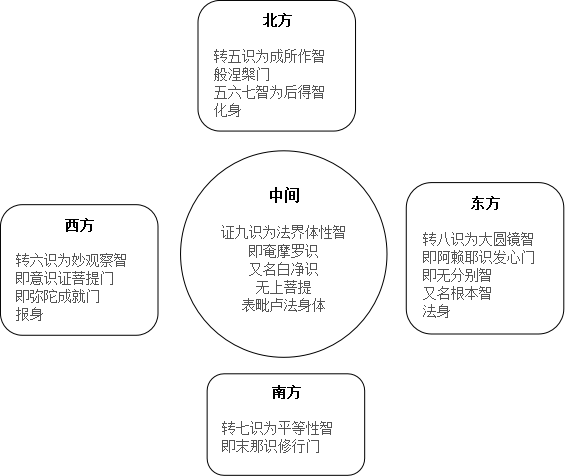 |
|
| 六、禅密二宗,先破无明,后除习气,往往大事已明而习气仍在,然习气已根本拔松,有慧照力,不似前此之昏迷不觉矣。他宗则反是,先除习气,欲待习气净后,方破无明,不知无明未破前,只是硬压习气,用力降伏,非是根本拔除,虽暂时可以见功,久久反动力大,等于未修,非属彻底,临终往往颠倒,即是此病。 |
6. The Chan and Esoteric schools first destroy avidya and afterward eliminate habitual tendencies. Often, though the great matter has already been clarified, habitual tendencies still remain. Yet their roots have already been loosened and removed; one possesses the power of prajna’s illumination and is no longer, as before, bewildered and unaware. Other schools are the reverse: they first seek to eliminate habitual tendencies and await their complete purification before destroying avidya. They do not understand that, before avidya has been destroyed, one merely forcefully suppresses habitual tendencies and strives to subdue them; this is not their eradication at the root. Though some effect may temporarily be seen, over time the counterforce becomes powerful, and it is as though one had never practiced. This is not thoroughgoing; at the moment of death, one will often fall into confusion and inversion. This is precisely the fault. |
| 七、禅密二宗,以此生破无明见性为成佛,若仗佛力,此生自可证到,至习气除净,原非此生可办。而显教每以破无明发五神通,习气除净,一切圆满,如释迦佛后,方谓成佛。譬如植果,一以初结果时为已成就。 |
7. The Chan and Esoteric schools hold that destroying avidya and seeing one’s nature in this very life constitutes Buddhahood. If one relies upon the Buddha’s power, this can certainly be realized in this life; as for completely eliminating habitual tendencies, that was never something that could be accomplished in a single lifetime. The exoteric teachings, however, generally hold that only after destroying avidya, manifesting the five supernormal powers, eliminating habitual tendencies, and bringing all things to perfection—as did Sakyamuni Buddha—may one be called a Buddha. This is like planting a fruit tree: one view considers the first setting of fruit to be accomplishment. |
| 一以果熟可食时,采下盛器后,方许为成就。一则无时间相,先后不二。一则执定形相,假立次第。一则有力承当,视为当然。一则过于郑重,遂分难易。若不一一分明,为之解释,则片面之执,门户之争,学者苦矣。 |
The other permits it to be called accomplishment only when the fruit has ripened and become edible, has been picked, and placed in a vessel. The one has no temporal mark: before and after are nondual. The other clings to fixed forms and provisionally establishes successive stages. The one has the strength to assume the burden and regards it as natural. The other is excessively cautious and thus divides matters into easy and difficult. Unless these points are clearly distinguished and explained one by one, practitioners will suffer from partial attachments and sectarian disputes. |
| 总之各宗修法,不同者是仪规和立场,相同者是目标与终点,如求开智慧,超登彼岸,解脱生死,各宗无不相同。兹有几个要诀,行者得此要诀,入门便不难矣。 |
In sum, the methods of practice of the various schools differ in their ritual forms and points of departure, but they share the same aim and final destination. In seeking to open wisdom, ascend to the other shore, and attain liberation from birth and death, all schools are alike. Here are several essential keys. Once practitioners obtain them, entering the gate will not be difficult. |
| 四要诀 |
Four Essential Keys |
| (一)先解修行正义,凡念佛打坐修法,不得名为修持,只可名为培养,如培养精神,以备行路之用,行路无力可以反证培养力之未足,故出佛堂下座后,行住坐卧,一切人事,种种行为,方是正修行,如感觉此时力量不足,则 |
1. First understand the true meaning of practice. Buddha-recitation, seated meditation, and the performance of Dharma methods should not be called practice; they may only be called cultivation, such as cultivating one’s strength in preparation for a journey. If one lacks strength while traveling, this proves in turn that one’s cultivation has been insufficient. Therefore, after leaving the Buddha hall and rising from one’s seat, amid walking, standing, sitting, and lying down, in every human affair and every kind of conduct—there lies true practice. If one feels that one’s strength is insufficient at such times, then |
| 再加工培养,再作许多法以资助之,此为正,彼为副,世人乃颠倒,忘却正义,遂有重彼轻此之嫌,所得效果,自然微薄,此是第一诀。 |
one should further cultivate it and undertake many more Dharma methods to support it. This is primary; that is secondary. Yet people reverse them, forget their true meaning, and consequently emphasize the latter while slighting the former. The results they obtain are naturally meager. This is the first key. |
| (二)如何谓之正修行,凡出佛堂后之正修行,应先明起用之妙,其妙诀在不忘二字,无论何事何地,不离警惕,处处照顾,只是要用惯这个心,用,便是觉照,不怕念起,只怕觉迟,不觉便被境夺,就此移引而去,移引既远, |
2. What is meant by true practice? In the true practice undertaken after leaving the Buddha hall, one must first understand the marvel of function. Its essential key lies in the two words, “do not forget.” Whatever the matter and wherever the place, never depart from vigilance; attend carefully in every circumstance. One need only become accustomed to employing this mind. To employ it is awareness and illumination. Do not fear the arising of thoughts; fear only that awareness comes too late. Without awareness, one is carried away by circumstances and drawn onward by them. Once drawn far away, |
| 不知所返,便是流浪,凡人对于贪嗔痴,已是熟极,亦非一朝一夕之修,今日由生返熟,亦得养成一习惯,到刻刻不忘时,便是功夫纯熟,入于欲罢不能之化境,学而时习之矣,乐可知也,此是第二诀。 |
one does not know how to return; this is wandering astray. People are already exceedingly habituated to greed, anger, and delusion; nor has this arisen through the cultivation of only a day or a night. Today, in turning what is raw back into what is familiar, one must likewise form a habit. When one does not forget at every moment, one’s skill has become mature, and one enters a state in which one cannot refrain from it. One learns and repeatedly puts it into practice; its joy may be readily known. This is the second key. |
| (三)简明修法,修是复义,克己复礼,天下归仁,回复到本来,即是无往而不通,万物皆备于我,始尽致知格物之能事,故曰归仁,但克己是因,复礼是果,克己复礼又是因,天下归仁是果矣,克己是修的初步,克己者制其心也,一切造作皆心,心攀缘故,念成为妄,制心一处,即无染着,无妄无真,即是修复到本来。 |
3. A concise explanation of practice. Practice has the sense of returning: “Conquer the self and return to propriety; then all under Heaven returns to benevolence.” Returning to one’s original nature means that there is nowhere one cannot penetrate; all things are fully present within oneself. Only then is the work of extending knowledge and investigating things brought to completion. Therefore it is called returning to benevolence. Yet conquering the self is the cause, and returning to propriety the result; conquering the self and returning to propriety are again the cause, and all under Heaven returning to benevolence is the result. Conquering the self is the first step of practice. To conquer the self is to restrain one’s mind. All fabrication is mind; because the mind grasps at conditions, thoughts become deluded. When the mind is restrained in one place, there is no defiled attachment. With neither delusion nor truth, one has practiced the return to the original state. |
| 一处者,不可死执谓有个一处也,一是无义,遍一切处而丝毫无着,乃名一处,此一处,是圆遍广大无着之处,非万法归一尖锐纯一之处也,非到修证,不知意会,但用一个照字,照之纯熟,即可不忘,由不忘而不惑不动,所谓行深般若波罗蜜,此是第三诀。 |
“One place” must not be rigidly grasped as though there were some single place. “One” has no fixed meaning. Pervading all places while not attaching to the slightest thing—this alone is called one place. This one place is a complete, all-pervading, vast, and unattached place; it is not a sharp and exclusive point to which the ten thousand dharmas return as one. Until one has practiced and realized it, one cannot understand its meaning through conceptual comprehension. Simply apply the single word “illuminate.” When illumination becomes mature, one can refrain from forgetting. From not forgetting comes freedom from delusion and immovability. This is what is meant by practicing deeply Prajnaparamita. This is the third key. |
| (四)修入之过程,功夫之进,必有过程,如登山然,由下而上,必有程次,顿根人,本来直上顶峰,原谈不到此。但为初学人,不可不方便也,照之功程有五:一知照,二照空,三照寂,四空空,五寂照。 |
4. The stages of entering practice. The progress of one’s skill must have a process, like climbing a mountain: from bottom to summit there must be successive distances. Those of sudden capacity ascend directly to the summit from the outset, and for them there is originally no need to speak of this. But for beginners, expedient means are indispensable. The process of illumination has five stages: first, knowing illumination; second, illuminating emptiness; third, illuminating quiescence; fourth, emptying emptiness; fifth, quiescent illumination. |
| 知照者,知起用也,且知非照不能转,开此觉慧,乃悟后正修,然系理解而始事修。照空者,非照不能空也,此已入于行矣。照寂者,已入湛寂之境,然有时忘照,及稍凛觉,即又湛然矣。空空者,亦照也,以照力空其空也。 |
Knowing illumination means knowing how to bring it into function, and knowing that without illumination one cannot turn. Opening this wisdom of awareness is true practice after awakening, though it begins with understanding and then proceeds to actual practice. Illuminating emptiness means that without illumination one cannot empty; here one has already entered practice. Illuminating quiescence means that one has entered the state of profound quiescence, though at times one forgets to illuminate; upon even the slightest alert awareness, one becomes serene again. Emptying emptiness is also illumination: through the power of illumination, one empties even emptiness. |
| 寂照者,乃常寂常照之境,固无时不寂,无时不照,照不照皆寂,并不自知其为照为寂也,简言之,功夫熟,则入于化境矣。 |
Quiescent illumination is the state of constant quiescence and constant illumination. There is never a time without quiescence and never a time without illumination. Whether illuminating or not illuminating, all is quiescent; one does not even know oneself to be illuminating or quiescent. In brief, when one’s skill is mature, one enters a state of spontaneous transformation. |
| 凡一切生死之系缚只是心境相对,心与境不分,外境为心,内心之境亦心,以心破心,即心境双破,总名之曰破无明,破乃空义,非打破意也,以破尚有一破相在,不得名空,无明与明为对立,明则无明不立,此破字,乃灭义, |
All bondage to birth and death is nothing but the opposition of mind and objects. Mind and objects are not separate: external objects are mind, and the objects within the mind are likewise mind. To use mind to destroy mind is to destroy both mind and objects; this is collectively called destroying avidya. Destruction here means emptiness, not smashing apart. For if there remains an appearance of destruction, it cannot be called emptiness. Avidya and illumination stand in opposition; when illumination is present, avidya cannot stand. This word “destroy” means extinction, |
| 灭则不可得也,破灭无明之法,妙诀在一照字,其不能照,或不知所照者,根本乃是定慧力不足,不知起用,而起用之总诀,仍在一照字,照则转,转则舍而之他,本体即空,如无明一转即不可得,一空即定,故照即转,转即空,空即定,定即不惑,不惑即不流浪,不流浪即无生死。 |
and what is extinguished cannot be obtained. The essential key to destroying and extinguishing avidya lies in the single word “illuminate.” If one cannot illuminate, or does not know what is to be illuminated, the root cause is simply insufficient strength of samadhi and prajna, and not knowing how to bring them into function. Yet the supreme key to bringing them into function still lies in the single word “illuminate.” With illumination there is transformation; with transformation one relinquishes this and moves to another. The fundamental nature is then empty. Thus, when avidya transforms, it cannot be obtained; once empty, there is samadhi. Therefore illumination is transformation; transformation is emptiness; emptiness is samadhi; samadhi is freedom from delusion; freedom from delusion is not wandering astray; and not wandering astray is freedom from birth and death. |
| 翻过来,照无能照所照,于是无所谓空定不惑不流浪等等,毕竟生死亦不可得,是真能了生死者。更在翻过来,一切本体既不可得,然则照不照,转不转,空不空,乃至生死之了不了,真际平等不二,都无所不可,如是固妙,不如是亦妙,是真超然自在入不二法门,并了亦无可了矣,是究竟了生死者。 |
Turning this around: there is no illuminator and nothing illuminated; therefore there is no such thing as emptiness, samadhi, freedom from delusion, not wandering astray, and so forth. In the end, birth and death too cannot be obtained. This is truly to resolve birth and death. Turn it around once more: since the fundamental nature of all things cannot be obtained, then whether one illuminates or not, transforms or not, is empty or not empty, even whether birth and death are resolved or not resolved—the ultimate reality is equal and nondual, and there is nothing that is not permissible. Thus it is wondrous; not thus, it is also wondrous. This is genuine transcendence and easeful freedom: entering the Dharma gate of nonduality, where even resolving has nothing left to resolve. This is the ultimate resolution of birth and death. |
| 此理既明,毫无所惑,是无明已破,只是习气深厚,似非此生可了,有九种程次,别之如下:(一)粗中粗,(二)粗中细,(三)粗中微细,(四)细中粗,(五)细中细,(六)细中微细,(七)微细粗,(八)微细细,(九)微细微细。 |
Once this principle is understood and no doubt remains, avidya has been destroyed. It is only that habitual tendencies are profound and heavy, and seemingly cannot be exhausted in this lifetime. There are nine stages, distinguished as follows: (1) coarse within coarseness; (2) subtle within coarseness; (3) extremely subtle within coarseness; (4) coarse within subtlety; (5) subtle within subtlety; (6) extremely subtle within subtlety; (7) coarse within extreme subtlety; (8) subtle within extreme subtlety; (9) extreme subtlety within extreme subtlety. |
| 此九种乃表心上系缚之深浅,至粗中微细,乃初地境界,已破无明,断色缚者。细中微细,乃三地至六地,已断心缚者。 |
These nine kinds indicate the relative depth of the mind’s bonds. At the stage of extreme subtlety within coarseness, one has reached the level of the first bhumi, destroyed avidya, and severed the bonds of form. At the stage of extreme subtlety within subtlety, one has reached the third through sixth bhumis and severed the bonds of mind. |
| 微细微细,则八地以上,已断色心二缚之余习,渐入等觉位矣,必微细微细尽而圆满大觉耳,非此生所可成者。譬如胎中婴儿,或初生之子,虽不能如大人,究不得谓为非人也,虽不能如佛之圆满大觉,究不得谓为非佛也。 |
Extreme subtlety within extreme subtlety pertains to the eighth bhumi and above. The residual habits of the two bonds of form and mind have already been severed, and one gradually enters the stage of Equal Enlightenment. Only when extreme subtlety within extreme subtlety has been exhausted does perfect great awakening ensue; this cannot be accomplished in this lifetime. It is like an infant in the womb or a newly born child: although unable to be like an adult, it cannot after all be called nonhuman. Likewise, although one cannot equal a Buddha’s perfect great awakening, one cannot after all be called a non-Buddha. |
| 即生成就,成此佛也,长养圣胎者,养已成佛之圣胎也,愚人执相,不可与语大乘法要,惟信心不逆,不惊不怖者斯可耳。 |
Immediate accomplishment in this very body is the accomplishment of this Buddhahood. To nurture the sacred embryo is to nurture the sacred embryo of one who has already become a Buddha. Foolish people cling to appearances and cannot be addressed concerning the essential teachings of Mahayana. Only those whose faith does not recoil, who are neither alarmed nor fearful, are fit for this. |
| 照转空定的过程 |
The Process of Illumination, Transformation, Emptiness, and Samadhi |
| 坚固→松动 |
Rigid → loosened |
| 长→短 |
Long → short |
| 大→小 |
Great → small |
| 奇怪→不惊怖 |
Strange → unafraid |
| 二→不二 |
Two → nondual |
| 勉强→自然 |
Forced → natural |
| 有→空 |
Existence → emptiness |
| 空→空空 |
Emptiness → emptying emptiness |
| 挂碍→无著 |
Obstruction → nonattachment |
| 缚→解脱 |
Bondage → liberation |
| 生→熟 |
Raw → mature |
| 识→智 |
Consciousness → wisdom |
| 惑乱→不动 |
Confusion → immovability |
| 流浪→止 |
Wandering astray → cessation |
| 牵摄→自在 |
Being drawn and controlled → easeful freedom |
| 空空→不空 |
Emptying emptiness → not empty |
| 无力→力充 |
Powerlessness → abundant strength |
| 偏→圆 |
Partial → complete |
| 由此至彼,不用慧照,无有是处,照之次数日多,力自充足,根尘自然脱落,如是方是正修,此是第四诀。 |
From this to that, there can be no way without the illumination of prajna. As the occasions of illumination increase day by day, one’s strength naturally becomes abundant, and the faculties and their objects naturally fall away. Only thus is there true practice. This is the fourth key. |
| 上面略说修法竟,然既落言诠,岂是究竟?故知究竟处,在行者自心领会得,非可言表。我今亦多事耳,哈哈。 |
The Dharma methods of practice have now been briefly explained. Yet once one has fallen into verbal formulation, how could this be ultimate? Thus one should know that the ultimate point lies in the practitioner’s own realization within the mind; it cannot be expressed in words. I too have merely been making unnecessary fuss—ha, ha. |
| 己、修之层次 |
J. Stages of Practice |
| 修法岂有一定,若有层次,即有定法,惟对初学人,当为决定,务使其简捷迅速,是在来会后,逐一面授,或先净后密,或先密后禅,再行商榷可也。 |
How could methods of practice have any fixed form? If there are stages, then there are fixed methods. Yet in teaching beginners, determinations should be made so that their path may be simple, swift, and direct. After you have come to meet me, these matters may be personally transmitted face to face, one by one: perhaps Pure Land first and then Esoteric practice, or Esoteric practice first and then Chan. This may be discussed further. |
| 又修法之赖师友者,无非求得一商量,得一决定而已,得其诀,则事半功倍,得其受用,自不肯退转。鄙人以一知半解,与诸仁商榷学佛法门,虽未臻其奥,或亦不致误人,如有怀疑,或认为不妥处,当直心见教,互相考证,则去印心不远矣。 |
Moreover, one relies on teachers and Dharma friends in practice for no more than obtaining discussion and gaining a settled determination. Once one obtains the key, twice the result is achieved with half the effort; once one receives its benefit, one will naturally not be willing to retreat or turn away. With my scant and partial understanding, I discuss with you worthy ones the Dharma gates for learning the Buddhadharma. Though I have not reached their profundity, perhaps I shall not mislead others. If you have doubts or consider anything inappropriate, please offer instruction with a straightforward mind. By mutually examining and verifying these matters, we shall not be far from the Mind Seal. |